Bhaag Neha Bhaag, Jantar Mantar Chalo: Protests inspire video games
Two satirical video games, Bhaag Neha Bhaag and Jantar Mantar Chalo, draw inspiration from protests in India. Through police chases, barricades, crowd-building and retro graphics, they turn political dissent into playful digital experiences created by young developers.


Hyderabad: The rollback of the SIR and the impeachment of the Chief Election Commissioner are two of the largest demands of the youth protesting across various parts of the country today. Be it in Panaji or the national capital of Delhi, as the opposition, the Cockroach Janta Party, and the All India Students Association (AISA) take to the streets to express their dissent, the government and security forces have resorted to a variety of tactics to contain them. While news channels and social media platforms alike attempt to capture democracy’s chaos, India’s youth have found creative, playful ways to document and engage with the moment.
Two games that have caught the eye are Bhaag Neha Bhaag and Jantar Mantar Chalo, as the nation’s youth tap into game-making to capture the moment in a satirical, playful fashion.
The first of these, Bhaag Neha Bhaag, plays similarly to Flappy Bird or T-Rex Runner (the game you play on Chrome when offline). You play as Neha Bora, president of the AISA, dodging police as they chase you down.
With cries of “Pakdo!” echoing in the background, Neha leaps past barricades, traffic, flying bricks, and government supporters – collecting ‘democracy coins’ along the way in classic Mario fashion.
An endless runner, the game measures success by distance covered and coins gathered. Featuring a global leaderboard and intuitive controls, it is available on both PC and mobile.
Once you are eventually caught, you can generate a custom scorecard to share across your socials.
Designed by filmmaker Anav Nayar and coded by his brother Akshay, Bhaag Neha Bhaag is purple, blocky, and nostalgic. With its old-school sound design and quirky art style, it makes players yearn for the 90s. Nostalgia aside, the game also captures the Delhi night vibe with the Metro, a silhouette of the Qutb Minar looming in the background, and neon-lit buildings casting light across the street.
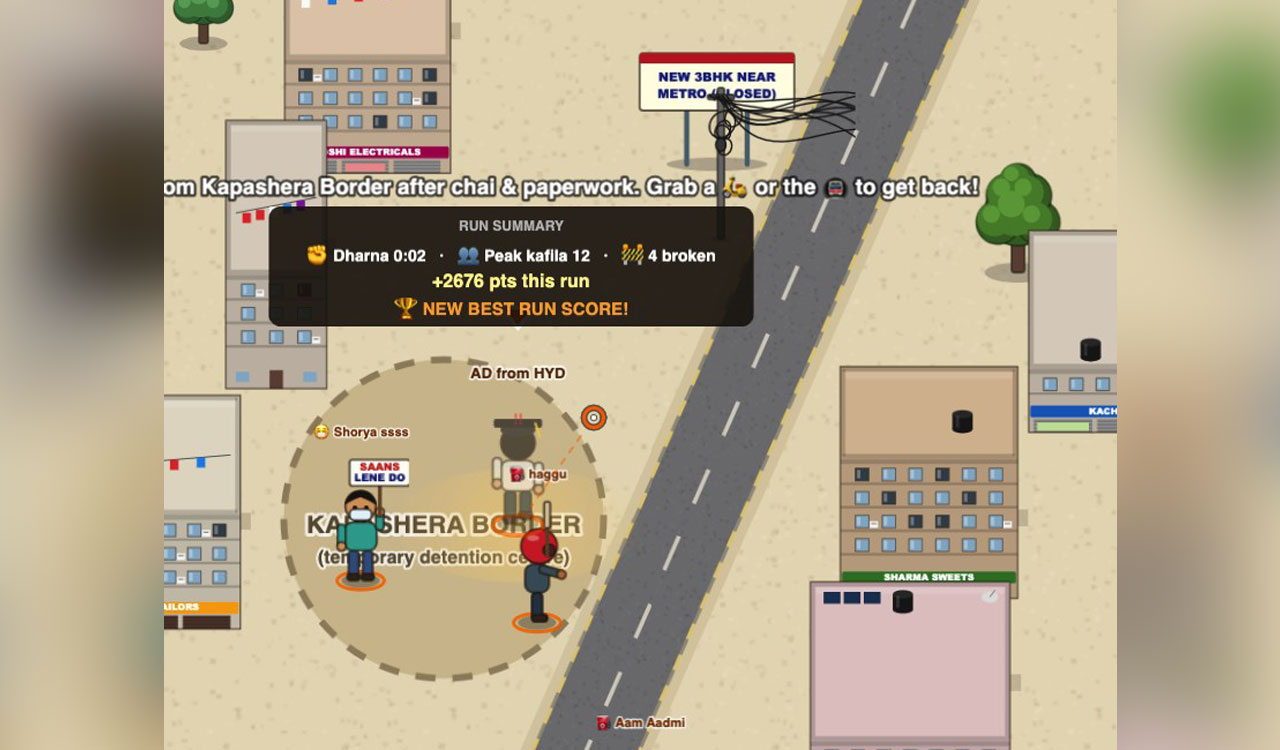
The second game, Jantar Mantar Chalo, is a bit more detailed and expansive, as you play as a protester in Delhi making your way to the protest site. Designed by Suraj Khuswah, the game tries to represent the sheer chaos of these demonstrations, thrusting you into madness from the very start.
You spawn at a random location in the city and must navigate your way to Jantar Mantar. As you demonstrate, fellow citizens join your crowd, requiring you to guide the growing procession while dodging barricades, police, and special forces.
Jantar Mantar Chalo captures a few elements exceptionally well, surrounding you not just with security forces, but also press crews and counter-protesters. The dialogue that triggers during these confrontations is hilarious. You can expand your retinue by gathering people at public gathering spots like tea stalls, paan shops, dhabas, and local landmarks.
As your kafila grows, you unlock the ability to call for a “halla bol,” smashing through barricades and nullifying security officers.
The more barricades you dismantle, the larger your crowd becomes and the more stars you stack. I managed to build a six-star crown above my head and hold down Jantar Mantar for nearly two whole minutes before getting bundled into a bus and sent off to a detention centre. Once detained, the run resets.
Jantar Mantar Chalo is a blast when played right; if you focus on a strategy of community mobilisation, reaching Jantar Mantar isn’t too hard; it’s staying there that proves to be the real challenge.

Related News
-

Fire breaks out at anti-drone equipment manufacturing firm in Madhapur
-
A mirror in space to turn night into day? Hyderabad-based Skyroot deal brings sci-fi closer to reality
-
Hyderabad leads Telangana in voter enrollment drive
-
From tear gas to water cannons, Delhi protest scenes recreated in video games