From Davos to New Delhi: The EU–India trade deal could reshape global order
As global uncertainty deepens and multilateral norms weaken, the EU and India are moving toward a historic free trade agreement, signalling a shift toward partnership, diversification, and cooperative global governance


By Dr Ramesh Chennamaneni
“A Spirit of Dialogue” was the theme of the 56th Annual Meeting of the World Economic Forum (WEF) at Davos from January 19 to 23, 2026. The meeting brought together aound 3,000 participants, including government representatives, CEOs, board presidents and envoys from international organisations from 120 countries, including more than 50 heads of state.
Discussions centred around five key global challenges: cooperation in a contested world, unlocking new sources of growth, investing in people, deploying innovation responsibly, and building prosperity within planetary boundaries. As the outcomes of these discussions will require careful and objective analysis, this write-up summarises the first impressions of these challenges based on the agenda-setting and deliberations concluded at Davos.
Firstly, ‘Uncertainty’ emerged as the defining theme of the global risks outlook in 2026. As global risks continue to spiral in scale and cooperative mechanisms crumble, with governments retreating from multilateral frameworks, stability is indeed under siege. A contested multipolar landscape is emerging where confrontation is replacing collaboration, and trust – the currency of cooperation – is losing its value.
Against this backdrop, ‘A Spirit of Dialogue’ has never been more essential. In a world shaped by geopolitical, economic and societal shifts, ‘A Spirit of Dialogue’ was meant to broaden the perspectives of respective countries and alliances through listening to one another and challenging their own views and adjusting to the changing ground realities.
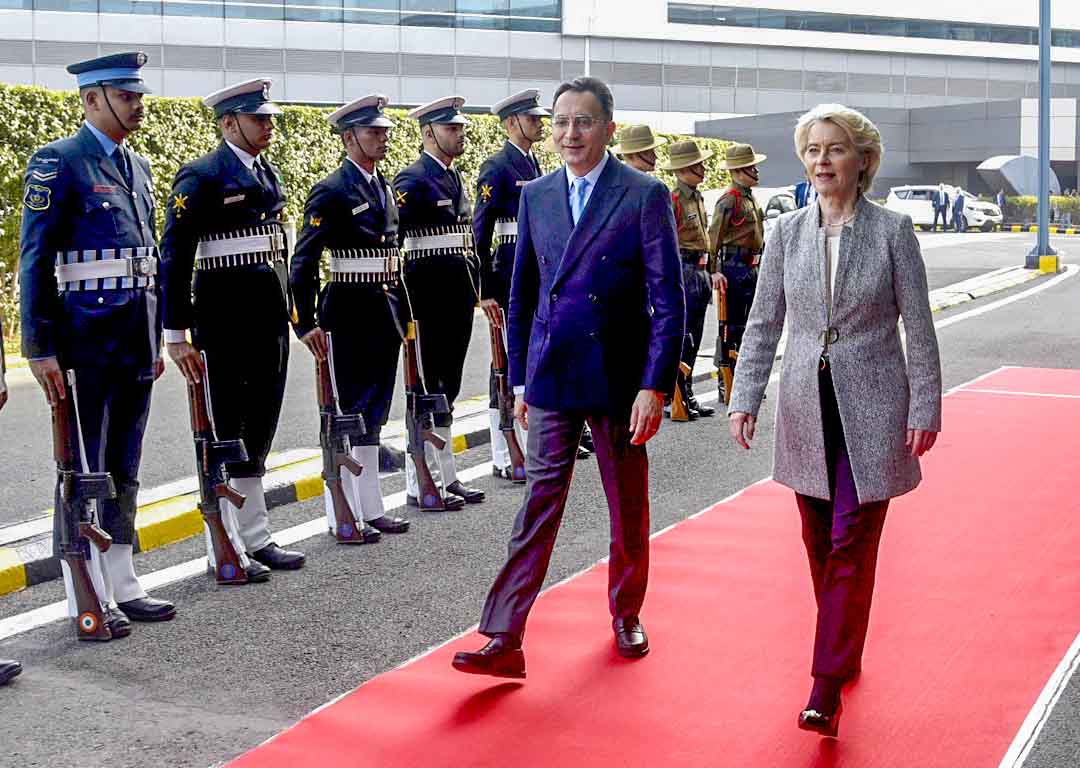
That spirit of dialogue has just left Davos and is heading towards New Delhi. Undoubtedly, the forthcoming free trade summit aimed at an agreement between the European Union and India on January 27, 2026, a day after India’s 77th Republic Day in New Delhi, after nearly two decades of negotiations, is being seen as one of the most historical events of this century.
European Commission President Ursula Von Der Leyen said at Davos, “The world may be very different today, without any question. But I believe the lesson is very much the same. That geopolitical shocks can – and must – serve as an opportunity for Europe”. This comes at a particularly trying geopolitical moment for Europe, with US President Donald Trump first threatening to escalate his trade war with European allies for opposing a US takeover of Greenland and then backing off.
India’s Prime Minister Narendra Modi is accelerating strategic and trade ties with the rest of the world as part of the continuation of a diversified foreign policy, where the impasse over Washington’s 50% tariffs on India is still on.
India and the EU are indeed on the verge of a historic free trade deal that could create a market of nearly two billion people, accounting for almost a quarter of global GDP. Both the EU President and India’s Minister of Commerce and Industry Piyush Goyal have called it the “mother of all deals”. Beyond trade, both sides are ready to deepen strategic ties through defence cooperation, a new security framework and a long-term strategic vision for 2026-2030.
India recently concluded a number of contracts, for example, with the European Free Trade Association (EFTA), consisting of four-member countries: Iceland, Liechtenstein, Norway, and Switzerland and with the United Kingdom. The EU, too, after 25 years of negotiations, has made concluding agreements with the Southern Common Market (MERCOSUR), consisting of Argentina, Brazil, Paraguay, Uruguay, and Bolivia.
And with it, the EU and Latin America have created the largest free trade zone in the world. A market worth over 20% of global GDP with 31 countries consisting of over 700 million consumers. These developments show the growing willingness to compromise, precisely because of the volatile global political and economic environment.
For India, the FTA offers a strategic opportunity to reduce its dependence on China, increase its exports to Europe and cushion the impact of protectionist policies elsewhere.
Customs duties or import duties are either reduced or eliminated under FTAs, facilitating market access and regulatory alignment. The India-EU deal is expected to benefit sectors such as technology, pharmaceuticals, automobiles, textiles, steel, petroleum products and electrical machinery. Labour-intensive sectors such as clothing, leatherand pharmaceuticals could see their competitiveness improved in the EU market, while Indian exports of services, particularly telecommunications, transport and business services, are also expected to grow.
The EU, on the other hand, stands to gain from increased exports of aircraft and parts, electrical machinery, diamonds and chemicals to India. European services such as intellectual property, IT, telecommunications and business services could also benefit from expanded access.
These negotiations and agreements send a powerful message to the global community: that many countries are choosing fair trade over tariffs. There is a clear indication that countries are preferring partnerships over isolation or confrontation and that they are serious about de-risking their economies, diversifying their supply chains according to their comparative political, economic and social advantage.
Mark Carney, Prime Minister of Canada, said in Davos, “The middle powers must act together because if we’re not at the table, we’re on the menu”.
(The author is former Advisor and Humboldt Expert in Agriculture, Environment and International Cooperation)

Related News