G Sathiyan calls for stronger support to make India a sporting powerhouse
Olympian G Sathiyan called for sustained collaboration among the government, corporates and sports industry to make India a global sporting powerhouse. At SPORTSCOM's Delhi conclave, policymakers and industry leaders discussed sports investment, manufacturing, technology, employment and grassroots development
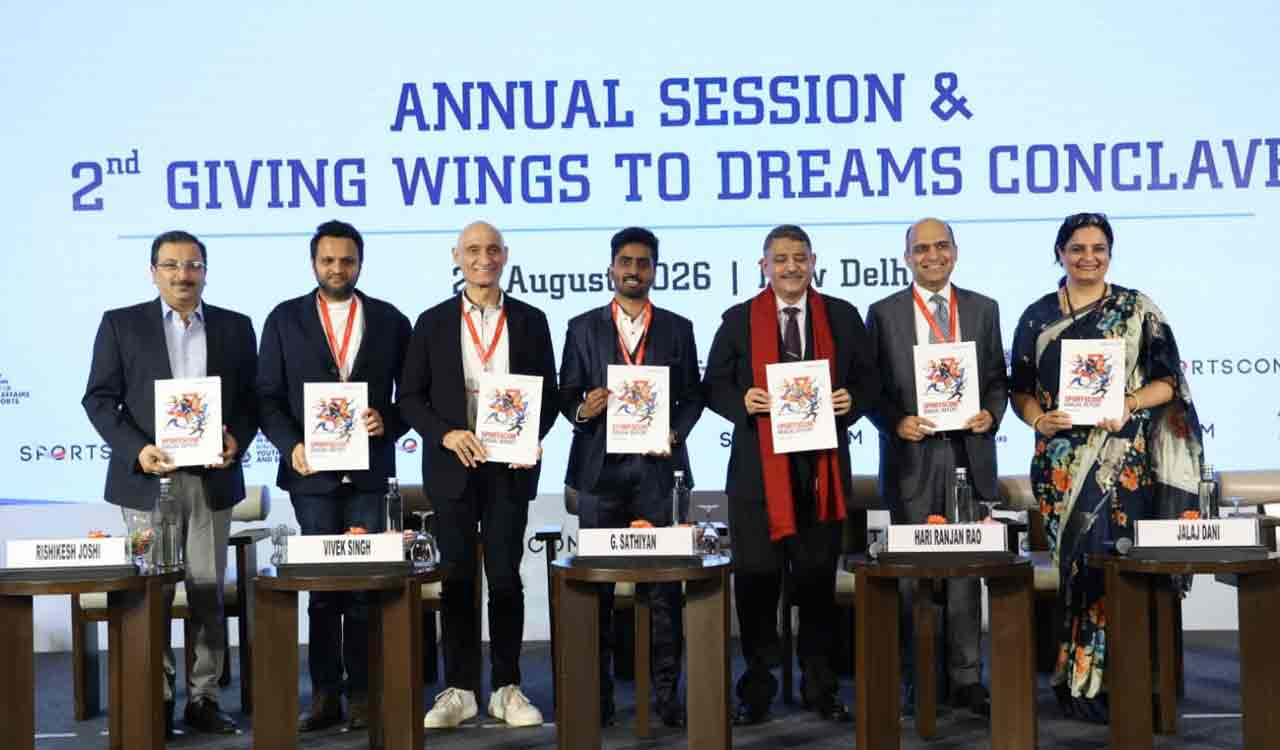


Hyderabad: Olympian and Arjuna Award-winning table tennis player G Sathiyan, alongside senior government officials, investors and key sports ecosystem stakeholders, gathered at Shangri-La Eros for SPORTSCOM’s Annual Session and the second edition of the Giving Wings to Dreams Conclave in Delhi on Tuesday.
Delivering the keynote address, G Sathiyan emphasised that India’s transformation into a global sporting powerhouse hinges on sustained, collaborative support from the government, corporate sector, leagues, sponsors and the broader industry. Reflecting on his career since the age of five, he noted how sports have evolved from an extracurricular pursuit into a viable profession and economic driver.
“It’s not just about athletes. For athletes to perform in the arena, you need a whole lot of people coming together. Athletes showcase talent, but they perform only when there is immense support from corporates and the government,” said Sathiyan. He stressed the role of grassroots visibility, adding, “When parents start seeing Olympians and Asian Games medallists close to home, they will believe their children can reach the next level. India can truly become a sporting powerhouse.”
The inaugural session brought together policymakers to outline the country’s macro sporting framework. Hari Ranjan Rao, Secretary, Sports, Ministry of Youth Affairs & Sports (MYAS), detailed upcoming policy developments, including the National Sports Policy, National Sports Governance Act, National Sports Board and National Sports Tribunal. He also highlighted the proposed Sports Goods Manufacturing Scheme and the importance of fan engagement.
In another special session, Jayant Chaudhary, Minister of State for Skill Development and Entrepreneurship, called for viewing sport beyond medals, as a driver of employment, entrepreneurship and economic growth. He emphasised integrating sport with education and skilling, while highlighting opportunities across sports science, coaching, nutrition, event management, content, technology, manufacturing and entrepreneurship. He also stressed collaboration among government, industry and academia, and highlighted AI, technology and women-led rural enterprises as enablers of inclusive growth in the sports ecosystem.
In a special session, Kunal, Joint Secretary (MYAS), reiterated the government’s vision to leverage sports for economic growth and youth engagement. He noted that India is pursuing a whole-of-government approach towards its 2036 Olympic host bid, while simultaneously promoting indigenous disciplines like Kho-Kho, Yogasana and Mallakhamb alongside an “Everyone Plays” grassroots initiative.
The investor panel, ‘Inside the Investor’s Mind: What Makes a Sports Startup Venture-Ready?’, moderated by Ayon Sengupta (Editor, SPORTSTAR), featured Chintan Thakkar (IAN Alpha Fund), Mustafa Ghouse (Center Court Capital) and Suhail Chandhok (U Mumba / Elev8 India Sportz). Panelists noted that while domestic and international capital availability is rising, startups require clear business models, proof of concept, scalability and pathways to profitability to secure investment.
Manufacturing emerged as a primary theme during the panel ‘Building India’s Global Sports Manufacturing Ecosystem’, moderated by Piyush Doshi (The Convergence Foundation). Sanjeet Singh, Senior Advisor, NITI Aayog, outlined key priorities – cost, clusters, competitiveness, collaboration and communication – targeting $8 billion in sports goods exports by 2036.
Industry leaders including Neeraj Jain (COSCO), P D Arya (Gem International), Shiv Prakash Singh (Shiv Naresh) and Arjun Anand (Anandco Sporting) discussed structural constraints such as raw material, logistics and power costs. They emphasised the need for dedicated manufacturing clusters, international certification infrastructure and public-private coordination. Dr Shobhit Jain, Joint Secretary (MYAS), urged industry leaders to present “applied advocacy” with specific, actionable policy recommendations.
The conclave marked a significant leadership shift for SPORTSCOM. Outgoing President Jalaj Dani announced he was stepping down after eight years, handing the presidency over to Vivek Singh.
“We started this journey eight years ago as a dream. Looking at where we are today, I feel proud, but the journey has just started,” said Dani, while encouraging stakeholders to capitalise on the proposed PLI framework for sports goods and gym equipment.
Incoming President Vivek Singh underlined the convergence of athletics and business, noting that sports properties must actively compete within the broader entertainment landscape.
“It’s no longer cricket versus other sports. It is sports versus everything else,” said Singh, calling for increased investment in audience engagement.
Rishikesh Joshi, Chairman of the Conclave and Secretary of SPORTSCOM, noted the expanding opportunities spanning manufacturing, infrastructure and sports tech.
Related News