
Hyderabad’s 1908 Musi flood: How a disaster transformed the city
On September 28, 1908, the Musi River flooded Hyderabad, killing thousands and devastating neighbourhoods. The disaster prompted sweeping changes in flood control, water management and urban planning, including the City Improvement Board and the construction of major reservoirs
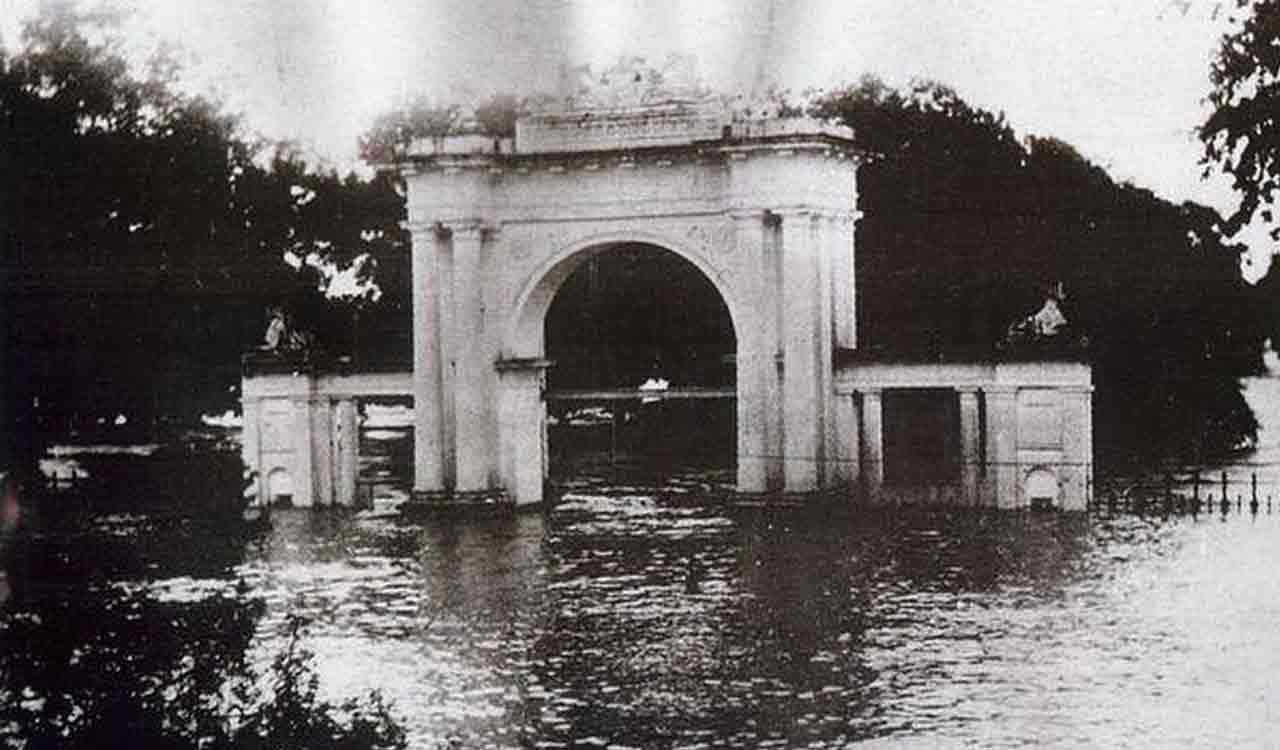


Hyderabad: Some memories are too painful to revisit, yet they remain essential to understanding a city’s history. For Hyderabad, September 28, 1908, is one such date. On that fateful day, the Musi River rose with terrifying force, sweeping through homes, neighbourhoods, markets and bridges, leaving behind a trail of death and destruction.
The Musi flood was more than a natural calamity. It became a turning point in Hyderabad’s history, compelling the rulers of the time to rethink the city’s infrastructure, water management and urban planning.
A Night of Terror
Put the clock back by 118 years and you see Hyderabad experiencing heavy rainfall for several days, when the situation suddenly turned catastrophic. The rains intensified on September 26, and by September 28, the Musi had swollen into a raging torrent.
According to renowned engineer Mokshagundam Visvesvaraya, who later played an important role in Hyderabad’s flood-prevention planning, the disaster was aggravated by the bursting of irrigation tanks following incessant rainfall.
The river rose at an alarming rate. Purana Pul was submerged, parts of the city’s ramparts were breached, and the Musi reportedly rose by 16 feet in just three hours. Bridges such as Afzal Bridge and Muslim Jung Pul were overwhelmed, while Chaderghat was among the areas severely affected.
By dawn, Hyderabad had been transformed. Houses lay in ruins, trees had been uprooted and the muddy floodwaters carried away livestock, possessions and human bodies. Entire neighbourhoods were devastated.
Thousands are believed to have perished. Kolsawadi and Ghansi Bazar were among the worst-hit areas, with some accounts reporting around 2,000 deaths in each locality. Overall estimates of the death toll vary widely, with historical accounts putting the number of lives lost at more than 15,000, while some later accounts have cited figures as high as 50,000.
Amid the horror were extraordinary stories of survival. Desperate residents clung to walls, rooftops, trees and anything that could keep them above the rising waters. One remarkable account tells of around 150 people who survived by taking refuge in a tamarind tree near what is today Osmania General Hospital. The tree continues to be remembered as a symbol of survival.
A Tragedy Immortalised in Poetry
The flood left a deep imprint not only on Hyderabad’s landscape but also on its literature. The celebrated poet Amjad Hyderabadi suffered an unimaginable personal loss in the disaster, losing his mother, wife and daughter. He later immortalised the tragedy in his Rubaiyat, particularly in his famous poem Qayamat-e-Soghra — “The Minor Doomsday”.
His verses capture the terror, grief and helplessness of that dreadful night:
Wo raat ka sannata, wo ghanghor ghatain
Barish ki lagatar jhadi, sard hawain
Girna wo makanon ka, wo cheekhon ki sadain
Wo mangna har ek ka ro-ro ke duain
(The sepulchral silence of night, the sinister clouds
The unrelenting rain, the freezing winds
The uprooting of houses, the screaming sounds
Praying with teary eyes, anguished minds)
The poem remains one of the most poignant literary memories of the Musi disaster, preserving the human anguish behind the statistics. Amjad Hyderabadi is also associated with the group of survivors who took refuge in the tamarind tree during the flood.
From Catastrophe to Reform
Ironically, the devastation of 1908 eventually became the catalyst for major changes in Hyderabad. The flood occurred during the reign of the sixth Nizam, Mir Mahboob Ali Khan. His successor, the seventh Nizam, Mir Osman Ali Khan, recognised the urgent need for planned development and measures to protect the city from future disasters.
The City Improvement Board (CIB), known as Aaraish-e-Balda, was established in 1912. It undertook major projects aimed at improving Hyderabad’s roads, housing, drainage and overall urban infrastructure.
Among the most important initiatives were the construction of Osman Sagar and Himayat Sagar reservoirs. These projects served two crucial purposes: reducing the threat of flooding and providing a dependable source of drinking water to the growing city.
Thus, from one of the darkest episodes in Hyderabad’s history emerged some of the foundations of its modern development. The tragedy forced the administration to look beyond immediate relief and consider the long-term needs of the city.
A Century Later, the Warning Remains
More than a century later, Hyderabad continues to confront the challenge of urban flooding. Every year, concerned citizens gather near the historic tamarind tree to remember those who perished in the 1908 disaster. Yet the city remains vulnerable whenever intense rainfall strikes.
Hyderabad has witnessed particularly severe spells of rainfall in several years, including 1994, 2000, 2009, 2016 and 2020. Each episode has exposed familiar weaknesses, including encroachment on water channels, inadequate drainage, unplanned construction and shortcomings in urban management.
The floods of 2000 prompted the government to appoint Kirloskar Consultants to examine Hyderabad’s drainage problems. The subsequent study identified inadequate drainage capacity, encroachments on natural watercourses, the disappearance of flood-absorbing tanks and construction in the foreshores of tanks among the factors contributing to urban flooding.
Every monsoon, the same scenes threaten to return — flooded roads, stranded commuters, overflowing drains, damaged homes and disrupted lives. Committees and inquiries are often constituted after major flooding, but the underlying vulnerabilities remain a continuing challenge.
Nature’s Fury, Human Vulnerability
The Musi flood of 1908 was a natural disaster intensified by extraordinary rainfall. But the impact of flooding in a modern city is shaped not just by nature. Urban planning, encroachment, drainage capacity, the loss of natural water channels and the protection of floodplains all influence how severely rainfall affects residents.
The most important lesson of 1908 is therefore not simply that nature can overwhelm a city. It is that cities can learn from catastrophe — if they choose to remember. More than a century ago, Hyderabad responded to the Musi tragedy with reservoirs, infrastructure and a new approach to urban planning. The challenge today is to preserve that spirit of foresight.
The waters of the Musi may have receded long ago, and the river itself may have been tamed to a great extent. But the memory of that terrible night has never disappeared. The tragedy of 1908 transformed Hyderabad because the city responded to its suffering with major changes in infrastructure and urban planning. More than a century later, the question is whether Hyderabad will once again have the foresight to act before disaster strikes.
The legacy of the Musi flood should not be confined to memorials and history books; it should serve as a reminder that a city’s safety is shaped by the choices it makes today. For Hyderabad, remembering 1908 must mean more than remembering the dead — it must mean preventing history from repeating itself.

