Indian researchers discover 3 supermassive black holes
The rare occurrence in the nearby universe indicates that small merging groups are ideal laboratories to detect multiple accreting supermassive black holes and increases the possibility of detecting such occurrences.


New Delhi: Indian researchers have discovered three supermassive black holes from three galaxies merging together to form a triple active galactic nucleus (AGN), that has a much-higher-than-normal luminosity.
The rare occurrence in the nearby universe indicates that small merging groups are ideal laboratories to detect multiple accreting supermassive black holes and increases the possibility of detecting such occurrences.
Supermassive black holes are difficult to detect because they do not emit any light, but can reveal their presence by interacting with their surroundings.
When the dust and gas from the surroundings fall onto a supermassive black hole, some of the mass is swallowed by the black hole, but some of it is converted into energy and emitted as electromagnetic radiation that makes the black hole appear very luminous.
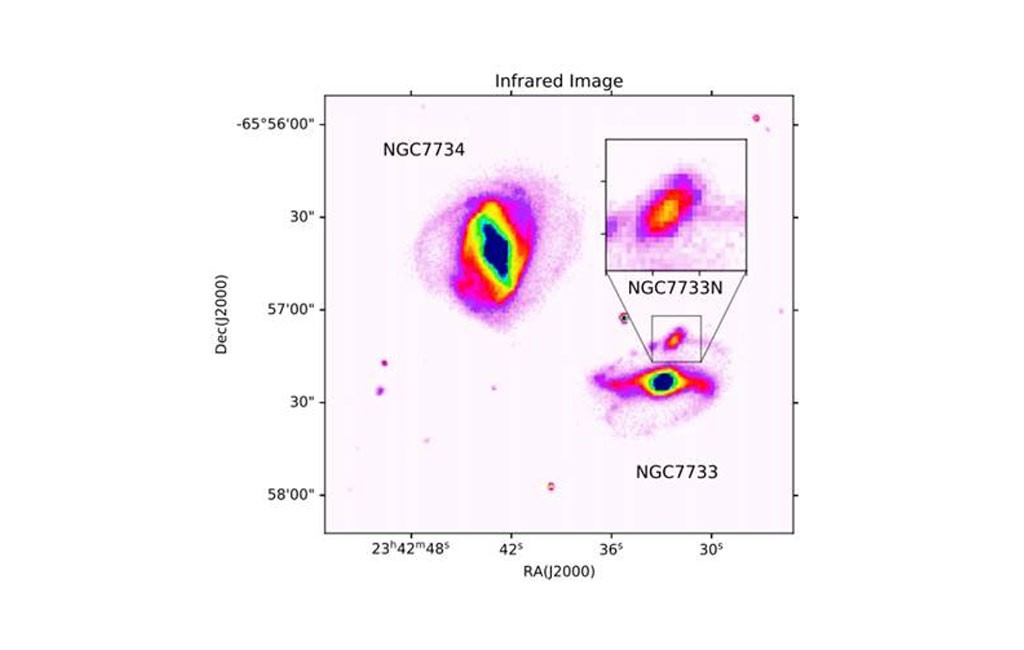
A team of researchers from the Indian Institute of Astrophysics consisting of Jyoti Yadav, Mousumi Das, and Sudhanshu Barway along with Francoise Combes of College de France, Chaire Galaxies et Cosmologie, Paris, while studying a known interacting galaxy pair, NGC7733, and NGC7734, detected unusual emissions from the centre of NGC7734 and a large, bright clump along the northern arm of NGC7733.
“Their investigations showed that the clump is moving with a different velocity compared to the galaxy NGC7733 itself. The scientists meant that this clump was not a part of NGC7733; rather, it was a small separate galaxy behind the arm. They named this galaxy NGC7733N,” a release from the Ministry of Science and Technology said on Friday.
The study, published as a letter in a journal Astronomy and Astrophysics, used data from the Ultraviolet Imaging Telescope (UVIT) onboard the first Indian space observatory ASTROSAT, the European integral field optical telescope called MUSE mounted on the Very Large Telescope (VLT) in Chile and infrared images from the optical telescope (IRSF) in South Africa.
The UV and H-alpha images also supported the presence of the third galaxy by revealing star formation along with the tidal tails, which could have formed from the merger of NGC7733N with the larger galaxy. Each of the galaxies hosts an active supermassive black hole in their nucleus and hence form a very rare triple AGN system.
According to the researchers, a major factor impacting galaxy evolution is galaxy interactions, which happen when galaxies move close by each other and exert tremendous gravitational forces on each other.
During such galaxy interactions, the respective supermassive black holes can get near each other. The dual black holes start consuming gas from their surroundings and become dual AGN.
The IIA team explains that if two galaxies collide, their black hole will also come closer by transferring the kinetic energy to the surrounding gas.
The distance between the blackholes decreases with time until the separation is around a parsec (3.26 light-years).
“The two black holes are then unable to lose any further kinetic energy in order to get even closer and merge. This is known as the final parsec problem,” the researchers elaborated.
“The presence of a third black hole can solve the problem. The dual merging blackholes can transfer their energy to the third blackhole and merge with each other,” they added.
“Many AGN pairs have been detected in the past, but triple AGN are extremely rare, and only a handful has been detected before using X-ray observations,” the release noted.
“However, the IIA team expects such triple AGN systems to be more common in small merging groups of galaxies. Although this study focuses only on one system, results suggest that small merging groups are ideal laboratories to detect multiple supermassive black holes,” it added.

Related News
-

University of Hyderabad researchers secure patent for Hyderacene rocket propellant material
-
Ajeetesh Sandhu leads Indian challenge at halfway stage of International Series Morocco
-
Indian men’s and women’s hockey teams set for action-packed fortnight across continents
-
Indian Haj spiritual experience enhances further with digital drive with Haj Suvidha app