India’s solar observatory Aditya-L1 starts collecting scientific data
The sensors of the Supra Thermal & Energetic Particle Spectrometer (STEPS) instrument, a part of the Aditya Solar Wind Particle Experiment (ASPEX) payload, have begun the collection of scientific data, said Indian Space Research Organisation (ISRO).
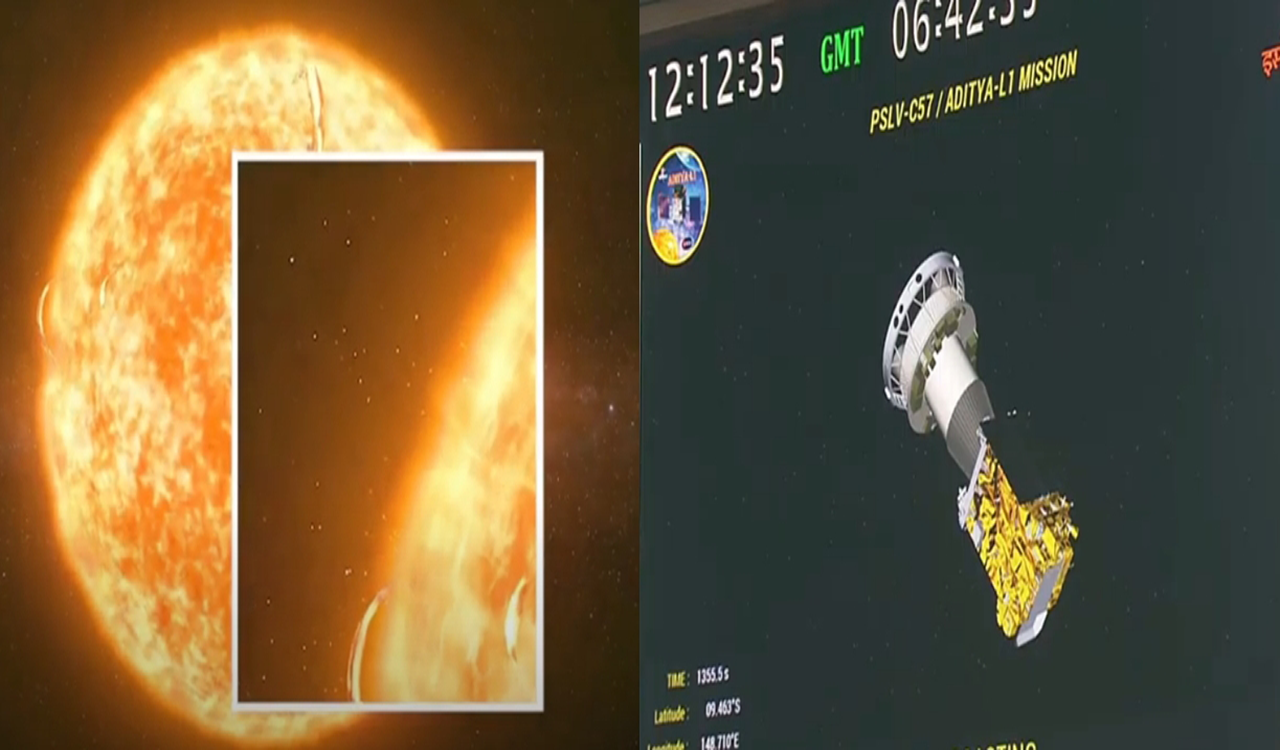


Chennai: India’s space based solar observatory Aditya-L1 has begun collecting scientific data en route to observe the Sun.
The sensors of the Supra Thermal & Energetic Particle Spectrometer (STEPS) instrument, a part of the Aditya Solar Wind Particle Experiment (ASPEX) payload, have begun the collection of scientific data, said Indian Space Research Organisation (ISRO).
Also Read
Developed by the Physical Research Laboratory (PRL) with the support of Space Application Centre (SAC) in Ahmedabad, the STEPS instrument has begun measuring supra-thermal and energetic ions and electrons at distances greater than 50,000 km from Earth.
This data helps scientists analyze the behaviour of particles surrounding the Earth.
STEPS comprises six sensors, each observing in different directions and measuring supra-thermal and energetic ions ranging from 20 keV/nucleon to 5 MeV/nucleon in addition to electrons exceeding 1 MeV.
These measurements are conducted by using low and high-energy particle spectrometers. The data collected during Earth’s orbits helps scientists to analyse the behaviour of particles surrounding the Earth, especially in the presence of the magnetic field of Earth.
According to ISRO, STEPS was activated on September 10 at a distance greater than 50,000 km from Earth. This distance is equivalent to more than eight times the Earth’s radius, placing it well beyond Earth’s radiation belt region.
After completing the necessary instrument health checks, data collection continued until the spacecraft had moved farther than 50,000 km from Earth.
Each unit of STEPS is operating within normal parameters. A figure displays measurements depicting variations in the energetic particle environment within Earth’s magnetosphere, collected by one of the units, ISRO said.
These STEPS measurements will persist during the cruise phase of the Aditya-L1 mission as it progresses towards the Sun-Earth L1 point.
They will continue once the spacecraft is positioned in its intended orbit. Data collected around L1 would provide insights into the origin, acceleration, and anisotropy of solar wind and space weather phenomena, ISRO said.
Meanwhile, Aditya-L1 will be given a formal send off towards the Sun on September 19 when the spacecraft will be maneuvered to Trans-Lagrangian Point 1 Insertion (TL1I), Indian space agency said.
On September 2 Aditya-L1 was orbited in low earth orbit (LEO) by an Indian rocket called Polar Satellite Launch Vehicle –XL (PSLV-XL) variant.
The spacecraft’s orbit has been raised by ISRO four times since then.
As the spacecraft travels towards Lagrange Point (L1), it will exit the earth’s gravitational Sphere of Influence (SOI).
After exit from SOI, the cruise phase will start and subsequently the spacecraft will be injected into a large halo orbit around the L1 — the point where the gravitational pull of two large bodies — Sun and Earth — will be equal and hence the spacecraft will not gravitate towards any one of the planet.
The total travel time from launch to L1 would take about four months for Aditya-L1 and the distance will be about 1.5 million km from the Earth.

Related News
-

Editorial: Diluting institutional autonomy may boomerang
-
Incredible to watch capability ISRO is developing in science missions: Indian-American NASA senior official
-
India, France step up space cooperation with new private-sector deals
-
ISRO says remains at centre of India’s space programme, refutes media reports as ‘baseless’