ISRO’s Aditya-L1 spacecraft to be placed in its final destination orbit on Saturday
According to ISRO officials, the spacecraft will be placed in a halo orbit around Lagrange point 1 (L1) of the Sun-Earth system, about 1.5 million km from the Earth. The L1 point is about one per cent of the total distance between the Earth and the Sun.


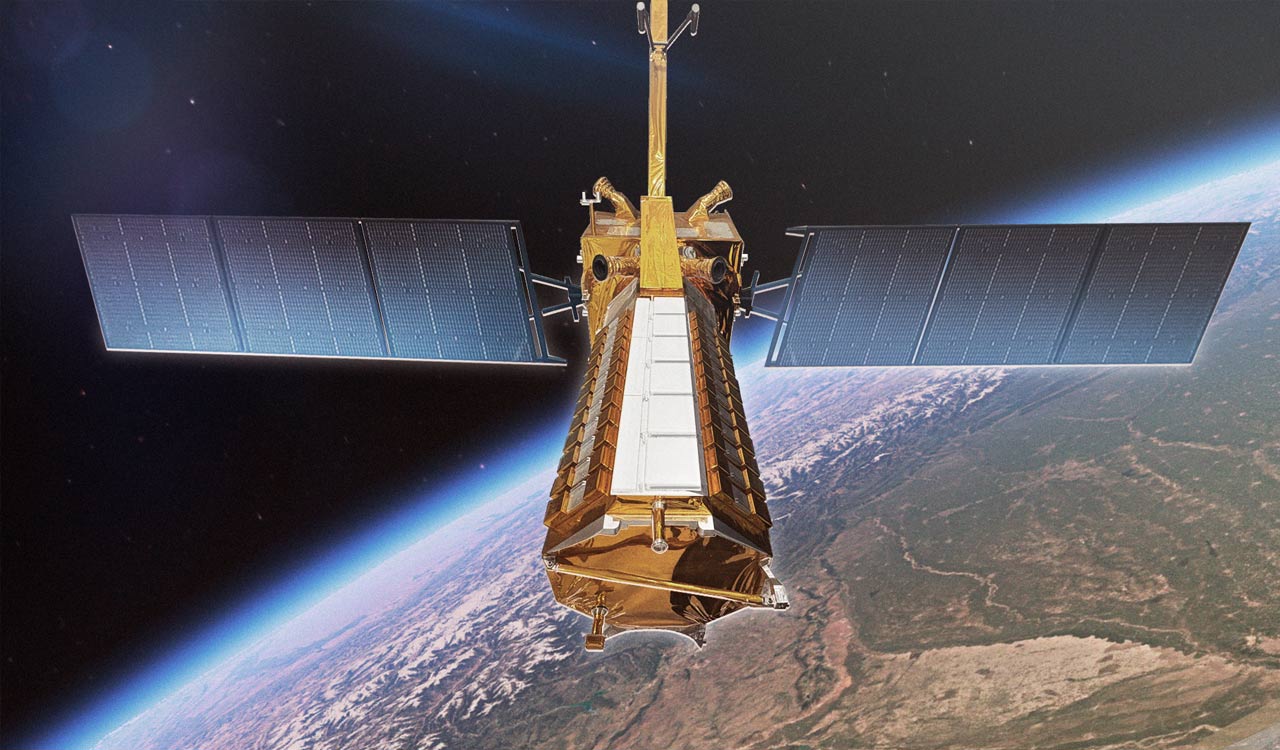
Bengaluru: ISRO will perform the final manoeuvre on Saturday to inject Aditya-L1 spacecraft — the first space-based Indian observatory to study the Sun — into its final destination orbit, some 1.5 million kilometres from the Earth.
According to ISRO officials, the spacecraft will be placed in a halo orbit around Lagrange point 1 (L1) of the Sun-Earth system, about 1.5 million km from the Earth. The L1 point is about one per cent of the total distance between the Earth and the Sun.
A satellite in a halo orbit around the L1 point has the major advantage of continuously viewing the Sun without any occultations/eclipses, they said, adding, this will provide a greater advantage in observing solar activities and its effect on space weather in real time.
“This manoeuvre (at around 4 pm on Saturday) will bind the Aditya-L1 to a halo orbit around L1. If we don’t do this, there is a possibility that it will continue its journey, maybe towards the Sun,” an ISRO official told PTI on Friday.
The Polar Satellite Launch Vehicle (PSLV-C57) launched the Aditya-L1 spacecraft from the second launch pad of Satish Dhawan Space Centre (SDSC), Sriharikota, on September 2 last year.
After a flight duration of 63 minutes and 20 seconds, it was successfully injected into an elliptical orbit of 235×19500 km around the Earth.
The spacecraft underwent a series of maneuvers thereafter and headed Sun-Earth Lagrange Point 1(L1), having escaped the Earth’s sphere of influence.
The spacecraft carries seven payloads to observe the photosphere, chromosphere and the outermost layers of the Sun (the corona) using electromagnetic and particle and magnetic field detectors.
“Using the special vantage point L1, four payloads directly view the Sun and the remaining three payloads carry out in-situ studies of particles and fields at the Lagrange point L1, thus providing important scientific studies of the propagatory effect of solar dynamics in the interplanetary medium,” according to the space agency.
The suits of Aditya L1 payloads are expected to provide the “most crucial information” to understand the problem of coronal heating, coronal mass ejection, pre-flare and flare activities and their characteristics, dynamics of space weather, and propagation of particles and fields, officials said.
The major science objectives of the Aditya-L1 mission are: – Study of the Solar upper atmospheric (chromosphere and corona) dynamics.
– Study of chromospheric and coronal heating, physics of the partially ionized plasma, initiation of the coronal mass ejections, and flares.
– Observe the in-situ particle and plasma environment, providing data for the study of particle dynamics from the Sun.
– Physics of the solar corona and its heating mechanism.
– Diagnostics of the coronal and coronal loops plasma: Temperature, velocity and density.
– Development, dynamics and origin of coronal mass ejections (CMEs).
– Identify the sequence of processes that occur at multiple layers (chromosphere, base and extended corona) which eventually leads to solar eruptive events.
– Magnetic field topology and magnetic field measurements in the solar corona.
– Drivers for space weather (origin, composition and dynamics of solar wind).

Related News
-

Editorial: Diluting institutional autonomy may boomerang
-
Incredible to watch capability ISRO is developing in science missions: Indian-American NASA senior official
-
India, France step up space cooperation with new private-sector deals
-
ISRO says remains at centre of India’s space programme, refutes media reports as ‘baseless’