ISRO’s solar mission Aditya-L1 to be launched on September 2
The Aditya-L1 mission, aimed at studying the Sun from an orbit around the L1, would carry seven payloads to observe the photosphere, chromosphere and the corona -- the outermost layers of the Sun -- in different wavebands.
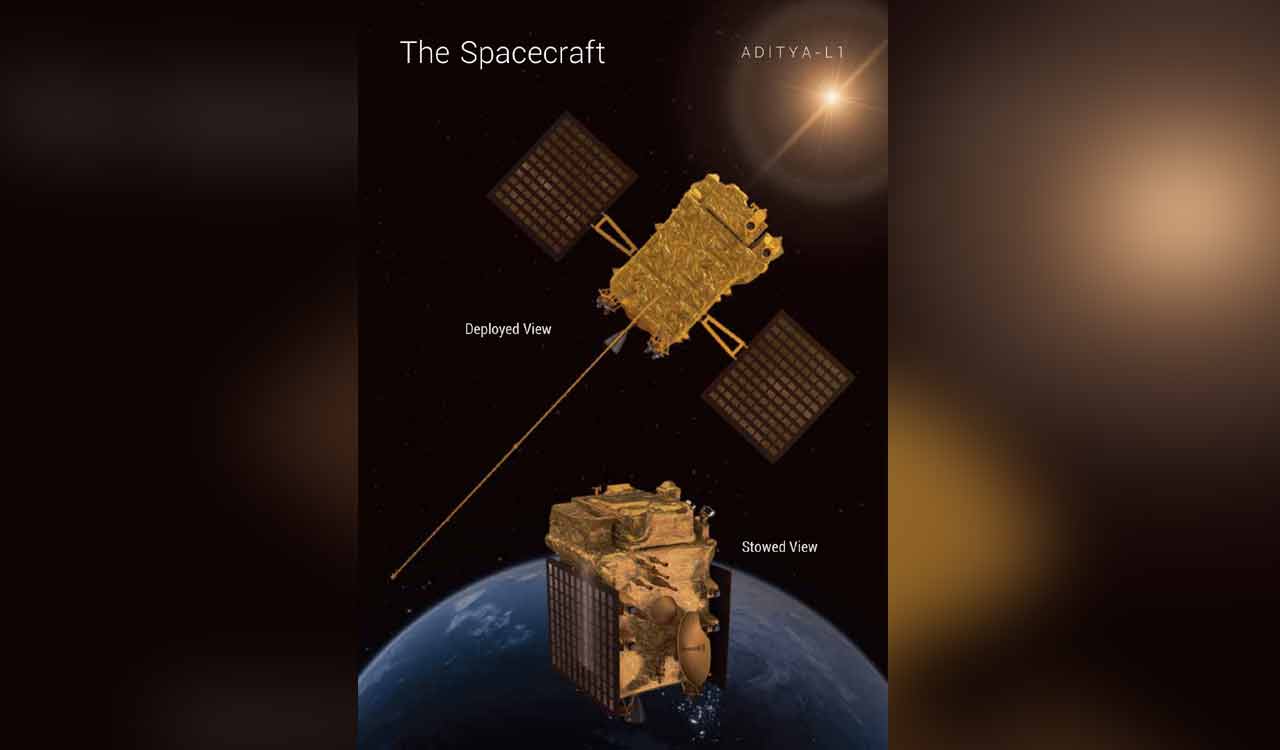


Bengaluru: After the successful Chandrayaan-3 mission to the Moon, ISRO on Monday announced that India’s first solar mission Aditya-L1 to study the Sun will be launched on September 2 at 11.50 am from Sriharikota spaceport.
Aditya-L1 spacecraft is designed to provide remote observations of the solar corona and in-situ observations of the solar wind at L1 (Sun-Earth Lagrange point), which is about 1.5 million kilometres from the Earth.
Also Read
Lagrange Points are positions in space where the gravitational forces of the Sun and the Earth produce enhanced regions of attraction and repulsion. These can be used by spacecraft to reduce fuel consumption needed to remain in position, according to NASA. Lagrange points are named in honor of Italian-French mathematician Josephy-Louis Lagrange.
The Bengaluru-headquartered space agency said in a social media post that the spacecraft — the first space-based Indian observatory to study the Sun — would be launched using a PSLV-C57 rocket.
The Aditya-L1 mission, aimed at studying the Sun from an orbit around the L1, would carry seven payloads to observe the photosphere, chromosphere and the corona — the outermost layers of the Sun — in different wavebands.
Aditya-L1 is a fully indigenous effort with the participation of national institutions, an ISRO official said.
The Bengaluru-based Indian Institute of Astrophysics (IIA) is the lead institute for the development of Visible Emission Line Coronagraph (VELC) payload while Inter-University Centre for Astronomy and Astrophysics, Pune, has developed the Solar Ultraviolet Imaging Telescope (SUIT) payload for the mission.
According to ISRO, VELC aims to collect the data for solving how the temperature of the corona can reach about a million degrees while the Sun’s surface itself stays just over 6000 degrees Centigrade.
Aditya-L1 can provide observations on the corona, and on the solar chromosphere using the UV payload and on the flares using the X-ray payloads. The particle detectors and the magnetometer payload can provide information on charged particles and the magnetic field reaching the halo orbit around L1.
The satellite, developed by U R Rao Satellite Centre here, arrived at ISRO’s spaceport of Sriharikota in Andhra Pradesh, earlier this month.
It is planned to be placed in a halo orbit around the L1 point of the Sun-Earth system.
A satellite placed in the halo orbit around the L1 point has the major advantage of continuously viewing the Sun without any planets obstructing the view or causing eclipses, ISRO noted. “This will provide a greater advantage of observing the solar activities and its effect on space weather in real time,” it said.
Using the special vantage point L1, four payloads would directly view the Sun and the remaining three payloads are expected to carry out in-situ studies of particles and fields at the L1 point, thus providing important scientific studies of the propagatory effect of solar dynamics in the interplanetary medium.

Related News
-

Editorial: Diluting institutional autonomy may boomerang
-
Incredible to watch capability ISRO is developing in science missions: Indian-American NASA senior official
-
India, France step up space cooperation with new private-sector deals
-
ISRO says remains at centre of India’s space programme, refutes media reports as ‘baseless’