KBR Park commuters fear fresh traffic disruptions as flyover work resumes
Commuters around KBR Park are concerned about fresh traffic disruption as work progresses on a revised 4.3-km elevated corridor. Motorists fear dust and delays and want GHMC to provide clear construction schedules, traffic diversions and dust-control measures.


Hyderabad: For months, commuters suffered with plumes of dust and navigated a maze of traffic as deep earth excavation turned the KBR Park perimeter into a frustrating battleground of barricades. Relief, however, appears short-lived.
Now, the Greater Hyderabad Municipal Corporation (GHMC) is gearing up to spark a similar crisis on the heavily congested artery connecting NFCL Junction (Punjagutta) and Mugdha Junction.
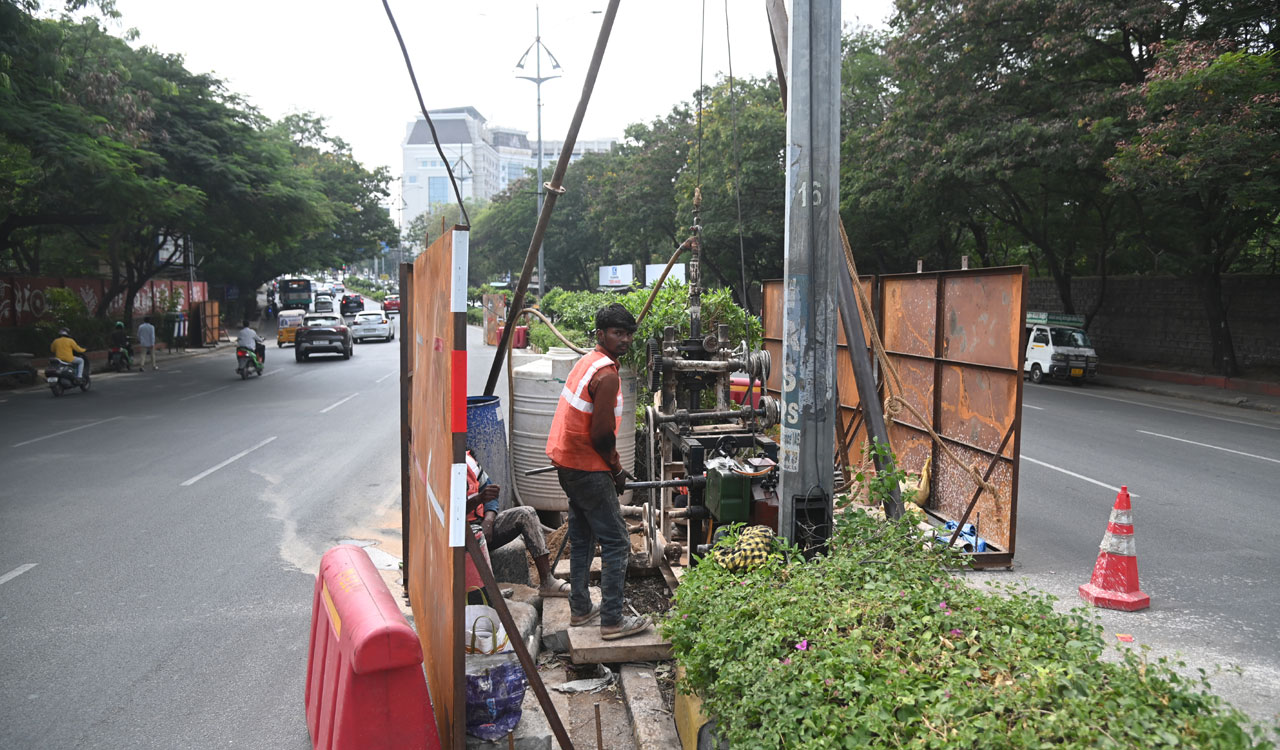
Following the recent Telangana government’s decision to build a 4.3-km six-lane steel elevated corridor, heavy machinery has quietly returned. The start of crucial soil testing along the stretch has sent a wave of anxiety through local motorists.
As drilling rigs block a key stretch, commuters must brace for the inevitable return of choking dust, sudden lane diversions, and endless bumper-to-bumper delays between Mugdha Junction (Sagar Society) and NFCL Junction, and vice versa.
A massive six-lane, bidirectional steel flyover designed to facilitate entirely signal-free traffic across five major junctions along the KBR Park under the Hyderabad City Innovative and Transformative Infrastructure (HCITI) Project.
For this, the GHMC will spend Rs 580 crore for completion of the steel flyover and another Rs 510 crore will be spent for the flyover from Mugdha Junction to Muffakham Jah College (extending via ramp down to Banjara Hills Road No.1, NFCL Junction.
However, commuters fume over next phase of earth excavation works. Heavy machinery has returned to the KBR Park perimeter, renewing traffic disruption after earlier digging, commuters said.
Motorists accuse GHMC authorities of poor planning as drilling rigs and gridlock affected daily travel. “The dust is unbearable, and our daily transit has turned into an obstacle course of drilling rigs and gridlock.” Taxpayers also seek answers on why extensive excavations were launched and later abandoned before work shifted to another junction.

Related News