Kharge seeks 25-year freeze on Lok Sabha strength, women’s quota from 2029
Congress president Mallikarjun Kharge urged Prime Minister Narendra Modi to share the government’s delimitation proposals with political parties and states. He sought a 25-year freeze on the Lok Sabha’s 543 seats and one-third reservation for women from 2029
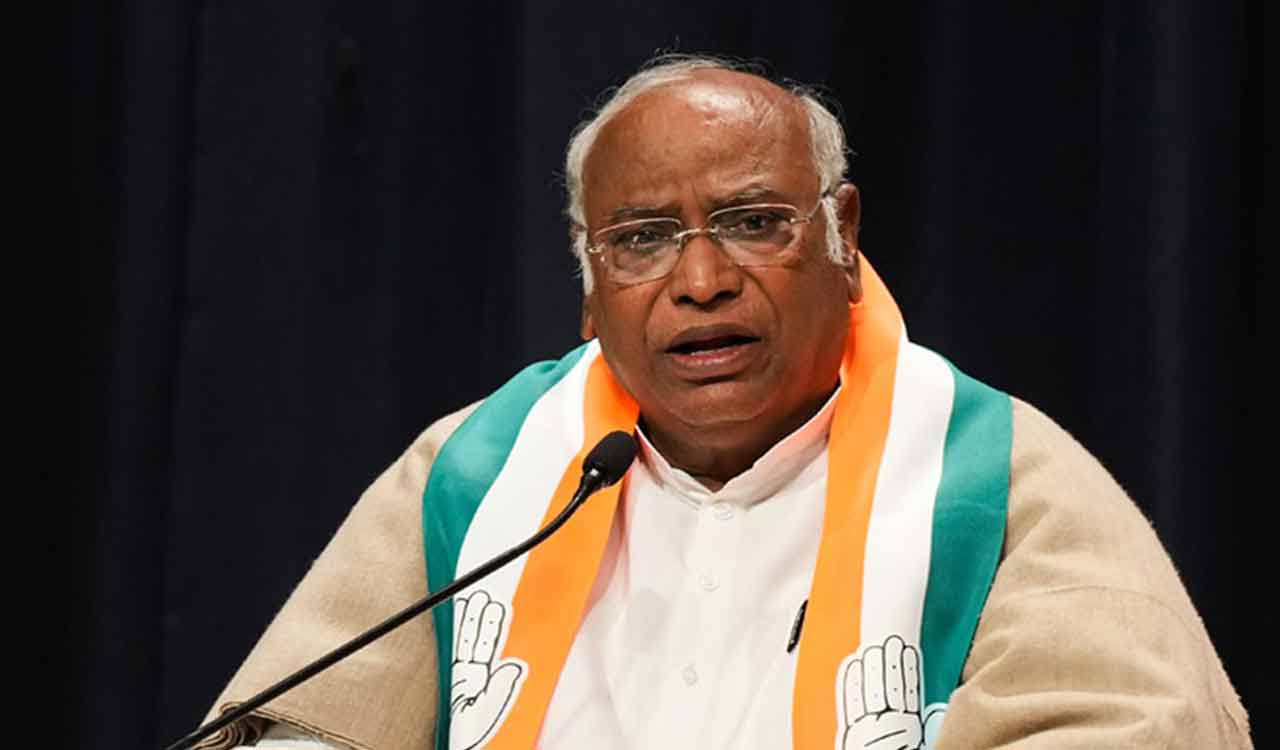


New Delhi: Congress president Mallikarjun Kharge on Thursday urged Prime Minister Narendra Modi to share with all political parties the government’s proposals for delimitation and called for a 25-year freeze on the Lok Sabha’s existing strength of 543, as well as the introduction of one-third reservation for women from the 2029 elections.
In a letter to Modi, Kharge called for convening an all-party meeting to discuss the delimitation proposals the government has in mind and giving all political parties and state governments adequate time to study them.
The Congress chief said he had written to the PM on July 16, requesting him to convene an all-party meeting to discuss the government’s proposals for delimitation.
“I had also requested you to give all political parties adequate time to study such proposals in detail before they are introduced in any special session of Parliament that you may be contemplating,” he said.
“I am writing now to reiterate this request since the Union Minister of Parliamentary Affairs has publicly stated in a television interview last night that such a special session of Parliament could well be convened,” Kharge said.
This perhaps explains the continued delay in the prorogation of the Monsoon session, he added.
Kharge said the Congress is very clear — maintain the existing strength of the Lok Sabha at 543 for another 25 years, maintain the existing state-wise strength in the Lok Sabha for another 25 years, and introduce one-third reservation for women from the 2029 Lok Sabha elections.
“Before you go ahead as indicated by the Union Minister of Parliamentary Affairs, I wish to reiterate my earlier request to you to — convene an all-party meeting to discuss whatever delimitation proposals you have in mind; give all political parties and state governments adequate time to study such proposals,” the Congress chief said.
This is an issue that has enormous significance for the country, he asserted.
“Please do not again try and bulldoze as you attempted on April 16 and 17, 2026,” Kharge said in his letter to Modi.
Sharing his letter on X, Kharge said, “I have written to PM Modi on delimitation, the delay in prorogation of the Monsoon Session of Parliament, and the likely special session mentioned by the Union Minister of Parliamentary Affairs in a television interview last evening.”
Tagging Kharge’s letter, Congress MP Shashi Tharoor said, “Important request from the President of @incIndia. One key additional detail is the request to consult state governments. The states are vital stakeholders in this exercise and no delimitation should be proposed without taking their views into account.”
“In my intervention during the parliamentary debate on delimitation in the Lok Sabha, in April 2026, I had called for a ‘grand National consultation’ on the issue before something of such portentous significance was finally decided,” he said.
It is truly deplorable that the government is proceeding in a clandestine manner to achieve its goals without any such national consultation taking place, Tharoor said.
The Congress has made the demands for freezing the Lok Sabha strength and implementation of 33 per cent reservation for women earlier as well.
In a resolution passed earlier this month, the Congress Working Committee had reiterated its commitment to the two demands.
The opposition party had termed “drama” the PM’s appeal to opposition parties to support the delimitation-linked bill for implementing women’s reservation, and alleged that his single-point agenda was “Modi preservation, not women’s reservation”.
During the Budget session on April 17, the Modi government faced a setback as the Constitution amendment bill, involving delimitation, for the implementation of the women’s reservation in the Lok Sabha and state assemblies was defeated in the Lower House.
Of the 528 MPs who voted in the Lok Sabha, 298 voted in support, while 230 opposed it. The bill required 352 votes for a two-thirds majority.

Related News
-

SC notice on plea alleging Rahul Gandhi pushed pregnant journalist during Oct 12 march
-
BJP’s Ramchander Rao slams Congress demand to halt electoral roll revision
-
EAM Jaishankar meets Liechtenstein Prince, discusses opportunities under TEPA
-
Modi, Jaishankar, Tharoor meet Iranian parliamentary delegation