Late rains lift sowing, but water uncertainty clouds Telangana’s Kharif prospects
Telangana's kharif cropped area has reached 96.74 lakh acres, or 73 per cent of the normal acreage, following improved monsoon activity. However, reservoir storage remains significantly lower than last year, raising concerns over irrigation availability and crop sustainability.


Hyderabad: The Vaanakalam (Kharif) sowing in Telangana gathered pace in the second half of July, with the total cropped area crossing 73 per cent of the season’s normal acreage by August 5. But the late surge offers little room for complacency, as reservoir storage remains substantially below last year’s level and farmers continue to depend heavily on rainfall and uncertain irrigation supplies, including groundwater.
The cropped area surged from 68.43 lakh acres, or 51.69 per cent of the season’s normal area of 132.38 lakh acres as on July 22, to 96.74 lakh acres (73 per cent of the season’s normal area) by August 5. The pickup followed renewed monsoon activity across the State and heavy rainfall in the upper Krishna basin in Maharashtra and Karnataka, which increased inflows into Telangana. Heavy rains in Maharashtra and Chhattisgarh also improved flows into the Godavari.
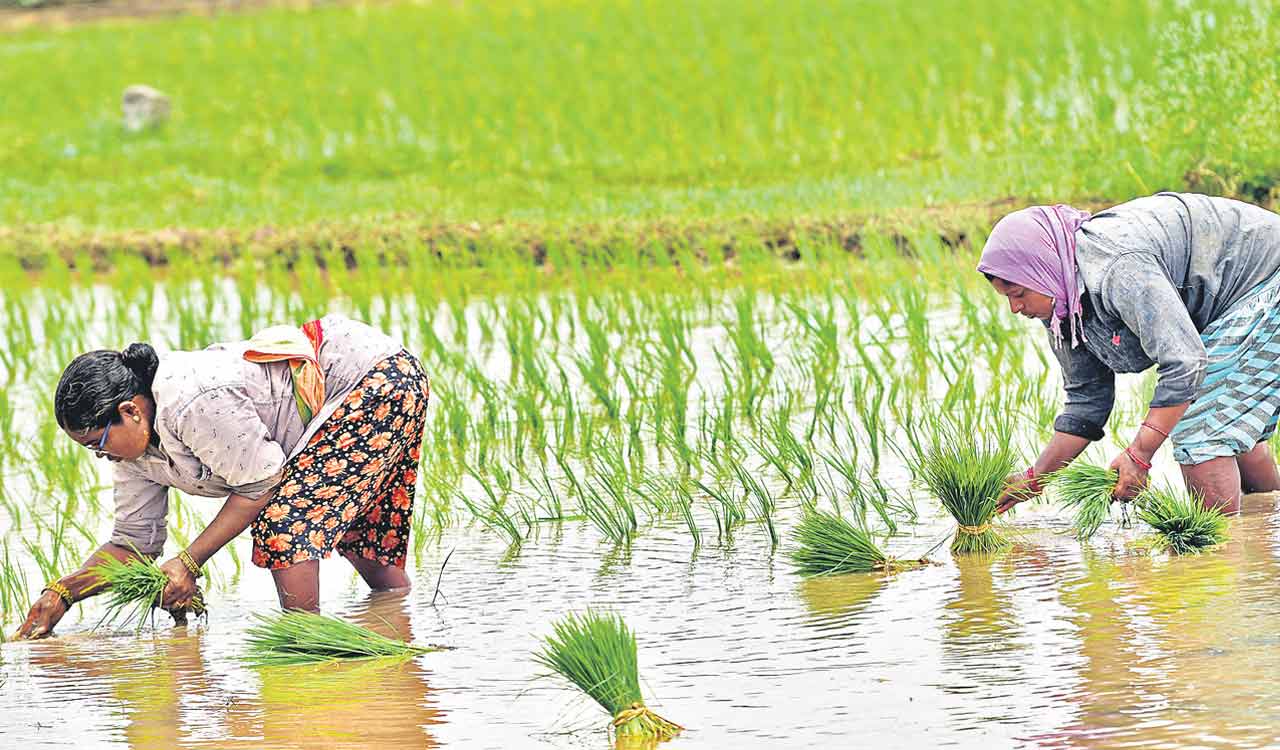
For farmers who had delayed sowing amid uncertainty over irrigation water, the rains provided a much-needed window. Rainfed crops, including jowar, bajra, maize, ragi, pulses, groundnut, soybean and cotton, are now being sown at a faster pace, while paddy nurseries are being raised in areas with assured irrigation.
Yet the water position remains a concern. The State’s major reservoirs held 438.9 TMCft on August 5, compared with 725.36 TMCft on the same date last year. Although storage has improved from 321.24 TMCft two weeks earlier, the deficit compared with last year remains substantial, raising concerns over the sustainability of crops due to water scarcity.
The crop-wise figures indicate the uneven nature of the recovery. Paddy remains the major worry. Only 26.16 lakh acres had been sown by August 5, against a normal area of 65.96 lakh acres and 28.74 lakh acres sown during the corresponding period last year.
However, cotton has almost reached its normal acreage, with 46.8 lakh acres sown against a seasonal normal of 47.41 lakh acres and 43.56 lakh acres during the corresponding period last year. Pulses have also exceeded last year’s coverage, with 5.48 lakh acres sown against 5.1 lakh acres during the corresponding period last year.
Major millets covered 5.3 lakh acres against a normal area of 6.52 lakh acres, while oilseeds stood at 3.74 lakh acres against a normal area of 4.47 lakh acres. Fodder and green-manure crops have already exceeded the normal area, reaching 2.81 lakh acres against a seasonal normal of 89,726 acres.
For farmers who waited for water, the delayed start has compressed the sowing window and increased dependence on the monsoon’s continued performance. The heavy inflows from the upper reaches of the Krishna and Godavari have temporarily eased the situation. But with agricultural scientists hinting at poor rainfall due to the El Nino impact and reservoir stocks remaining far below last year’s levels, uncertainty continues over the sustainability of crops.
“Farmers largely kept away from paddy and opted for alternative crops this season. But with no assured irrigation, there is no clarity on the sustainability and yield of the crops,” an agricultural scientist at Prof K Jayashankar Telangana State Agricultural University said.
- Cultivation area surged from 68.43 lakh acres to 96.74 lakh acres in two weeks.
- Major reservoirs held 438.9 TMCft on August 5 against 725.36 TMCft on the same date last year.
- Paddy cultivation declined by around two lakh acres, while the cultivation of cotton, pulses, millets and oilseeds increased.

Related News