NASA captures 1st direct image of exoplanet outside our solar system
The exoplanet called 'HIP 65426 b' is a gas giant, meaning it has no rocky surface and could not be habitable.
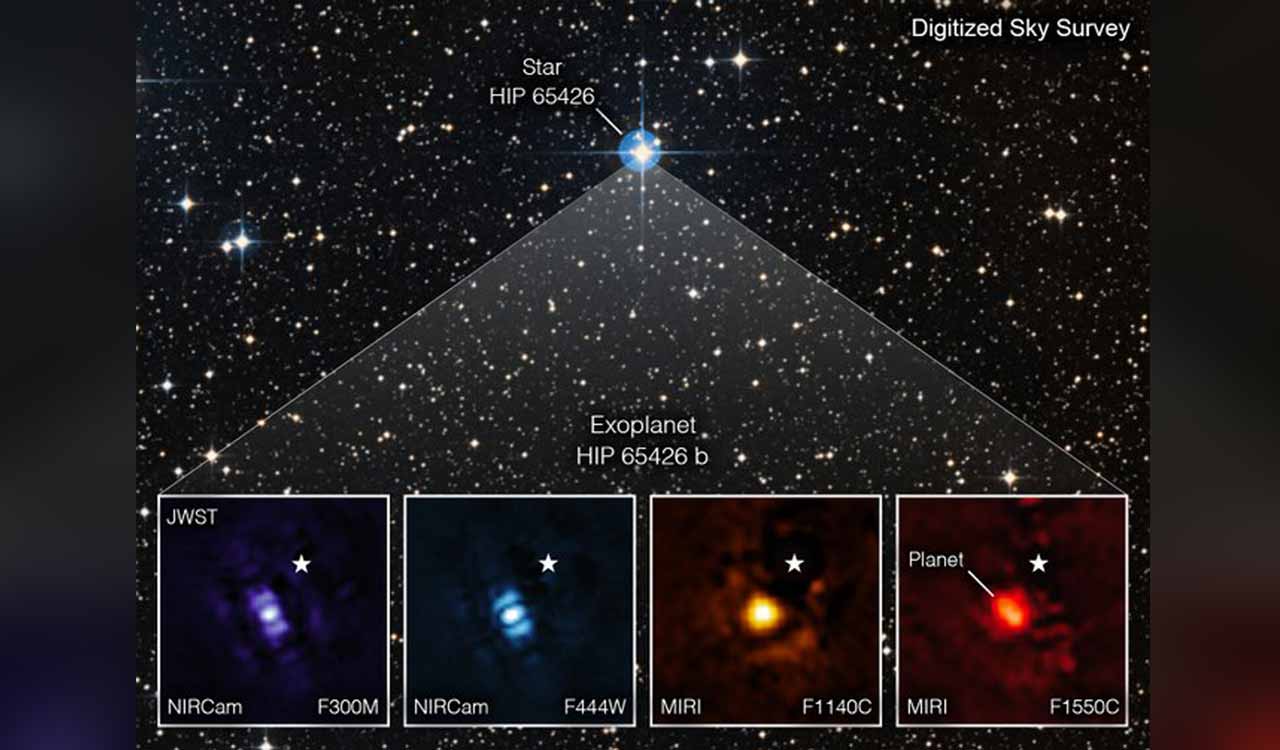


New York: For the first time, astronomers have used NASA‘s James Webb Space Telescope to take a direct image of a planet outside our solar system.
The exoplanet called ‘HIP 65426 b’ is a gas giant, meaning it has no rocky surface and could not be habitable.
Also Read
The exoplanet is about six to 12 times the mass of Jupiter, and these observations could help narrow that down even further.
It is young, about 15 to 20 million years old, compared to our 4.5-billion-year-old Earth.
“This is a transformative moment, not only for Webb but also for astronomy generally,” said Sasha Hinkley, Associate Professor of Physics and Astronomy at the University of Exeter in the UK.
The image, as seen through four different light filters, shows how Webb’s powerful infrared gaze can easily capture worlds beyond our solar system, pointing the way to future observations that will reveal more information than ever before about exoplanets, the space agency said in a statement.
This image shows the exoplanet ‘HIP 65426 b’ in different bands of infrared light.
A set of masks within each instrument, called a coronagraph, blocks out the host star’s light so that the planet can be seen.
Astronomers discovered the planet in 2017 using the SPHERE instrument on the European Southern Observatory’s Very Large Telescope in Chile and took images of it using short infrared wavelengths of light.
Webb’s view, at longer infrared wavelengths, reveals new details that ground-based telescopes would not be able to detect because of the intrinsic infrared glow of Earth’s atmosphere.
Since ‘HIP 65426 b’ is about 100 times farther from its host star than Earth is from the Sun, it is sufficiently distant from the star that Webb can easily separate the planet from the star in the image.
“It was really impressive how well the Webb coronagraphs worked to suppress the light of the host star,” Hinkley said.
Taking direct images of exoplanets is challenging because stars are so much brighter than planets.
The ‘HIP 65426 b’ planet is more than 10,000 times fainter than its host star in the near-infrared, and a few thousand times fainter in the mid-infrared.
“Obtaining this image felt like digging for space treasure,” said Aarynn Carter, a postdoctoral researcher at the University of California, Santa Cruz.
In July, James Webb Space Telescope produced the deepest and sharpest infrared image of the distant universe to date.

Related News
-

Incredible to watch capability ISRO is developing in science missions: Indian-American NASA senior official
-
Astronauts remove faulty ISS antenna during spacewalk; out of time to install spare
-
NASA invites ISRO to join Moon Base programme for lunar South Pole outpost
-
NASA astronauts Anil Menon, Jessica Meir undertake spacewalk to upgrade space station