Opinion: India’s great untapped resource
By Craig Jeffrey, Jane Dyson Young people have been taking to the streets across India, demanding governments act to provide more jobs. In Bihar, large numbers protested recently at delays in filling public sector vacancies. Some of them had passed the required examinations but waited several years for their job to start. In July and […]


By Craig Jeffrey, Jane Dyson
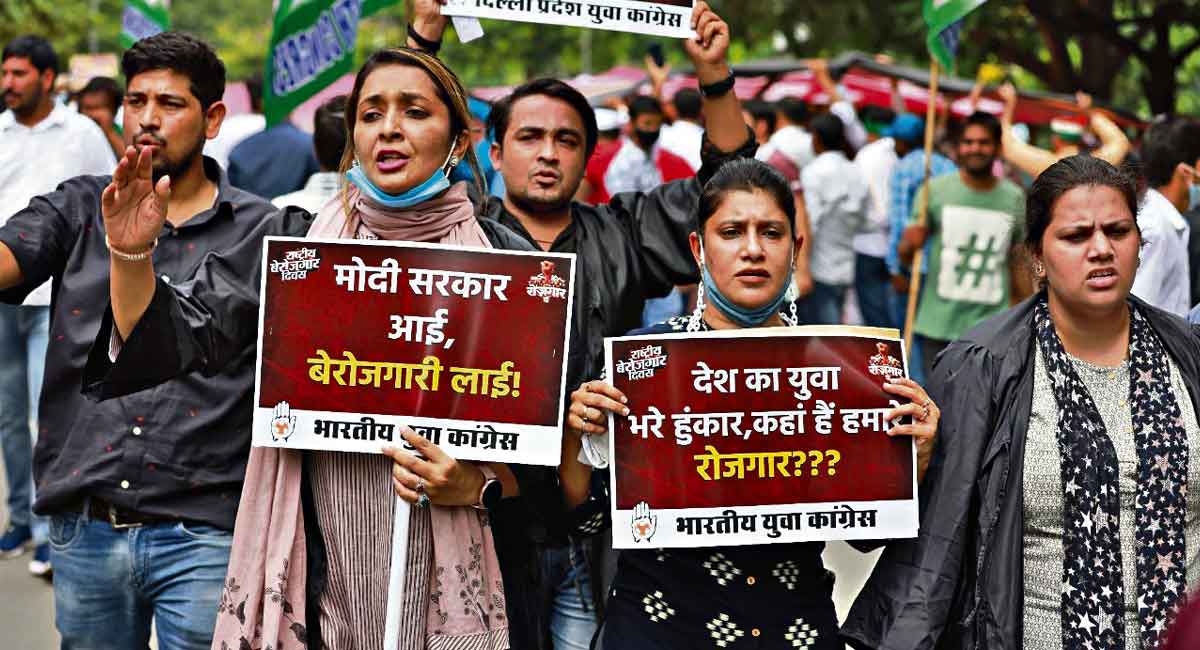
Young people have been taking to the streets across India, demanding governments act to provide more jobs. In Bihar, large numbers protested recently at delays in filling public sector vacancies. Some of them had passed the required examinations but waited several years for their job to start.
In July and early August, hundreds of young people walked more than 900km from Nagpur to Delhi, again focusing on the problem of government posts lying vacant.
Behind these headlines is one of India’s most pressing problems: widespread, entrenched unemployment. Youth unemployment rose sharply from about 6% in 2011-12 to more than 17% in 2018-19. By then, nearly 40% of young graduates were unemployed.
Equally troubling has been an increase in the number of young people trapped in part-time, insecure work that doesn’t reflect their aspirations.
Diverging Trends
High levels of unemployment and underemployment reflect two related trends: the very large numbers of young Indians drawn into education over the past 40 years, increasing demand for salaried jobs; and the Indian economy’s failure to respond with large numbers of new jobs.
Development theory suggests that agriculturally based countries will make a transition into manufacturing and services, opening up jobs for young aspirants. But this transformation isn’t occurring in India.
The number of people working in services in India rose only marginally from about 35 million in 2005 to 39 million in 2018-19. The number of manufacturing jobs in India declined over this period. Conversely, the proportion of young people in agriculture has been increasing in recent years.
These trends have stopped India from experiencing the “demographic dividend” predicted by economists, whereby the productivity of a large youth population promotes economic growth. Not surprisingly, this dividend effect only operates if young people actually are in jobs.
Should jobs come first?
Harnessing the energies of young people in India could be part of a solution to unemployment. Social research in India, including our own work in Uttar Pradesh and Uttarakhand, suggests young people, while frequently frustrated, often have the skills, motivation, and time to assist their communities in processes of development.
Educated unemployed or underemployed young people have often accumulated a store of useful information and capabilities in their efforts to navigate schooling and employment markets. They also have experience in a range of places: rural, small town and big city. Reflecting these skills and experience, they are often called on to assist their families and communities in gaining access to healthcare or educational opportunities, for example, or to attract infrastructure and development schemes.
New Business
Unemployed young people, especially young women, are often involved in challenging gender norms that have limited women’s participation in schooling and paid employment. By advising on relationships, health and other issues, they also act as interpreters of change for the generation coming after them (teenagers and pre-teens).
Unemployed young people often have exciting ideas about how to bring about social change. Our research has shown they bring urban thinking into rural areas to encourage schooling, agriculture and gender empowerment. In turn, they enhance the viability of rural lives. By improving schooling, unemployed young people ensure villagers remain in rural areas rather than migrating to urban areas. By campaigning for better infrastructure, they enable new business.
Group of Guides
Attempts to build on this work could usefully look at formalising unemployed young people’s involvement in advising children about education, work, and other issues. The government might identify, support and remunerate a group of “guides” who could help young people navigate the changing landscapes of schooling and employment.
This is especially important since teenagers’ and pre-teens’ parents, who are typically in their forties and fifties, often lack a close recent understanding of how contemporary schooling and employment markets work.
The government could also partner with unemployed youth to develop new platforms for providing practical advice on rural entrepreneurship, skills, the use of technology and other issues.
In the parts of northern India where we have worked, young people frequently emphasise the need to develop portfolio careers rather than relying on a single line of work. The state could learn from their experiences to develop new online materials and revise school and university curricula to reflect new landscapes of work.
Such schemes could assist in allowing unemployed youth to be change makers. Even if they haven’t yet been able to yield an economic dividend, many young people are producing a social and cultural dividend for India, and more should be given the chance to do so.

(Craig Jeffrey is Professor of Geography, The University of Melbourne. Jane Dyson is Associate Professor in Social Geography & Development Geography, The University of Melbourne, theconversation.com)

Related News