Scientists aren’t entirely sure why whales breach
Whales live in waters over 1,000 metres deep and are social, forming cohesive groups that in some cases may number hundreds of animals
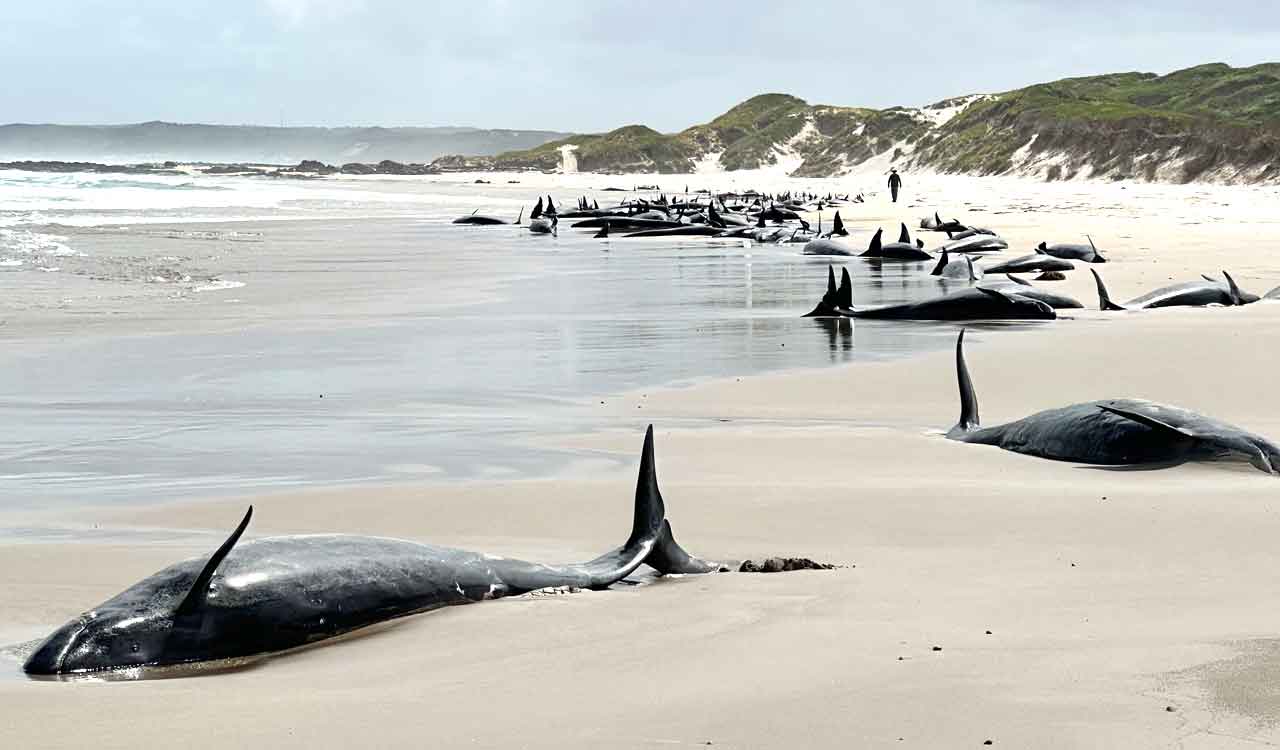


Hyderabad: Over 150 false killer whales were reported to be stranded on a remote beach on Australia’s island State of Tasmania on February 19. Of them 136 appeared to be still alive and rescue operations were launched to refloat them.
The largest mass-stranding in Australian history occurred in the Macquarie harbour in 2020 when 470 long-finned pilot whales became stuck on sandbars. Most of the beached whales died.
Why do these creatures, who are masters of oceans, enter an inhospitable environment where they could die?
Mass stranding involves whales. Long-finned and short-finned pilot whales tend to be the frequent casualties. Other species typically are false killer whales, melon-headed whales, Cuvier’s beaked whales and sperm whales. All of these live in waters over 1,000 metres deep and are social, forming cohesive groups that in some cases may number hundreds of animals.
Although we blame whale stranding on human activity, in many cases there is an involvement of natural causes as well.
Mass stranding of these species tend to be in shallow areas with gently sloping, often sandy, seabed. In those situations, it is no surprise that these animals, which are used to swimming in deep waters, can get into difficulties and even if re-floated will often re-strand.
The echolocation, which they use for navigation does not work well in such environments. So it is quite possible that the majority of such stranding was due to navigational error, for example when whales have followed a prey into unfamiliar and dangerous territory.
However, mass stranding aren’t only caused by whales getting lost or misjudging the depth of the water. One or more individuals may be diseased and, as they become weaker, they seek shallower waters so they can more easily come to the surface to breathe. Once their bodies come to rest on a hard surface for any extended period, there is a greatly increased chance that their chest walls will be compressed and their internal organs damaged.
Occasionally, live stranding may derive from human activities, particularly military activity that involves the use of sonar . This connection was first suggested in 1996 after a NATO military exercise off the coast of Greece coincided with the stranding of 12 Cuvier’s beaked whales.
During another beaked whale mass stranding in Bahamas, alongside naval activity, haemorrhaging, particularly around the inner ear of whales, was discovered, indicating acoustic trauma. It was also found that sometimes, the animals die at sea first, not after standing.
Many researchers believe that naval sonar might be producing behaviour in whales that interferes with their ability to dive and rise to the surface safely.
Loud noise in the ocean has become a major conservation concern as humans introduce sounds of varying intensities and frequencies into the marine environment from different technologies and even explosions.
Seaquakes are another source of intense underwater sound and those might also lead to physical damage or behaviour resulting in stranding.
The kind of stranding seen in New Zealand, where very large numbers of whales become beached but a significant proportion can be rescued, also raises the question of whether some healthy animals simply follow others into dangerously shallow waters.
When we see large numbers of whales or dolphins doing mass suicide, the chances are that they are vocally responding to one another, reflecting their strong social bond.

Related News
-

Ten injured after car drives into rugby fans north of Sydney
-
Australian man is accused of being Islamic State group propagandist who shared 10,000 files online
-
Nathan Ellis helps Australia edge Zimbabwe by one wicket in third ODI
-
Tejal Hasabnis and Anushka Sharma power India A to victory over Australia A