Supermassive black hole in motion detected
The supermassive black hole is moving with a speed of about 110,000 miles (approximately 177,028km) per hour inside the galaxy J0437+2456, said the study published in the Astrophysical Journal.
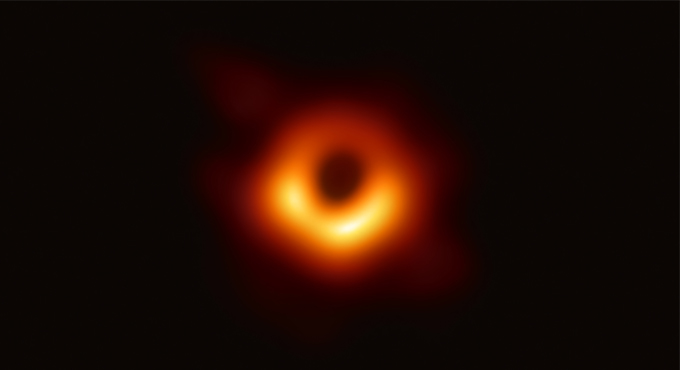


New York: Researchers at the Harvard-Smithsonian Centre for Astrophysics have identified the clearest case to date of a supermassive black hole in motion.
The supermassive black hole is moving with a speed of about 110,000 miles (approximately 177,028km) per hour inside the galaxy J0437+2456, said the study published in the Astrophysical Journal.
Catching a moving supermassive black holes has proven difficult, although scientists have long theorised that they can wander through space.
“We don’t expect the majority of supermassive black holes to be moving; they’re usually content to just sit around,” said Dominic Pesce, an astronomer at the Centre for Astrophysics who led the study.
“They’re just so heavy that it’s tough to get them going.”
Pesce and his collaborators have been working to observe this rare occurrence for the last five years by comparing the velocities of supermassive black holes and galaxies.
“We asked: Are the velocities of the black holes the same as the velocities of the galaxies they reside in?” he explained.
“We expect them to have the same velocity. If they don’t, that implies the black hole has been disturbed.”
For their search, the team initially surveyed 10 distant galaxies and the supermassive black holes at their cores.
They specifically studied black holes that contained water within their accretion disks — the spiral structures that spin inward towards the black hole.
As the water orbits around the black hole, it produces a laser-like beam of radio light known as a maser.
When studied with a combined network of radio antennas using a technique known as very long baseline interferometry (VLBI), masers can help measure a black hole’s velocity very precisely, Pesce said.
The technique helped the team determine that nine of the 10 supermassive black holes were at rest — but one stood out and seemed to be in motion.
Located 230 million light-years away from Earth, the black hole sits at the centre of a galaxy named J0437+2456.
Its mass is about three million times that of our Sun.
Using follow-up observations with the Arecibo and Gemini Observatories, the team has now confirmed their initial findings.
But what’s causing the motion is not known. The team suspects there are two possibilities.
“We may be observing the aftermath of two supermassive black holes merging,” said Jim Condon, a radio astronomer at the National Radio Astronomy Observatory in the US.
“The result of such a merger can cause the newborn black hole to recoil, and we may be watching it in the act of recoiling or as it settles down again.”
But there is another, perhaps even more exciting possibility: the black hole may be part of a binary system, according to the researchers.

Related News
-

Flydubai co-pilot who attacked Indian captain identified as Omani citizen
-
‘Peace track our number one priority’: Zelensky says Trump meeting could change a lot
-
EAM Jaishankar arrives in Zurich, briefed on India-Switzerland-Liechtenstein ties ahead of UNGA visit
-
Crude oil futures fall by Rs 89 to Rs 9,730 per barrel