Teddy tigers and preserved embryos: Museum in Corbett tries to keep them ‘alive’
A museum near Jim Corbett National Park in Uttarakhand preserves life-sized taxidermied tigers, leopards and other wildlife that died naturally or in human-animal conflicts. The exhibits aim to educate visitors, especially children, about wildlife conservation and coexistence


Ramnagar: Way back in 1902 the then US President Theodore Roosevelt refused to shoot a captive and tied-up bear during a shooting trip. It inspired a political cartoonist working with the Washington Post sketch a cartoon to depict the incident.
The cartoon went viral, long before it became a household term in the age of social media, and a small toy shop owner in Brooklyn decided to create and sell a small stuffed bear, naming it ‘Teddy’s Bear’ after the president’s nickname ‘Teddy’.
The name soon got traction and ‘Teddy Bear’ soon became a noun for a soft stuffed toy.
More than a century has passed since then, and a small museum in Ramnagar, on the outskirts of India’s oldest national park, Jim Corbett Forest Reserve, now showcases many ‘teddy tigers’ and other ‘teddys’.
The only difference being that these ‘teddys’ are actual-size recreations stuffed inside the real skin of tigers and other animals who have died during a conflict or for natural reasons.
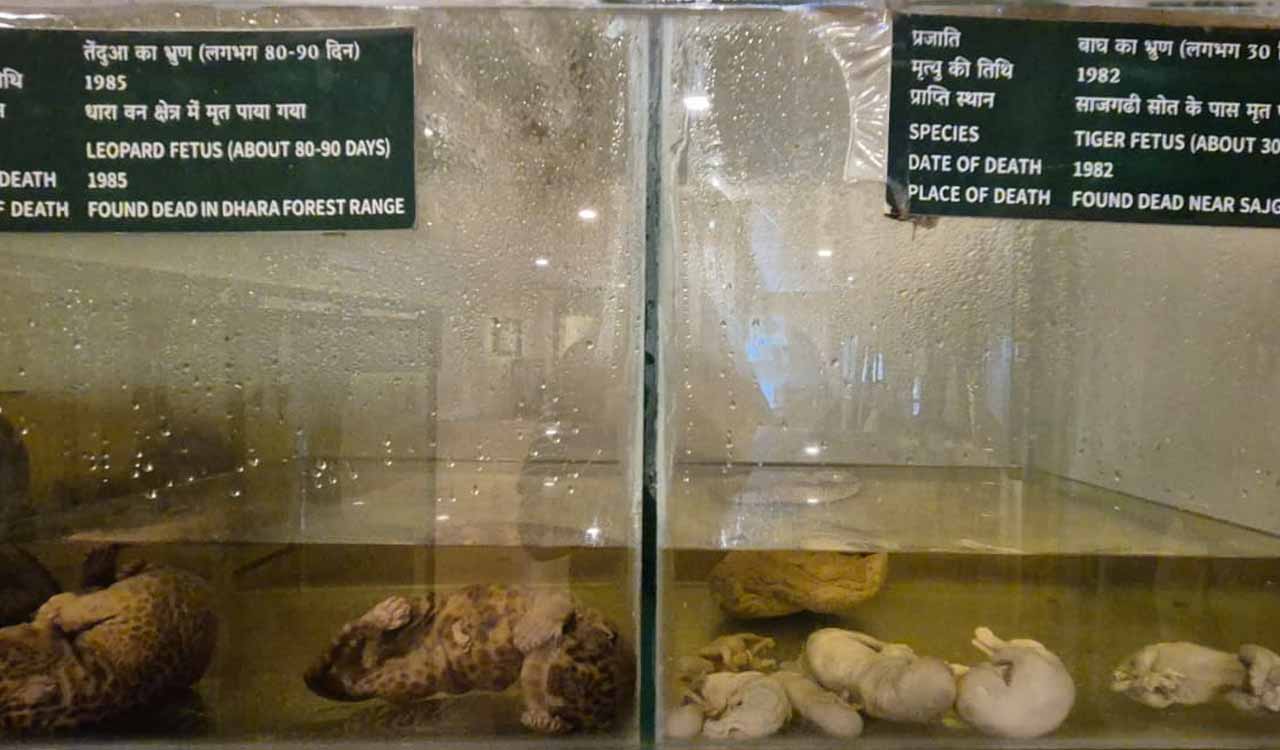
The museum also preserves embryos of stillborn animals, including a tiger and a cobra.
Taxidermy, as the craft is called, takes a lot of effort and medical help to preserve these pelts and create the stuffed animals, but these life-size models serve as a specimen of human-animal coexistence, as difficult as it may be.
The oldest exhibit is of a tiger that died on March 7, 1977, at Gairal. The big cat died in an interspecific fight with an elephant. The fight is said to have continued through the night, and the tiger was found crushed to death by the tusker the next morning, a forester working there, Dharampal Negi, told PTI.
Then there is a tigress that was found dead on December 28, 1982, at Sajgarhi Sot. An autopsy revealed that the death was due to pneumonia. The tigress is displayed with a taxidermied cub by her side.
A tiger that died a natural death on February 25, 1986, at Pipal Parao, outside the tiger reserve, is also on display, mouth open in a snarl.
Not all exhibits reflect the nature’s course. Two pantheresses on display were declared man-eaters and shot dead. One, killed on December 6, 1983, in the Salt area of Almora, had killed six children, according to details shown alongside its glass ‘cage’. The other, shot on August 11, 1986, at Kathpudia in Ranikhet, had killed two people and a score of cattle.
Such cases highlight the conflict between people and the big cats in the hills of Uttarakhand, where leopards frequently stray into villages.
Apart from the big cats, the museum also keeps preserved specimens in glass tanks. These include the foetus of a leopard, about 80-90 days old, found stillborn in the Dhara forest range in 1985, and that of a tiger, about 30 days old, found near Sajgarhi Sot in 1982.
A spotted deer foetus of about five months, found in the Dhangadi forest range in 1980, and a king cobra found dead during patrolling in the Dhela forest range are also on display.
“Preserving these specimens takes constant care. Every exhibit is checked regularly so that it can be shown to visitors for years to come,” Negi said.
“Each of these animals has a story, and many of them show how difficult coexistence can be. We want visitors, especially children, to understand that and learn to respect wildlife,” he added.
“The museum showcases several exhibits of the park’s rich wildlife, including preserved specimens of animals that are native to the region, like tigers, leopards, elephants, and crocodiles.
The taxidermied animals, skulls, and bones give visitors a closer look at the fauna that roams within the park,” said an attendant working at the museum located at the Dhangarhi gate of the Jim Corbett Park.
The process mostly involves cryopreservation and taxidermy.
Cryopreservation helps with the long-term storage of biological materials by cooling them to extremely low temperatures at which metabolic and biochemical processes are effectively slowed or halted. It minimises ice crystal formation and cellular damage during freezing and thawing processes.
Taxidermy, on the other hand, involves creating lifelike replicas of animals by using their skins and other structures that do not spoil or decompose them. The process dates back to an ancient custom of preserving hunted animals as trophies, but now it is more about preserving dead animals in museums to tell people about natural history.
It requires using a lot of chemicals to preserve skins, hair, and feathers from decay, while stuffing the sewed-up skins with hay or straw, or at times even concrete to give them realistic structures.

Related News