Telangana gets two new gecko species from Nalgonda, Warangal
Scientists have discovered two new gecko species in Telangana, one in Nalgonda and another in Pakhal Wildlife Sanctuary in Warangal. The species, 'Hemidactylus cairnicola' and 'H. koyaorum', were identified during joint field research and recently described in a taxonomic journal.
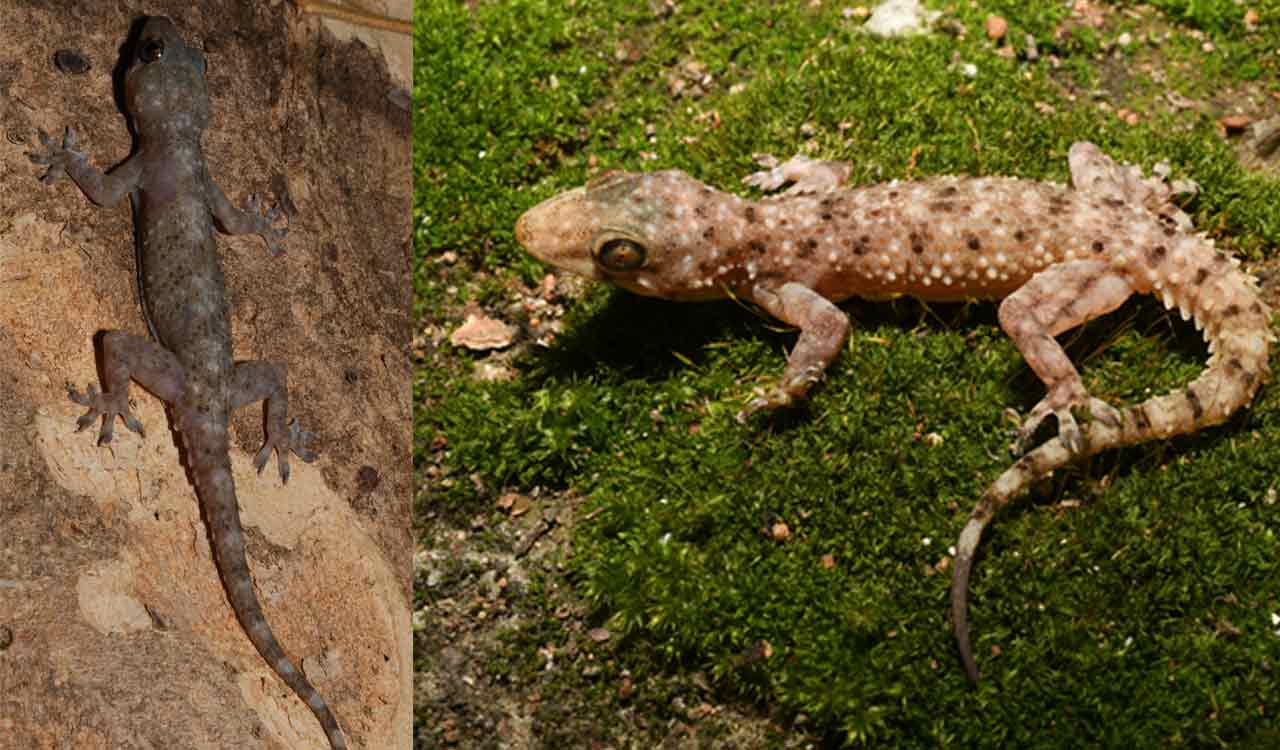


Hyderabad: For those who have herpetophobia, Telangana has two more new lizards to worry about, with scientists discovering one species each in Nalgonda and Warangal districts.
‘Hemidactylus cairnicola’ was discovered in a rocky area near Vardhamani Gudem bus shelter, Guntu Madgu, between Pendlipakala and Pedda Vagu Reservoirs in Nalgonda district. ‘Hemidactylus koyaorum’ was identified in the Pakhal Wildlife Sanctuary in Warangal district.
The new species came to light during field research jointly conducted by scientists from the Freshwater Biology Regional Centre, Zoological Survey of India (ZSI), Hyderabad, Fakir Mohan University, Balasore, Odisha, ZSI, Kolkata, Nehru Zoological Park, Hyderabad, and Wildlife Institute of India, Dehradun.
The team was led by Scientist-E at ZSI, Kolkata, Dr Pratyush P Mohapatra and comprised Bharat Bhupathi, Sumidh Roy, Dr B Laxmi Narayana, Amrita Balan, and Dr Deepa Jaiswal.
With discovery of two new species, the present endemic reptile species in Telangana increased to six. The research findings have recently been published in the ‘European Journal of Taxonomy ‘.
The first species, ‘Hemidactylus cairnicola’, has been named for its close association with traditional stone cairns. They are with heterogeneous, granular scales intermixed with enlarged keeled scales. The lizard, which grows up to 49 mm in length, has a distinctive colour that helps it blend into dark rocks and provides effective camouflage for protection against predators.
According to scientists, this reptile appears to be primarily nocturnal. Locals observed it basking and resting on rock surfaces during daylight hours during winters and rainy days. However, it retreats into rock crevices during periods of inactivity and becomes active at night, when it forages for insects, they said.
The second species, ‘Hemidactylus koyayorum’, was named in honour of the Koya people, an indigenous tribal community that has deep cultural ties to the forests and hills. It grows up to 55.6 mm in length.
This lizard, which is mostly homogeneous and without any keeled scales, has dorsal colouration grey with four prominent white flower-like patterns on its body, surrounded by darker margins.
According to researchers, local individuals encountered this lizard beneath a boulder, positioned slightly above the ground surface. Upon disturbance, this reptile quickly moved in a serpentine manner through the grass and leaf litter, suggesting an adaptation for movement within dense ground cover, they added.

Related News