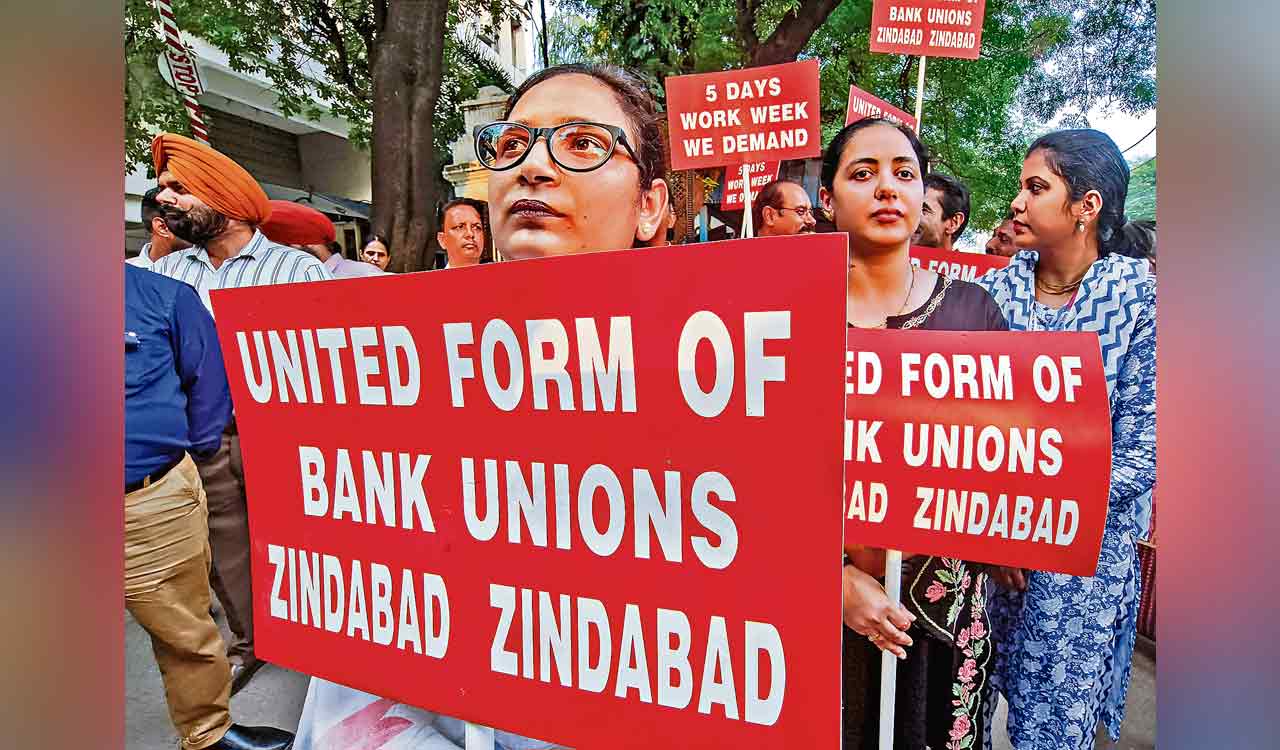
Bank unions to begin three-day strike on September 28 over five-day week
Banking services may face disruption from September 28 to 30 as bank unions launch a nationwide strike seeking a five-day working week and other demands. Digital banking services are expected to remain available, while branch operations may be affected



New Delhi: Banking services, including cheque clearance, cash withdrawals and deposits, are likely to be disrupted for three days beginning Monday as bank unions go on a nationwide strike to press for a five-day working week and other pending demands.
The impact is expected to be felt primarily at public sector banks, old-generation private sector banks and regional rural banks, though digital banking and other online services are likely to remain available.
Besides, branches of new-generation private sector lenders such as ICICI Bank, HDFC Bank and Axis Bank will remain open during those three days.
The three-day strike follows a one-day nationwide strike observed on September 11.
Most public sector banks and other institutions have issued advisories to their customers about the strike and the impending inconvenience.
In its advisory to customers, SBI said that while the bank would make every effort to provide essential banking services at branches and offices, certain services might be affected during the strike period, which could inconvenience customers.
“Customers are therefore requested to complete their essential banking transactions well in advance of the proposed strike dates to avoid any inconvenience. Customers are also requested to make use of ATMs/ADWMs for their cash requirements and utilise YONO, Internet/Mobile Banking, UPI and other digital channels for their banking needs, wherever possible,” it said.
The strike call given by the United Forum of Bank Unions (UFBU), an umbrella body representing seven bank employees’ and officers’ unions, has also threatened an indefinite strike from October 26, 2026, if their demands are not met.
The demand for a five-day banking week has remained unresolved for several years. During recent conciliation meetings before the Chief Labour Commissioner, the government did not give any commitment on implementing the five-day working week, union leaders said.
“Agitation has been forced on the unions due to the actions of the government and management,” said Rupam Roy, general secretary of the All India Bank Officers’ Confederation (AIBOC).
Unions have argued that a five-day working week is already followed by several government and financial institutions.
“A five-day working week is already followed by central and state government offices, the RBI, LIC, GIC, NABARD and several other institutions. The stock market, money market and foreign exchange market also function on a five-day basis,” said L Chandrasekhar, general secretary of the National Confederation of Bank Employees (NCBE).
Besides five-day banking, unions are seeking resolution of several other issues, including the updation and improvement of pension benefits, a uniform dearness allowance formula for all pensioners, and an option for employees covered under the National Pension System (NPS) to switch to the Old Pension Scheme (OPS).
Meanwhile, the Finance Ministry earlier this week appealed to bank employees to refrain from resorting to strikes and resolve their remaining demands through dialogue, saying most concerns of the unions had been substantially addressed.
“Given that most concerns of the unions have been substantially addressed, that the remaining demand continues to be examined, and that the government continues to proactively introduce welfare measures for the banking workforce, bank employees are urged to refrain from resorting to strikes, work towards resolving issues through dialogue, and ensure that banking services remain uninterrupted,” it said.
It also said that one of the main demands of the unions, namely the withdrawal of the performance-linked incentive (PLI) scheme, was put in abeyance earlier this month after detailed discussions.
Despite the government having resolved one of the two major demands of the union, and sustained conciliatory engagement, a one-day strike was held on September 11.

Related News