
BrahMos performance during Operation Sindoor boosts global interest
The BrahMos missile's reported performance during Operation Sindoor has increased international interest in India's supersonic cruise missile. With production expanding across four facilities, India is also pursuing new variants and export deals as demand for advanced defence systems grows
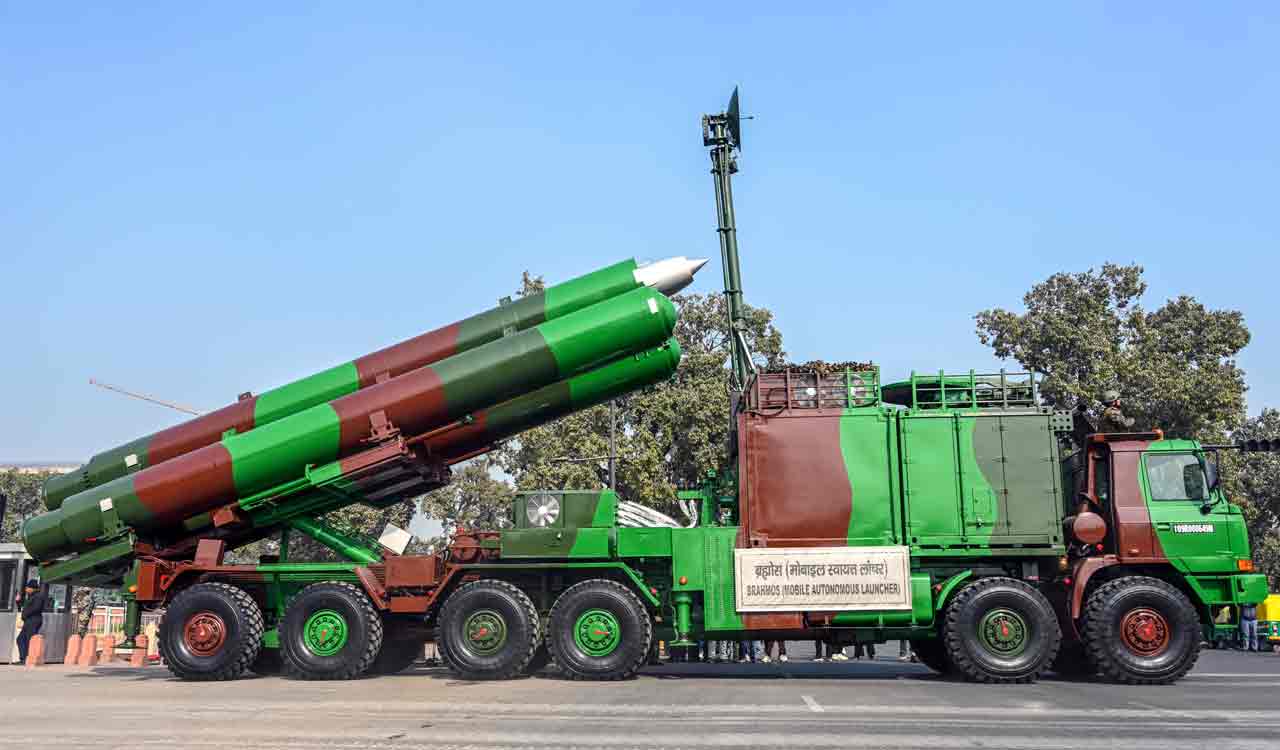


New Delhi: The accuracy and lethality of the BrahMos supersonic cruise missile played a crucial role in prompting Pakistan to swiftly call for a ceasefire during Operation Sindoor, as the weapon demonstrated its capability to successfully evade Chinese-origin air defence systems deployed by it, according to a new report.
The battlefield performance of the missile subsequently triggered keen interest among several countries seeking to strengthen their defence capabilities, according to a report published by The Week.
India had earlier signed a $375-million agreement with the Philippines in January 2022 to supply three BrahMos missile batteries. Following Operation Sindoor, negotiations with other prospective buyers also gathered pace.
Vietnam has concluded a deal estimated at $629 million, while Indonesia has also finalised an agreement believed to be worth between $200 million and $300 million.
The report mentioned that the BrahMos project traces its origins to 1997. At the time, A.P.J. Abdul Kalam, who was then heading the Defence Research and Development Organisation (DRDO) and serving as the head of the Integrated Guided Missile Development Programme (IGMDP), was overseeing a programme whose five flagship missile systems — Prithvi, Agni, Akash, Trishul and Nag — did not include a terrain-hugging cruise missile.
This gap eventually paved the way for the development of BrahMos, a supersonic cruise missile jointly developed by India and Russia, according to The Week report.
It said that in 1997, a team of 27 Indian representatives, comprising DRDO scientists, officials from government defence companies and representatives of the private sector, travelled to a military-industrial facility in Reutov, a small township located outside Moscow. The team studied an engine that powered a Russian cruise missile, with Russian authorities willing to share the technology with India.
The engine was used to power Russia’s Onyx supersonic cruise missile, while work was underway to further refine the missile system. The Indian delegation spent nearly three months in Russia assessing and evaluating the technology.
Impressed by what they witnessed, New Delhi subsequently signed an inter-governmental agreement with Russia in 1998 to establish what would eventually become BrahMos Aerospace, the report stated.
The report further noted that the BrahMos agreement was fast-tracked after receiving clearance at the highest political level. Within India’s defence establishment, the highly classified programme was referred to simply as the “JV”, representing the joint venture between the DRDO and Russia’s state-owned NPO Mashinostroyeniya. Within the DRDO, the project came to be known as PJ-10 as development work began.
Over the years, BrahMos evolved from a closely guarded Indo-Russian joint venture into one of India’s most prominent defence export products. Its combat debut came during Operation Sindoor in May 2025, when the missile was reportedly used in a significant role during India’s military response.
Operation Sindoor was a precise and decisive military operation conducted by the Indian armed forces against high-value terror targets in Pakistan-occupied Kashmir and Pakistan following the deadly Pahalgam terror attack.
According to the report, sources said that at least 15 BrahMos missiles were fired by Indian fighter aircraft during Operation Sindoor at Pakistani military installations, with the aircraft launching the strikes without crossing the international border.
“The accuracy and lethality of the missile strikes were crucial in prompting Pakistan to swiftly call for a ceasefire. BrahMos also demonstrated its ability to evade Chinese-origin air defence systems deployed by Pakistan. That was cue enough for many countries to take keen interest in the missile,” the report quoted sources as saying.
The successful deployment during the operation further enhanced the international profile of the missile and contributed to increased interest among countries looking to acquire advanced precision-strike capabilities.
Production of BrahMos has also expanded significantly, with manufacturing facilities now operational in Hyderabad, Nagpur, and Pilani.
A newly commissioned facility in Lucknow has also recently begun production, adding another major centre to the country’s growing BrahMos manufacturing network.
According to the report, all four production centres currently have the capability to manufacture at least four missiles every month, while efforts are underway to further expand their production capacity in response to increasing domestic and international demand.
The demand for BrahMos, however, is reportedly growing at an even faster pace. The Indian government envisages equipping every major Indian naval warship and fighter aircraft with BrahMos as part of their weapons systems.
At least a dozen countries across Europe, West Asia, Latin America, and Africa have also expressed interest in acquiring the missile, according to the report.
At the same time, work continues on developing newer and more advanced variants of BrahMos. These include a version with underwater capability as well as a miniaturised variant designed to expand the missile’s deployment options.
The long-term objective is reportedly to pair a fully indigenous version of BrahMos with India’s homegrown fighter aircraft, including the Tejas and the upcoming LCA Mk 2.
Such integration would further strengthen India’s efforts to build an increasingly self-reliant defence ecosystem while expanding the country’s position as an exporter of advanced military technology.

