Rewind: Did Telangana surrender its water rights? The truth behind the Krishna deal
Political allegations obscure the facts: The 299 (TG):512 (AP) TMC arrangement was temporary, while Telangana’s fight for its rightful share of Krishna waters continued


By Sridhar Rao Deshpande
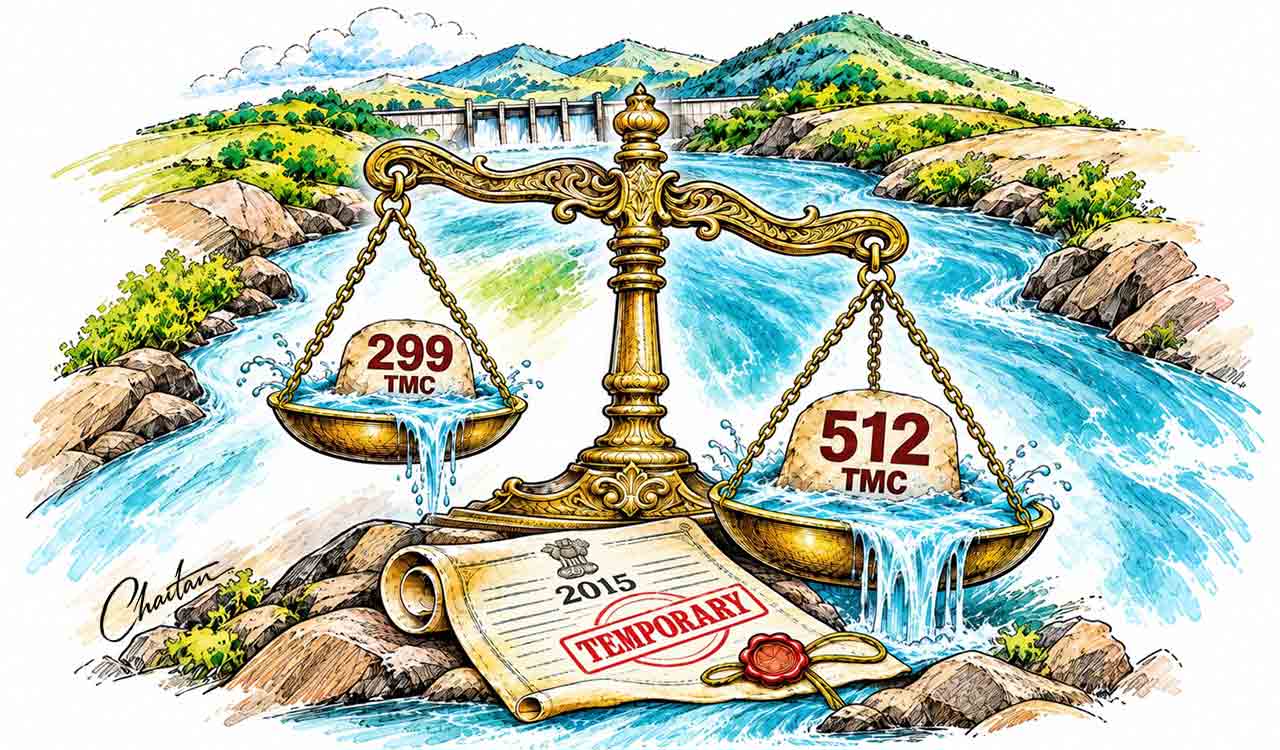
At a meeting in Siddipet on November 19, Chief Minister A Revanth Reddy alleged that K Chandrashekhar Rao had effectively signed a “death warrant” for Telangana by agreeing to an allocation of 299 TMC of Krishna River water to Telangana and 512 TMC to Andhra Pradesh.
Also Read
This is not a new accusation. It has been levelled hundreds of times, both before and after the Congress government came to power. The evidence cited to support this claim consists of minutes from an official-level meeting held in Delhi in June 2015 and from the First Apex Council meeting held in September 2016. Let us examine the facts behind this allegation.
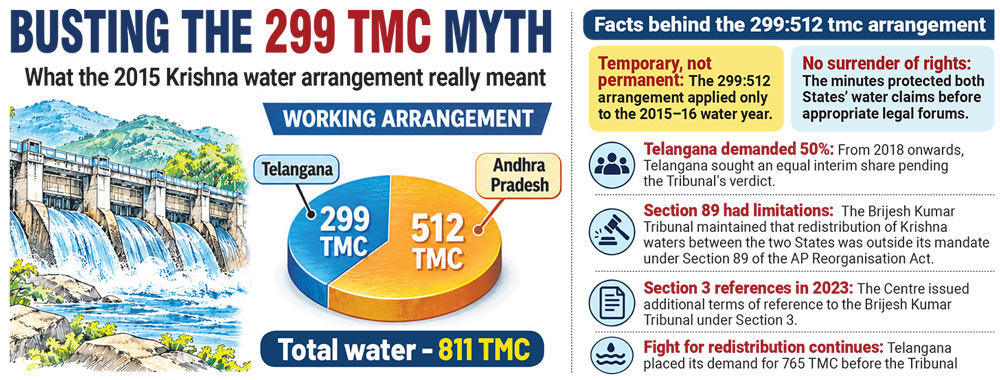
It is being falsely alleged that the KCR government caused permanent harm to Telangana’s interests in the distribution of Krishna waters through an agreement reached in June 2015. The claim suggests that Telangana’s share was capped at 299 TMC, while 512 TMC was handed over to Andhra Pradesh.
Reading it Right
However, a reading of the minutes of the inter-State meeting held on June 18-19, 2015, makes it clear that the arrangement was temporary. Those spreading the contrary narrative have either failed to read the minutes or are deliberately misrepresenting their contents for political gain.
The following are the lines recorded in the minutes:
• Para 5, first page: “It was agreed in the meeting that the figures of share of the two states as mentioned in the list of projects dated 18.10.2013 (appended herewith as Annexure) may be followed as the working arrangement for the current year only without prejudice to the rights of the two states about their entitlements which have been raised or to be raised before appropriate fora.”
• Para 6, same page: “The representatives of both the States agreed that they may utilise their share of water wherever they decide, subject to the availability of water at that place and without affecting the rights of the other State.”
• Para 7, same page: “Thereafter, project-related issues were discussed and following working arrangements for the water year 2015-2016 only were agreed as a temporary measure.”
The same points were repeated once again at the end
• Para 17, last page: “It was agreed that for the current year, the quantity of water available after the allocation of 811 TMC would be shared proportionately. Similarly, any deficit below 811 TMC would also be shared accordingly.”
• Para 18: “The entire set of arrangements agreed upon for the current year shall be without prejudice to the respective positions taken by both States before any forum.”
Anyone reading these provisions should be able to understand that the arrangement was temporary and did not constitute a permanent surrender of Telangana’s water rights to Andhra. The minutes clearly states that the arrangement for the distribution of Krishna River waters was for one year only. In the First Apex Council meeting held on September 21, 2016, the arrangement was extended for another year.
These minutes were drafted under the direct supervision of the late R Vidyasagar Rao, who served as Irrigation Adviser to the KCR-led government at the time. He was a man who ignited a fierce struggle over water issues during the Telangana statehood movement. In his speeches, he meticulously explained the injustices and discrimination faced by the Telangana region in the undivided State of Andhra Pradesh, especially in the distribution of Krishna waters.
He argued that, based on Krishna Basin parameters, Telangana should get 70 per cent of the 811 TMC allocated to undivided AP. Instead, the AP government allocated only 299 TMC to projects in the Telangana region and 512 TMC to projects in the Andhra region. He also raised awareness of the issue by compiling two volumes titled ‘Neellu–Nijalu’ (Water–Facts).
It is difficult to imagine that such a committed and principled activist would have agreed to any arrangement that compromised Telangana’s interest in the distribution of Krishna waters. Would KCR, a leader who had campaigned for the reallocation of Krishna waters since 2002, have agreed to an arrangement that resulted in an injustice to Telangana?
AP Reorganisation Act
Under Section 85 of the Andhra Pradesh Reorganisation Act, 2014, the Krishna River Management Board (KRMB) had already been established and entrusted with the task of overseeing the distribution of the river waters between the two States for the 2015–16 water year.
Furthermore, in accordance with Section 89 of the same Act, the Centre issued a Gazette Notification on May 15, 2014, extending the tenure of the Krishna Water Disputes Tribunal (KWDT-2), chaired by Justice Brijesh Kumar, by two years. The Tribunal commenced its proceedings immediately and issued notices on June 20, 2014, to the four Krishna Basin States, including Telangana, asking them to appear before it. This raised hopes among all stakeholders that the Tribunal might deliver its verdict within the extended two-year period.
In the undivided Mahabubnagar district, irrigation projects such as Kalwakurthy, Nettempadu, Bhima, and Koilsagar, which had been initiated under the ‘Jalayagnam’ programme, had not yet reached a stage where they could utilise Krishna waters. For various reasons, these projects remained incomplete till the formation of Telangana State. Work on the Palamuru-Rangareddy and Dindi lift irrigation schemes, which had been sanctioned in the undivided State, had not even commenced.
Following the formation of Telangana, the KCR-led government accorded high priority to completing these projects in Mahabubnagar, a district synonymous with drought, migration, and farmer suicides. The government undertook land acquisition, resolved forest-related issues, addressed challenges involving railway and road crossings, and secured the necessary funding. By the time of 2015 agreement, work on these projects was well underway, and by 2018, they had reached a stage at which they could supply water.
For the reasons outlined above, a two-day Inter-State meeting held in June 2015 resulted in a temporary ‘Working Arrangement’ for the distribution of Krishna waters for one year. Vidyasagar Rao, who led the Telangana delegation, took care to ensure that the State’s interests were not compromised in the minutes of the meeting. It was explicitly stated twice on the first page and twice on the last page that the arrangement was strictly for one year only and would have no bearing on the respective water rights of the two States before any tribunal, court, or other statutory body.
With the government’s special focus on these projects, Kalwakurthy, Nettempadu, Bhima and Koilsagar lift irrigation schemes were completed by 2018, and had reached a stage where they could be partially utilised. The KCR government completed the Tummilla lift irrigation scheme in just 11 months to stabilise 58,000 acres under the RDS canal. Consequently, the Telangana government consistently urged the Union Ministry of Jal Shakti and KRMB to set aside the one-year interim agreement and grant permission to utilise 50 per cent of the Krishna waters until a final Tribunal verdict is delivered.
The Fight For 50% Share
This demand for a 50 per cent share began with a letter dated February 15, 2018, and continued until 2023. At every annual KRMB meeting, Telangana’s representatives firmly pressed their case. This is evident from the meeting minutes and the numerous letters addressed to the ministry and the Board. However, the Board Chairman, exercising his discretionary powers, continued to maintain the existing water-sharing ratio of 34:66 between Telangana and Andhra Pradesh.
During the 14th KRMB meeting in 2021 and the 16th meeting in 2022, then Special Chief Secretary for Irrigation Rajat Kumar strongly argued, based on the Krishna Basin parameters, that Telangana was entitled to a 70 per cent share of Krishna waters. He insisted that the State be permitted to utilise 105 TMC for projects already in operation within the Krishna basin: 40 TMC for Srisailam Left Bank Canal (SLBC), 40 TMC for Kalwakurthy LIS and 25 TMC for Nettempadu LIS. He further informed the Board Chairman that, pending a final verdict from the Tribunal, Telangana would utilise 405.5 TMC out of the 811 TMC previously allocated to undivided AP.
At the 17th Board meeting in 2023, Telangana’s representatives not only firmly advocated a 50 per cent share but also opposed the Board Chairman’s move to determine the water-sharing ratio by exercising his discretionary powers. The minutes of that year were released without specifying a sharing ratio. Thus, throughout the tenure of the KCR-led government, the struggle for a 50 per cent interim share of the Krishna waters continued.
Dispute Tribunal Sought
At the same time, the KCR-led government consistently urged the Centre to constitute a Krishna Water Disputes Tribunal under Section 3 of the Inter-State River Water Disputes Act (ISRWD), 1956. Just 42 days after Telangana was formed, on July 14, 2014, a formal request was made to refer the matter of the reallocation of Krishna waters to a Tribunal under Section 3 of the Act.
Subsequently, KCR, as Chief Minister, wrote personal letters to Prime Minister Narendra Modi and the Minister for Water Resources. Harish Rao, then State Minister for Irrigation, wrote to the Union Minister. KCR strongly pressed the demand at the First Apex Council meeting in 2016. Then Union Minister for Water Resources Uma Bharati promised that steps would be taken to constitute a Tribunal. She made efforts in this regard, but these were thwarted by certain malevolent forces.
Even a year and a half after Telangana submitted its request, the Centre had taken no action. The State government then approached the Supreme Court seeking a direction to the Centre to constitute a Tribunal under Section 3 of the ISRWD Act to settle the complaint it had submitted in 2014. Despite the matter being sub judice, the State government continued its consultations and correspondence with the Centre.
While the Brijesh Kumar Tribunal was conducting an inquiry under Section 89 of the APRA, why was there a demand for a separate Tribunal under Section 3 of the ISRWD Act? There was a specific reason for this demand. Section 89 of the APRA does not provide for the redistribution of Krishna waters between the two States; it only provides for the allocation of water on a project-wise basis.
This was a drafting mistake in the Act. Had a provision been included in the APRA for the redistribution of Krishna waters under Section 3 of the ISRWD Act, 1956, Telangana would have secured its fair share by now. Telangana activists identified several such omissions and shortcomings in the APRA and sought amendments to address them.
However, Union government leaders presented them with an ultimatum: either accept the Bill in its existing form or push for amendments. With the final session of Parliament approaching, they were left with little choice but to agree to the passage of the Bill with its pro-Andhra clauses rather than insist on amendments that could have jeopardised its passage.
Redistributing Waters
KCR was well aware that an inquiry under Section 89 of APRA would not secure justice for Telangana. On two occasions, the Tribunal itself stated in writing that it lacked the mandate to redistribute Krishna waters between the two States under Section 89, clarifying that the issue fell outside the scope of its inquiry. This position was also reiterated several times during the Tribunal’s proceedings. Consequently, KCR consistently advocated for an inquiry under Section 3 of the ISRWD Act, believing it to be the only legal remedy through which Telangana could secure a fair share of Krishna waters.
At the second Apex Council meeting on October 6, 2020, KCR firmly pressed this demand, following which then Jal Shakti minister Gajendra Singh Shekhawat agreed to the constitution of a Tribunal under Section 3 of the ISRWD Act. However, he laid certain conditions.
First, the Telangana government would have to withdraw the case it had filed in the Supreme Court. Second, the Union Ministry of Law and Justice would be consulted on whether the references under Section 3 should be assigned to a new Tribunal or to the existing Brijesh Kumar Tribunal, which is already conducting an inquiry under Section 89 of APRA. Appropriate action would follow thereafter. All these points were duly recorded in the minutes of the second Apex Council meeting.
Following the Union Minister’s assurance, KCR directed irrigation officials to withdraw the case filed in the Supreme Court. In October 2021, the Supreme Court formally permitted the withdrawal of the case.
Additional Terms of Reference
Two years later, on October 6, 2023, just ahead of the Assembly elections, the Centre issued a Gazette Notification stipulating additional terms of reference (ToR) to the Brijesh Kumar Tribunal under Section 3 of the ISRWD Act. This marked a successful outcome of the decade-long struggle by the KCR-led government regarding the constitution of the Krishna Water Disputes Tribunal.
The AP government challenged these additional references in the Supreme Court, which did not grant a stay on them. The Tribunal also announced that it would prioritise proceedings under Section 3.
Hearings before the Tribunal under Section 3 have now reached their final stage. In its Statement of Case submitted to the Tribunal, the Telangana government has sought allocation of 765 TMC out of the 1,005 TMC originally allocated to undivided AP by KWDT-2, based on water availability at 75 per cent, 65 per cent, and 50 per cent dependability.
In view of the facts outlined above, people, intellectuals and thoughtful citizens must look beyond politics and acknowledge one fundamental truth: the Section 3 references are the direct result of the persistent efforts and struggle of the KCR-led government. This is undeniable.
The real challenge before the Telangana government and society is how to secure 765 TMC of water, the demand that was placed before the Tribunal.
Telangana’s interests must take precedence over politics. How long will the false narrative that the KCR government signed a “death warrant” for Telangana by agreeing to 299 TMC continue to be propagated? At least on this issue, political differences must be set aside, and we must unite with a single-minded focus on securing Telangana’s rightful share of Krishna waters.
(The author is Superintending Engineer [Retd], I&CAD Department)

Related News
-

Harish Rao questions Revanth Reddy govt over delay in acting against Palnadu Water Grid project
-
KT Rama Rao questions Revanth government over Andhra’s alleged 9 TMCft water diversion
-
Telangana faces drinking water crisis over delayed river board meetings
-
Rewind: Fighting the drought—the reality of Telangana’s agricultural crisis