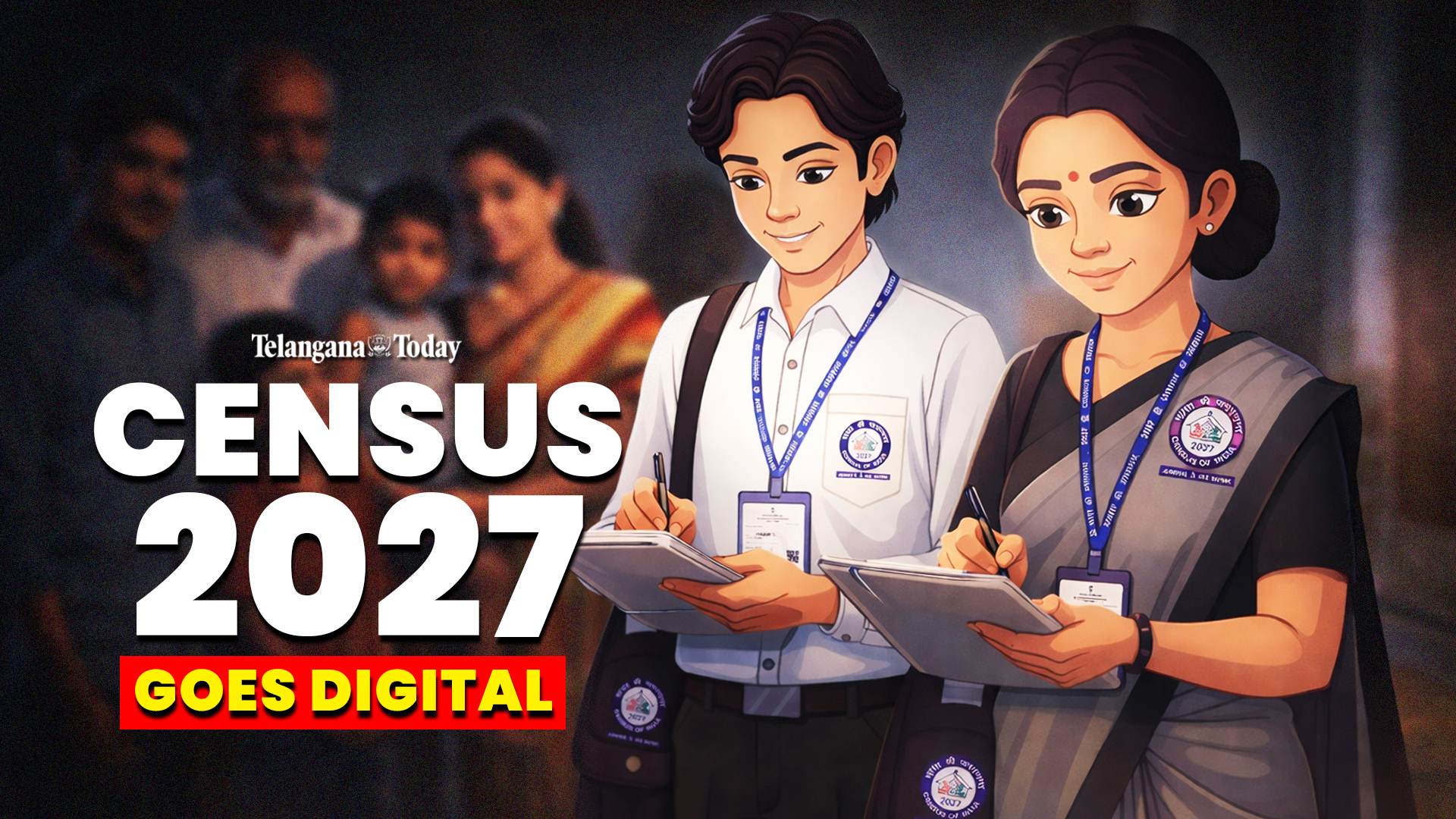
Census 2027 to be fully digital with new CMMS portal
Census 2027 will be India’s first fully digital population count, using the Census Management and Monitoring System. The new platform will enable real-time data collection, geo-tagging, and faster processing, replacing paper-based methods used in previous exercises


New Delhi: The Census 2027, which will recast the decennial headcount as a fully digital enterprise, will have at its heart the Census Management and Monitoring System, or CMMS, a dedicated digital portal designed to manage one of the largest administrative exercises in the world.
Marking a decisive break from paper-bound enumeration, the portal will replace clipboards and carbon copies with handheld devices, geo-tagged mapping tools, and a centralised web-based command platform in what will be India’s first fully digital Census.
The bespoke software backbone, designed to monitor the exercise in near real time, will allow 3.2 million field functionaries, enumerators and supervisors, to capture granular demographic, social, and economic data from hundreds of millions of households using handheld devices.
The data can be transmitted, aggregated, and validated through the CMMS architecture, significantly reducing the time required for compilation and error correction.
“The ensuing Census 2027 will make extensive use of digital technology to enhance the quality, efficiency, and timeliness of data collection and dissemination. In the forthcoming Census, data will be collected through digital mode, marking a significant and transformative step towards the modernisation of the Census process,” Registrar General of India Mrityunjay Kumar Narayan said in a circular addressed to Chief Secretaries of all states and Union Territories.
The circular, seen by PTI, said that the CMMS will facilitate end-to-end management of the Census operations, including creation of users at various levels, handling of training modules, creation of houselisting blocks (HLB) and their description and supervisory circles, allocation of supervisory circles and HLBs, generation of appointment letters and ID cards of enumerators and supervisors, among others.
It said the CMMS also enables role-based access control to facilitate appointments, training, and near-real-time monitoring of Census field operations.
The software will include a web-based mapping application that facilitates the geo-tagging of houselisting blocks, effectively linking spatial data with demographic enumeration.
The digital mapping tools will help officials delineate boundaries with greater precision, reducing overlaps and omissions, officials familiar with the developments said.
Geo-tagging is expected to enhance data integrity, creating a valuable digital spatial archive for planning, disaster management, and infrastructure development long after the Census tables are compiled.
The Union Cabinet has approved Rs 11,718 crore for conducting the Census 2027, which will include caste enumeration for the first time.
The 16th Census since Independence will be a fully digital exercise and will offer citizens the option of self-enumeration.
Originally scheduled for 2021, the decadal exercise was postponed due to the COVID-19 pandemic.
The Census will be conducted in two phases: house-listing and housing census from April to September 2026, and population enumeration (PE) in February 2027. The RGI has provided a list of 33 questions that will be asked of citizens during the first phase of the Census, houselisting and housing census, starting April 1.
The houselisting and housing census systematically list all structures, houses, and households throughout the country to provide a sound framework for the conduct of population enumeration.
To ensure equitable distribution of work among field enumerators during the houselisting operations, a village or ward of a town will be divided into ‘blocks’, which will be well-defined areas that can be clearly demarcated on the ground and for which a map will be drawn for Census operations.
“Such blocks created for HLO and population enumeration (PE) are called houselisting blocks (HLBs) and enumeration blocks (EBs), respectively. The HLBs and EBs would ultimately be the smallest administrative units for conducting the Census and would form the basis for processing of data after the field operations are over,” another circular issued by RGI Mrityunjay Kumar Narayan recently said.
An HLB is to be created in accordance with the criteria for a population of 700 to 800 in residential areas. In sparsely populated non-residential areas, one HLB may be formed by taking 300 or more Census houses, it said.
“For the first time, the creation and demarcation of HLBs, formation of SC and allocation of enumerators and supervisors for the HLBs and SCs will be carried out through the Census Monitoring and Management System (CMMS) portal and HLB Census of India 2027 Circular No. 10 Page 5 of 12 Creator (HLBC) Web Mapping Application, respectively,” it said.

Related News