Cyberabad police to test counterflow bus lane in IT corridor
The Cyberabad Traffic Police are planning a trial of a counterflow Bus Rapid Transit (BRT) system for TGSRTC buses on the congested JNTU-Hitec City-Raidurgam-Financial District corridor. The proposal, based on a traffic study conducted by FRIP and SCSC, aims to improve bus movement and capacity without major infrastructure changes.
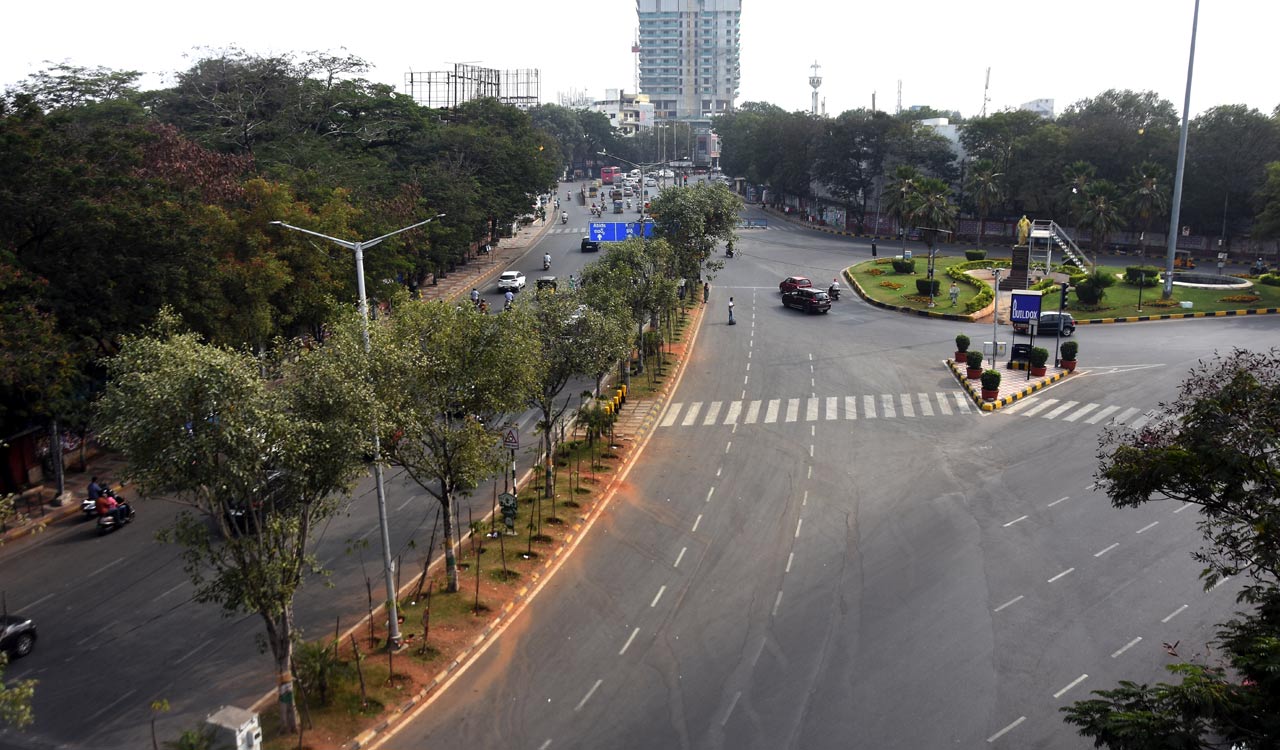


Hyderabad: To give buses a more continuous movement path through stretches that usually experience heavy peak hour traffic, the Cyberabad Traffic Police are preparing to test a counterflow Bus Rapid Transit (BRT) arrangement for TGSRTC buses on the busy JNTU–Hitec City–Raidurgam–Financial District corridor.
A counterflow bus lane is a dedicated road space in which buses are allowed to travel in the direction opposite to the normal flow of general traffic. Under the proposed arrangement, the lane would be restricted to buses and operated under traffic controls designed to prevent conflict with other vehicles.
The proposal emerged from a traffic assessment conducted by the Foundation for Resources and Innovations Policy (FRIP) in coordination with the Society for Cyberabad Security Council (SCSC).
According to traffic officials, the proposed corridor covers JNTU Junction, Hitec City, Raidurgam Metro Station, Waverock and the Financial District, besides connected stretches. Officials want to examine how buses enter the dedicated section, travel through it and rejoin the regular carriageway.
“The Raidurgam Metro Station junction is expected to be a crucial point in the trial. Buses using the proposed counterflow section would eventually have to merge with regular traffic,” said a senior traffic official.
Officials have asked for a detailed assessment of traffic movement from all departments concerned, merging conditions and possible conflicts at this location.
According to TGSRTC officials, around 15 buses are currently operating along the corridor every hour. Authorities are also examining whether additional services can be introduced and whether existing and new bus services can use the proposed lane.
Further, traffic officials have identified several factors contributing to congestion, including roadside parking, encroachments, poor lane discipline, unauthorised vehicle stoppages, pedestrian crossings and conflicts at junctions. Inadequate bus bays, shelters, footpaths and pedestrian facilities were also identified as contributing factors.
Meanwhile, officials are seeking a solution that can improve bus capacity without major changes to existing road infrastructure. Traffic conditions under the existing system, along with counterflow and curb-side BRT models, have been assessed. Authorities are also looking at improvements to bus stops, footpaths and shelters.
Recently, the RTC has discussed operational requirements such as bus entry and exit points, stopping locations, turning movements and passenger boarding arrangements.
Officials said the outcome of the physical trial and subsequent traffic assessment will determine whether the counterflow BRT model can be introduced on the busy IT corridor in the coming days.

Related News