Find out how radio astronomers contribute in mapping the universe
Radio astronomers can study emissions from gas giant planets, blasts from the hearts of galaxies, or even precisely ticking signals from a dying star. In simple words, radio astronomers see what the naked eye can’t
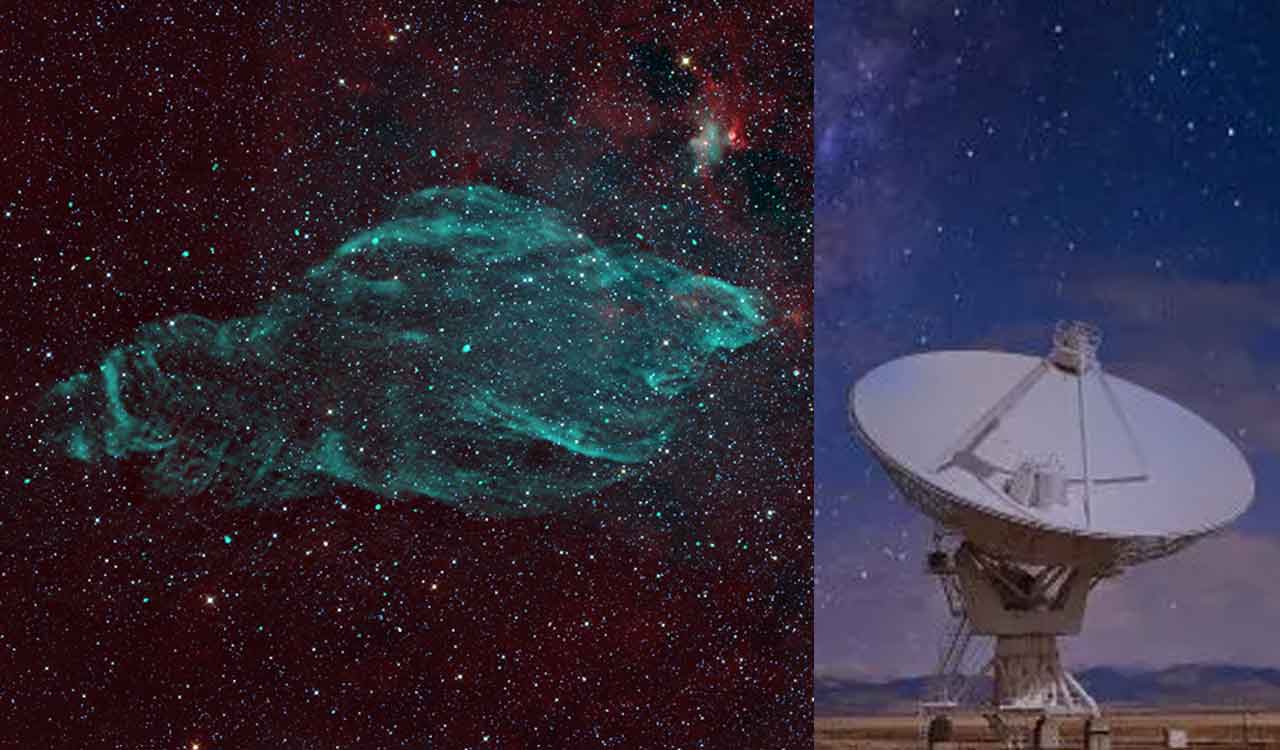


Hyderabad: A telescope such as Hubble or James Webb shows us — what is seen with eyes. And most of us are familiar with optical light astronomy and what it reveals about these objects. Visible light — also known as optical light — is what we see with our eyes, however, visible light doesn’t tell the whole story. Our universe is mysterious in hundreds and thousands of ways.
There’s a hidden universe out there, radiating at wavelengths and frequencies we can’t see with our eyes. Each object in the cosmos gives off unique patterns of radio emissions that allow astronomers to get the whole picture of a distant object.
Radio astronomers study emissions from gas giant planets, blasts from the hearts of galaxies, or even precisely ticking signals from a dying star. In simple words, radio astronomers see what the naked eye can’t.
They study the sky with telescopes that record naturally-occurring radio signals rather than light that come from stars, planets, galaxies, clouds of dust, and molecules of gas.
With the newest generation of radio telescopes such as the Australian Square Kilometre Array Pathfinder (ASKAP) and MeerKAT, a telescope in South Africa, these radio astronomers are revealing incredibly faint cosmic objects, never before seen.
Today, radio astronomy is a major branch of astronomy and reveals otherwise-hidden characteristics of everything in the universe.
What are radio waves in universe?
Beside visible light, objects in the universe radiate many other types of light, across what’s called the “electromagnetic spectrum”. Light travels through space in waves, like ripples in a pond. Each ripple has a peak and a trough, which is called a cycle.
An object emitting radio waves gives off many cycles in a very short period of time. During each cycle, the wave moves a short distance, which is called its wavelength.
For radio waves of all kinds, the number of cycles per second is called a frequency. One cycle per second is called one hertz. A thousand cycles per second is a kilohertz; a gigahertz is a billion cycles per second.
Radio astronomers are most interested in objects that emit in the frequency range between 3 kilohertz and about 900 gigahertz. It’s easier to think of these in terms of wavelengths, however, which range from a very large 100-km radio wave to those less than a millimeter in length.
How do radio telescopes work?
The radio portion of the electromagnetic spectrum can come from energetic objects and processes in the universe as well as cold, dark objects that emit no visible light.
Radio telescopes receive radio waves from space using antennas which traditionally look like a big version of a domestic satellite dish. Signals that are collected are sent through a processing chain (hardware and software designed to amplify and digitise the signals) which enables the astronomical data ultimately to be turned into an image of the sky. The resulting images let scientists and the public see the otherwise invisible radio objects.
Unlike optical telescopes, which can be hampered by cloud or poor weather conditions on Earth, radio telescopes can be used even in cloudy skies, as the longer wavelengths can pass through clouds unhindered.
One of the key capabilities of radio telescopes is that they can detect invisible hydrogen gas, the most abundant element in the universe, which emits in the radio band at 1420 MHz. They can also reveal areas of space that may be obscured by cosmic dust, as radio waves are can travel through these dust clouds.
To obtain the same level of detail and resolution in their images as their optical cousins, radio telescopes have to be much larger. In fact, to match the resolution you would need a radio telescope kilometres across, which is not possible or practical for a single dish. To get around this limitation in size, radio astronomers use a technique known as interferometry, which is linking lots of antennas together so two telescopes can each act as one enormous telescope.
Now, the radio astronomers are mapping the entire sky — EMU (Evolutionary Map of the Universe) — a spectacular new radio atlas that will be used for decades to come to unravel the many mysteries of the universe.

Related News