From Mushaira to Medicine: Redefining Urdu
Dr. Abid Moiz, physician and scholar, argues that Urdu must move beyond poetry to embrace science and modern knowledge. His latest books — Shayari Zariya-e-Izzat Nahin and Istilahaat: Bujhiye aur Banaiye — highlight Urdu’s potential to develop scientific terminology and reclaim its heritage as a language of scholarship.
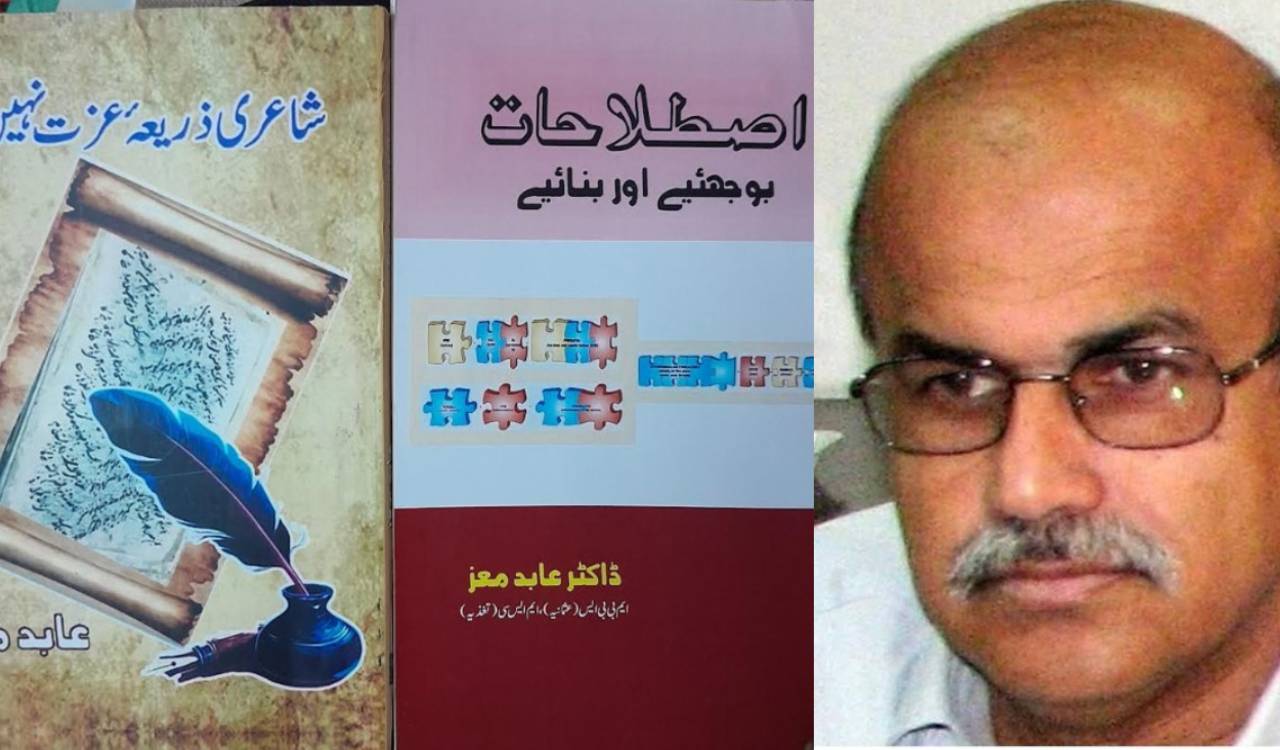


Hyderabad: Is Urdu merely the language of poetry, ghazals and mushairas? For many, Urdu is inseparable from Ghalib, Iqbal, Faiz and lyrical verses that draw applause in literary gatherings. The popular saying, “Jahan Urdu, wahan shayari,” reinforces this perception.
But can Urdu also become a language of science, medicine and modern knowledge? Physician, nutritionist and scholar Dr. Abid Moiz believes it can. Through his extensive writings, he has consistently demonstrated that Urdu is capable of expressing not only emotions but also ideas, discoveries and scientific concepts.
Author of more than forty books on health, medicine, science, humour and language, Dr. Moiz represents a rare combination of the adeeb and the tabeeb — the man of letters and the man of medicine. Alongside a distinguished medical career, he has devoted himself to enriching Urdu prose.
His two latest books, Shayari Zaria-e-Izzat Nahin and Istelahaat: Bojhiye aur Banaiye, bring his total publications close to fifty. Together, these works argue that Urdu should not remain confined to poetry alone.
The title Shayari Zaria-e-Izzat Nahin is borrowed from Mirza Ghalib’s famous couplet:
Sau pusht se hai pesha-e-aaba sipahgari
Kuch shayari zaria-e-izzat nahin mujhe
(For generations my forefathers pursued soldiering;
Poetry is not my means of earning honour.)
Dr. Moiz uses this verse to challenge the belief that recognition in Urdu comes only through poetry. He argues that scholarship, science, medicine and research deserve equal respect.
The book contains essays written during his stay in Saudi Arabia, where he organized literary gatherings and mushairas. Though he enjoyed poetry, he also observed the excesses and vanities of literary culture. Through humorous essays such as Wazan Sambhal Ke, Daad Talab and Arz Kiya Hai, he gently satirizes the eccentricities of poets and literary circles.
His second book, Istelahaat: Bojhiye aur Banaiye, addresses the development of scientific and technical terminology in Urdu. Dr. Moiz argues that languages survive only when they adapt to new knowledge and changing times. While English has developed a vast scientific vocabulary, Urdu has struggled because of the decline of Urdu-medium education and limited professional opportunities.
At the same time, he advocates flexibility, noting that widely accepted words such as computer, internet and television need not always be replaced. Yet Urdu already possesses many scientific terms, including buland fishar-e-khoon for hypertension and falaki harkiyat for celestial mechanics.
The book also highlights Urdu’s scientific heritage. Medical and scientific works such as Ilm-e-Amraz-e-Niswan (gynecology), Amraz-e-Chashm (ophthalmology), Tashreeh-e-Badan (Anatomy) and Faliyat-e-Hayati Kimiya (Biochemistry) demonstrate that Urdu once served as an important language of knowledge. The translation bureau of Osmania University further enriched Urdu by translating major Western works.
By explaining medical roots, prefixes, suffixes and technical abbreviations, Dr. Moiz makes scientific terminology accessible to students and readers alike.
Through these two books, Dr. Abid Moiz presents a compelling vision of Urdu as a language not only of poetry but also of science, scholarship and modern knowledge. His mission is clear: to take Urdu beyond verse and prepare it for the future.

Related News