Honest Money: The idea that was right — and ignored
A neutral international trade settlement system, where no single nation's domestic politics determines the monetary conditions of every other nation, has never been built—because the nation that benefits the most from the current arrangement has never faced sufficient pressure to accept an alternative


By Chandu Kumar Potti
Some lessons the world keeps refusing to learn.
Also Read
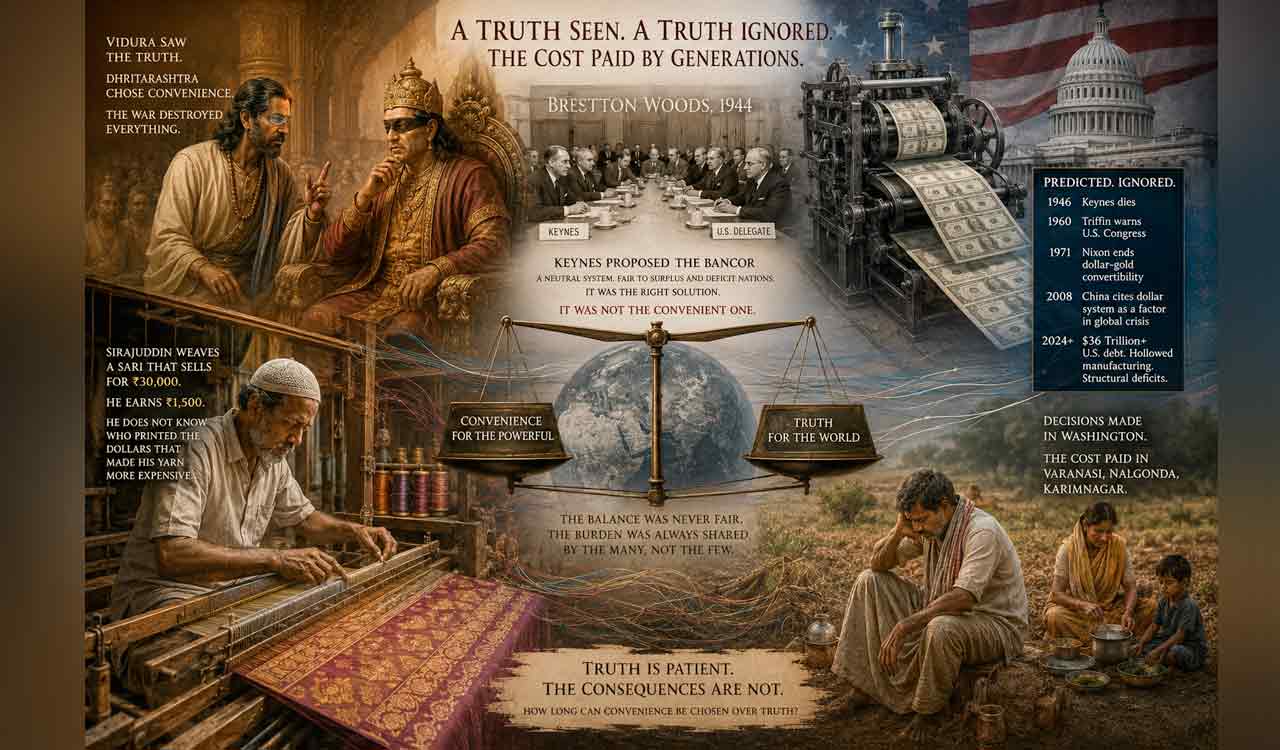
In the Mahabharata, there is a man who sees everything clearly.
Vidura — half-brother to the blind king Dhritarashtra, chief minister of Hastinapura — is perhaps the wisest figure in the entire epic. Not the most powerful. Not the most celebrated. The wisest.
He sees the Kurukshetra war coming long before it arrives. He sees what it will cost — the lives, the kingdoms, the generations lost. He says so plainly, to anyone who will listen.
He tells Dhritarashtra: this path leads to destruction. Turn back.
Dhritarashtra listens. Nods. Chooses his son’s ambition over Vidura’s counsel.
The war happens. Everything Vidura said would happen — happened.
He was not wrong. He was not unheard. He was heard — and ignored.
That is a specific kind of tragedy. Not the tragedy of ignorance. The tragedy of a truth that was available — and rejected — because the powerful found it inconvenient.
The Loom in Varanasi
Sirajuddin has been weaving Banarasi silk for thirty years.
His hands know things that cannot be taught in any school. The tension of the thread. The weight of the zari. The difference between a pattern that will last a generation and one that will not.
A single sari — his current work — will sell for Rs 30,000 in the market.
He will receive Rs 1,500. Perhaps Rs 2,000 on a good day.
The rest goes to the yarn supplier, the middleman, the trader, the retailer.
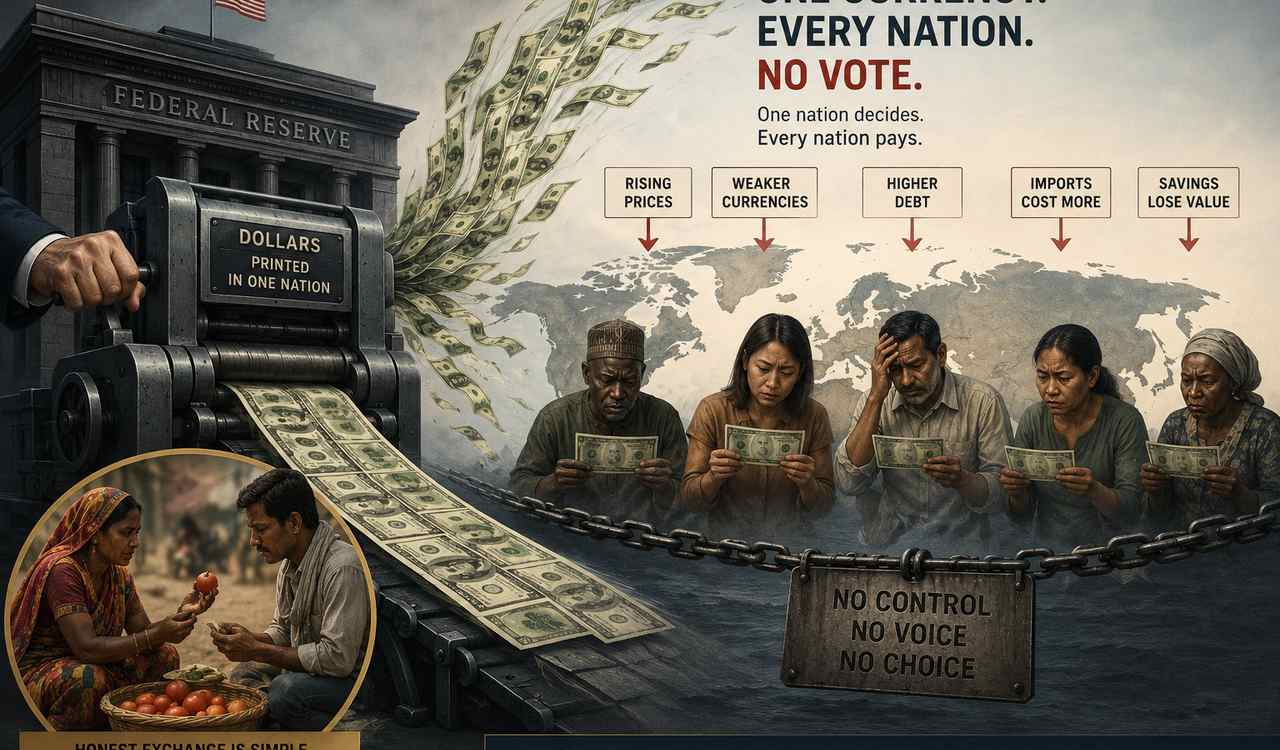
But here is what Sirajuddin does not know — and has no reason to know: The yarn he buys comes from China. It is priced in US dollars. When America’s central bank prints more dollars, each dollar buys fewer rupees. The yarn costs more in rupees. His input costs rise. His margin shrinks further.
He does not know who made that decision. He does not know when it was made. He only knows that the same bale of yarn costs more this year.
He adjusts. Works longer. Earns less.
A printing press running in Washington. A loom falling silent in Varanasi.
The connection between these two things — that is what this series has been about from the beginning.
And it is what one man tried to fix, eighty years ago, in a hotel in New Hampshire.
A Room in New Hampshire
The Second World War was nearly over.
Forty-four nations sent representatives to the Mount Washington Hotel in Bretton Woods, New Hampshire. Their task — design the monetary system for the post-war world.
John Maynard Keynes — the most celebrated economist alive — came with a proposal he had spent years developing.
He called it the Bancor.
What Keynes Actually Proposed
The Bancor was not complicated in its essential logic.
Create a neutral international currency — owned by no single nation. Use it only for trade settlement between countries. Not for citizens to hold. Just for nations to settle accounts with each other.
The elegant part: both surplus nations AND deficit nations would face pressure to adjust.
If a country ran persistent surpluses — exported more than it imported — it would be penalised. Required to spend, invest, or return the excess.
If a country ran persistent deficits — it would face adjustment pressure too.
Both sides. Equally. Automatically.
No single nation could run its printing press indefinitely while every other nation absorbed the consequences. The mathematics itself would enforce balance.
Sirajuddin’s yarn costs — in such a system — would not be at the mercy of decisions made in Washington.
Why Power Won
America in 1944 held the majority of the world’s gold. Its factories were intact. It was the world’s largest surplus nation.
Under Bancor — America’s surpluses would have been penalised the same way deficit nations were. America would have had to share the burden of global monetary adjustment.
That was against American interest. America’s negotiator opposed it. Britain — exhausted and indebted from the war — negotiated from weakness. The Bancor was removed from the agenda before the formal conference even began.
The dollar became the world’s reserve currency instead.
Chanakya’s Arthashastra captures this pattern: statecraft and truth do not always walk the same road. When they diverge, power chooses what is convenient. Truth waits.
In 1944, power won. Truth waited.
What Was Predicted — And What Happened
Keynes died in 1946. Two years after Bretton Woods.
In 1960 — sixteen years later — economist Robert Triffin testified before the United States Congress.
He said: the dollar system contains the seeds of its own instability. To supply the world with dollars, America must run persistent trade deficits. Persistent deficits eventually erode confidence. There is no way out of this contradiction — only ways to defer it.
He was ignored.
In 1971 — Nixon cancelled dollar-gold convertibility entirely.
In 2008 — the governor of China’s central bank cited the dollar’s reserve currency status as a contributing factor to the global financial crisis.
Today — US national debt stands at approximately $36 trillion. America’s manufacturing base has hollowed out. The trade deficit is structural and permanent.
The contradiction Triffin identified has not been resolved. It has only been deferred — at growing cost. A cost paid not in Washington — but at looms in Varanasi, at farms in Nalgonda, in kitchens in Karimnagar.
The Pattern
This is not a story about one genius defeated by one villain.
It is a story about a pattern.
The same structural problem — one nation’s printing press, every other nation’s burden — has been seen clearly by different people across eight decades. Solutions have been proposed. Each time, the convenient answer was chosen over the correct one.
Chanakya’s Arthashastra also reminds us: truth is patient. The consequences of ignoring it accumulate quietly — until they cannot be ignored.
Vidura was proved right at Kurukshetra.
Keynes was proved right by Nixon’s press conference in 1971.
The Nalgonda farmer, the Varanasi weaver, the housewife in Karimnagar — none of them had a seat at Bretton Woods in 1944.
All of them are paying for what was decided there.
The Question Worth Asking
A neutral international settlement system — where no single nation’s domestic politics determines the monetary conditions of every other nation — has never been built.
Not because it is impossible.
Because the nation that benefits most from the current arrangement has never faced sufficient pressure to accept an alternative.
Vidura’s question to Dhritarashtra was simple:
How long can you choose convenience over truth — before truth chooses for you?
(The author is Founder & Chairman, Versatile Auto Components Pvt Ltd, Versatile Electric Automotive Private Limited, Former Chairman, Pashamylaram Industrial Park and Founding Secretary, Society for Sangareddy Security Council)

Related News
-

Honest Money: The patient dragon—what twenty years of quiet preparation looks like, and what it means for India
-
Honest Money: What Is India actually worth—the gap between what is declared and what is real
-
Honest Money: When money loses its anchor, economies pay the hidden price
-
From Cowrie to Crypto: 5,000 years of money—one trick that destroyed every system