Hyderabad’s Grade E lakes emerge as breeding grounds for vector-borne diseases
Several Grade E lakes in Hyderabad have become major breeding grounds for disease-carrying mosquitoes due to severe pollution, low oxygen levels and water hyacinth growth, raising concerns over dengue, chikungunya and malaria risks, according to experts and the Telangana Lake Health Survey.
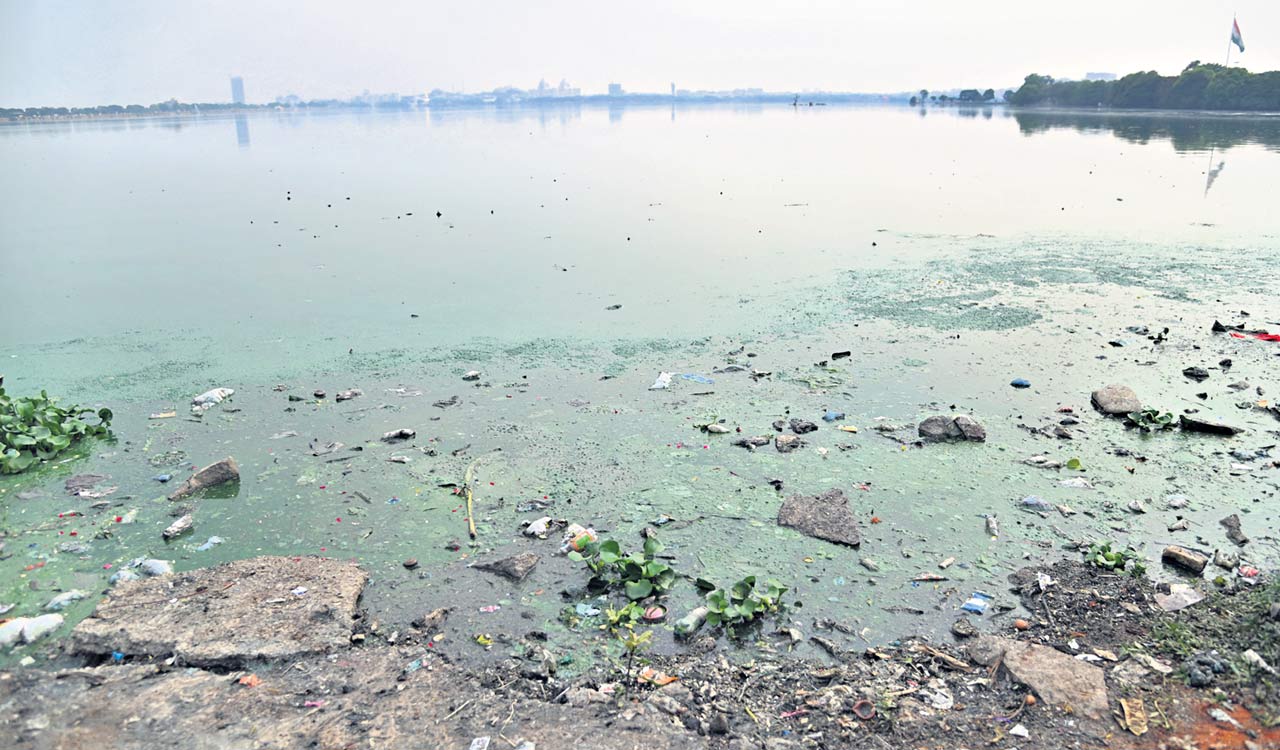


Hyderabad: A majority of the well-known lakes in Hyderabad have, over the last few years, quietly transformed into massive, permanent incubators for vector-borne diseases, presenting a severe public health hazard that authorities are allegedly downplaying.
While the focus of municipal authorities is usually on lakefront beautification, senior doctors from the Integrated Disease Surveillance Programme (IDSP) in Hyderabad point out that the heavily polluted and hyacinth-infested water bodies in the city are now functioning as high-density breeding grounds for mosquitoes carrying dengue, chikungunya and malaria.
The present-day vector crisis is directly driven by environmental degradation documented in the 2026 Telangana Lake Health Survey by the Telangana Pollution Control Board (TGPCB).
Almost all the key urban water bodies, including Sunnam Cheruvu, Asanikunta, Uppal Cheruvu and several recently “restored” lakes, have degraded to Grade E, the worst possible environmental classification, the survey said.
Due to unchecked sewage and industrial inflows, the Dissolved Oxygen (DO) levels in these lakes have fallen and range between 0.3 mg/l and 1.1 mg/l against a safe public baseline of 5 mg/l. As a result, these water bodies are biologically dead and have therefore been classified as Grade E lakes.
The stagnant, oxygen-starved lake waters do not support normal aquatic life such as fish, but are highly hospitable to disease-carrying mosquitoes.
A majority of these lakes have witnessed massive overgrowth of thick green water hyacinth (Gurrappa Dekka), covering almost the entire water body and making it almost devoid of oxygen.
However, the hyacinth provides an ideal cover for mosquito larvae from natural predators and chemical sprays by the GHMC‘s entomology wing, allowing vector populations to multiply unchecked.
Senior entomologists and zoologists involved in training field-level staff of the GHMC entomology division point out that municipal authorities must not view lake degradation as merely a cosmetic issue but should consider it a public health issue.
“If you visit Uppal Nalla Cheruvu in the evening, it is easy to spot swarms of mosquitoes. Almost all lakes in Hyderabad with hyacinth have this issue. Thousands of residents live in dense semi-urban clusters very close to Grade E lakes. They are completely unaware of the heightened disease risks surrounding their homes,” a senior doctor from IDSP, Hyderabad, said.
Some Grade E lakes in Hyderabad:
Sunnam Cheruvu (Allwyn Colony/Kukatpally): Experiencing heavy industrial runoff and domestic sewage.
Asanikunta (Sainikpuri/Kapra area): Degraded due to continuous contamination of inlet channels from surrounding residential clusters, leaving it highly anoxic.
Kamuni Cheruvu (Moosapet): Heavily choked with massive, dense mats of water hyacinth.
Fox Sagar/Kolla Cheruvu (Kompally/Jeedimetla): Plagued by industrial effluents from adjacent manufacturing zones and local domestic discharge.
Rangadhamuni Cheruvu/IDPL Lake (Kukatpally): Located near the industrial belt, showing extreme pollution levels, heavy algal blooms and collapsed aquatic oxygen baselines.
Hussain Sagar: Despite persistent extraction and partial treatment measures, the core inflows continue to register Grade E levels due to massive storm-water drain mix-ups.
Saroornagar Lake (LB Nagar belt): Suffers from extreme nutrient overloading, turning it into a persistent vector breeding pocket in east Hyderabad.

Related News
-

Grand ‘Saddula Bathukamma’ celebrations light up Tank Bund at Hussain Sagar
-
VC Sajjanar felicitates three men who rescued girl from Hussain Sagar
-
Hyderabad: Ganesh immersion waste removal begins around Hussain Sagar
-
Hyderabad’s Ganesh immersion concludes on Saturday afternoon; 1.2 lakh idols immersed