Hyderabad’s last Kalaiwalas keep centuries-old copper tinning tradition alive
Hyderabad's traditional Kalai craftsmen are witnessing renewed demand as restaurants and households return to copper cookware. Though only a few workshops remain, the centuries-old tin-coating craft continues to protect health, preserve cooking quality and keep an important part of the city's heritage alive.
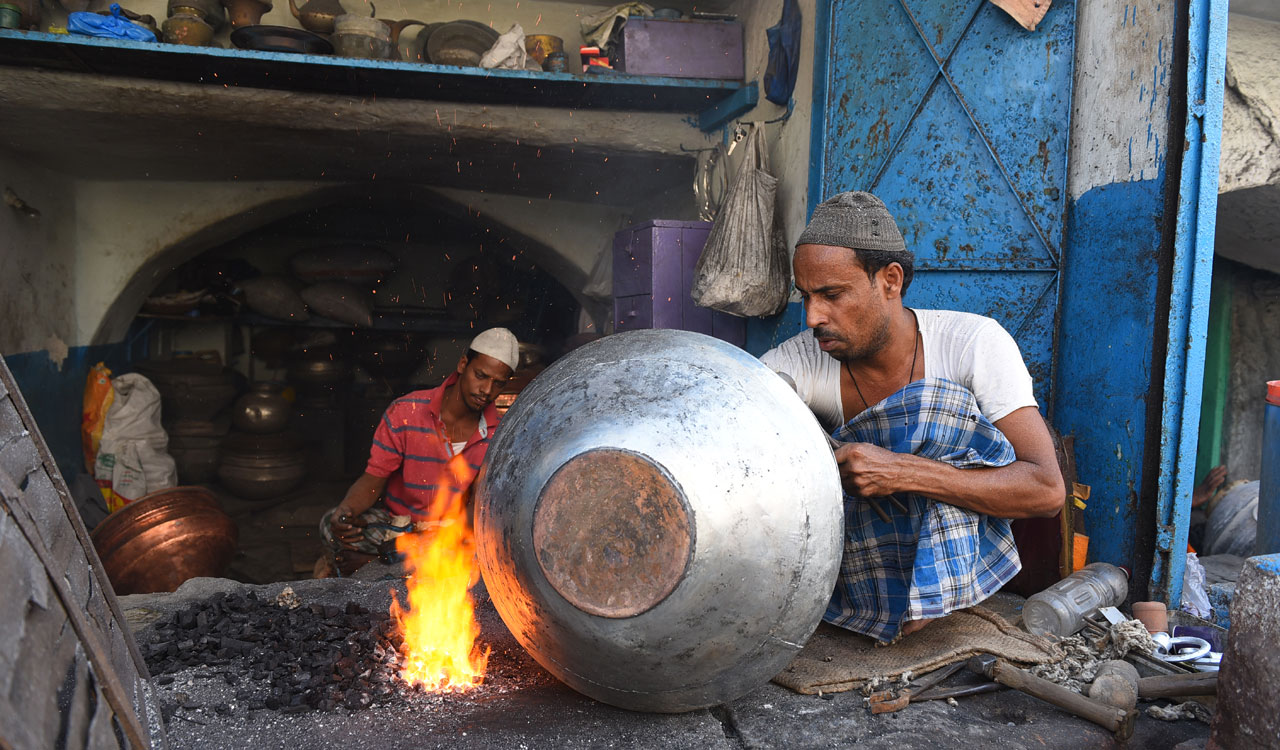


HYDERABAD: In the bustling lanes of Mahbub Chowk and Afzalgunj in Hyderabad’s Old City, the glow of freshly tinned copper vessels still reflects a tradition that has survived for generations.
Though the number of Kalaiwalas has declined sharply with the arrival of stainless steel and aluminium cookware, a handful of craftsmen continue to practice the centuries-old art of Kalai, preserving a craft that is once again finding relevance in modern kitchens.
The revival has been driven by growing awareness of the health benefits of cooking in copper and brass utensils and frequent food safety inspections. Many restaurants preparing biryani and haleem have returned to traditional cookware, which must be coated with a thin layer of pure tin before use to prevent the metal from reacting with food.
Among those keeping the tradition alive is Mohammad Saleem, a second-generation Kalaiwala from Afzalgunj.
“I have been helping my father for the past 30 years. We were hardly making any profits a few years ago, but now business has improved because many restaurants are using copper utensils to prepare haleem and biryani,” says Saleem. According to him, a properly tinned utensil remains effective for six to eight months before it needs re-coating.
Kalai is more than polishing metal. Copper and brass react with acidic foods such as tomatoes and tamarind, which can discolour food, alter its taste and even cause food poisoning. The thin coating of pure tin forms a safe, non-reactive barrier while retaining the heat conductivity of the utensils.
The process itself has changed little over the years. The utensil is heated over a coal fire until it turns pinkish. Ammonium chloride, locally known as Naushadar, is sprinkled on the surface to clean it, producing dense white smoke. A piece of pure tin is then rubbed onto the hot metal and spread evenly with a thick cotton cloth, leaving behind a bright silvery coating before the vessel is cooled in water.
For Mohd Shakeel, another second-generation craftsman, Kalai is a family legacy. “This craft is our identity. We learnt it from our elders, and it protects people’s health,” he says.
Shaik Babu, who also inherited the trade from his father, says Kalai prevents food poisoning and stops copper vessels from turning black. “Tin is also a good conductor of heat, so the cooking quality of the utensil remains unchanged,” he explains.
Only eight to ten Kalai workshops now operate around Mahbub Chowk. “The demand is nowhere near what it once was, but more people are returning to traditional cookware,” says Mahmood Miya, who runs one of the remaining workshops. “That gives us hope that this old craft will continue to survive.”

Related News