IIT, BIT fan changes draw focus to student mental health and suicide prevention
Recent student suicides at IIT Bombay and BIT Mesra have renewed debate over campus mental health and suicide prevention. While institutions are replacing ceiling fans, experts say sustained counselling, stronger support systems, action against bullying and broader educational reforms are needed


New Delhi: Back-to-back suicides at two elite engineering colleges have led to grief and searching questions about student pressures, as IIT Bombay and BIT Mesra move towards installing ceiling fans in hostel rooms as a possible preventive measure.
This follows the Kota playbook of three years ago, when 25 students preparing for competitive exams ended their lives, prompting the administration in the coaching hub to mandate hostels across the city to install “anti-suicide spring-loaded ceiling fans” and fit “anti-suicide nets” in balconies and lobbies.
Then, as now, the concern was that managements and administrations could be missing the wood for the trees, opting for cosmetic measures rather than delving into the root causes. Installing ceiling fans could only do so much to prevent students from harming themselves, experts said, stressing the need for sustained counselling and an overhaul of the competitive nature of the Indian education system.
A nationwide survey conducted by a Supreme Court-appointed panel underscores the magnitude of the problem. According to the findings, accessed by PTI, about 15 per cent of students in higher education institutions had experienced a period in the previous six months when they felt overwhelmed or distressed, while nine per cent reported experiencing suicidal thoughts.
The survey findings are expected to be part of the final report of the National Task Force (NTF), which is expected to be submitted by October 31.
The environment of institutions such as the Indian Institutes of Technology does not allow for emotional expression, said clinical psychologist Shweta Sharma.
Some 60 to 70 per cent of her patients are from the IITs and Indian Institutes of Management. They are very good with their high IQ and high performance, but “they are also the ones struggling the most with relationship and social things”. “There is a special need to focus on mental wellness. Having this fan or that fan is not the issue, you are actually working on the physical aspect of the problem; mental health support is still missing in higher educational institutions,” Sharma told PTI.
The student-to-counsellor ratio is never adequate, Sharma said.
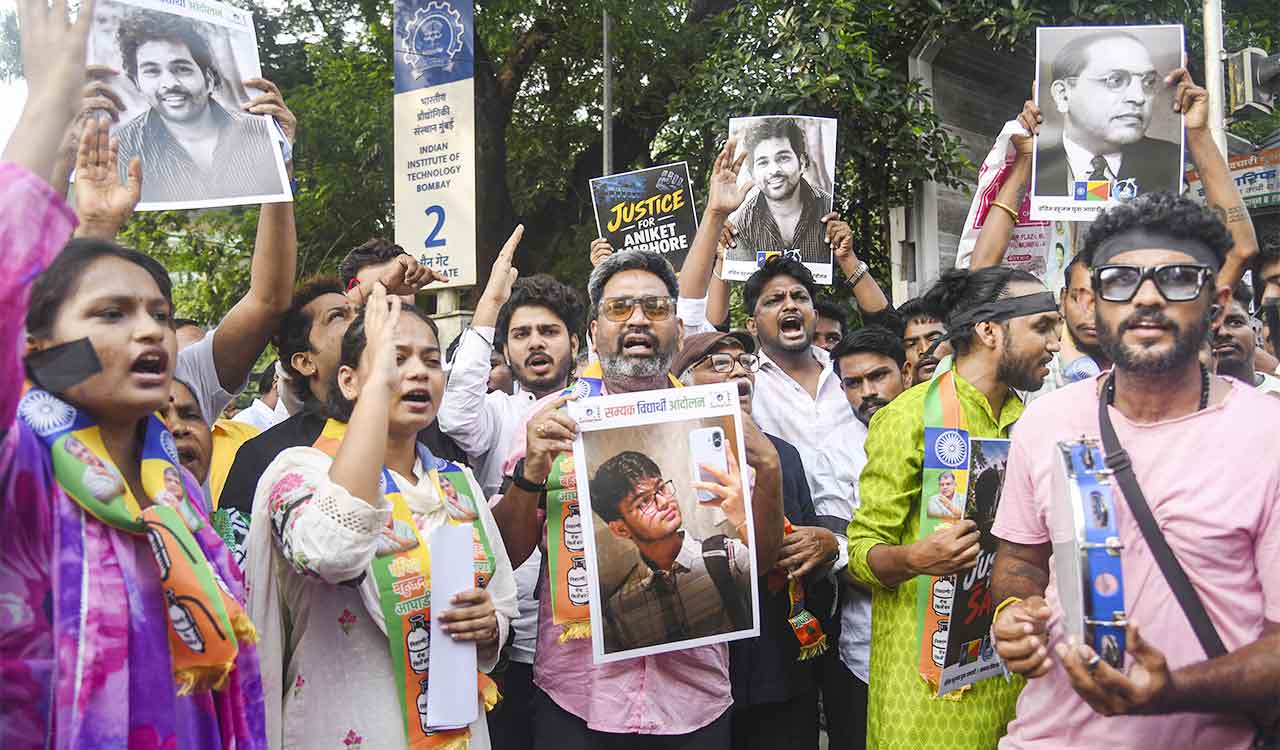
Discussion on what leads a young man or woman — caught in a competitive trap of first studying for years to enter an IIT and then struggling to cope once inside — took on added urgency after IIT Bombay student Sahil Wakode was found hanging from the ceiling fan in his room on September 18.
The process of replacing ceiling fans with wall-mounted ones had started in July after a student took the extreme step, sources said.
According to official data, 45 student suicides were reported across 23 IITs between 2020-21 and 2024-25, 28 of them involving students from SC, ST and OBC communities.
The day after Wakode ended his life, a student from Birla Institute of Technology (BIT), Mesra, was found dead in her room. The college is now replacing ceiling fans with models fitted with “anti-suicide rods” in hostels, an official said.
As senior therapist Maitri Chand sees it, students harming themselves is a “systemic issue”, and taking down ceiling fans is done for the optics that can feel reassuring “…but when a child, a student wants to or needs to put themselves in harm’s way, they will find a way to do it”.
“The optics of taking such an action might help people to feel a little reassured about their own actions, for them to then know that they have done something about an issue like this. But it’s a systemic thing and cannot be looked at in isolation,” Chand told PTI.
For something like the removal of ceiling fans to work, a large amount of systemic shift needs to be brought about, she said. “Institutions can have counselling departments with well-trained therapists who know the nuances of child development,” the therapist added.
The Supreme Court in March 2025 emphasised the need to address mental health concerns among students in higher education institutions and constituted the National Task Force (NTF).
Its mandate is to “deliberate on student mental health issues, recommend preventive measures to reduce student suicides, and strengthen support systems across higher educational institutions”, according to the NTF website.
In January this year, the University Grants Commission (UGC) mandated all higher educational institutions to establish “a structured, comprehensive mental health and well-being framework” following Supreme Court directives.
Institutions need to take strict measures against incidents of bullying and avoid cosmetic solutions, said Aparajita Gautam from Delhi Parents Association.
“We should work on the root cause. Issues like doing away with ceiling fans are not going to solve the problem. There should be a directive for everyone and there should be a directive to take strict action if anyone does these things, whether it is bullying or anything else,” Gautam said.
Noted educationist Suparna Diwakar emphasised the role of a trained counsellor who can facilitate a human connection among peers and with faculty.
“Having somebody who is dedicatedly spending time with students one-on-one makes a huge difference. Students begin to feel very isolated when they are transitioning from school to college. We need human connection, especially in very large institutions. Relationships are an important part of the education process.”
The survey, accessed by PTI and conducted by the NTF with responses from over 2.43 lakh students, 67 per cent of whom belonged to SC, ST and OBC categories, found that about 34 per cent reported feeling like an outsider on campus to varying degrees.
“About 15 per cent of students recalled a period in the previous six months when they felt very overwhelmed or distressed, or experienced low moods or anxiety continuously for several weeks. Nine per cent reported experiencing suicidal thoughts often or very often in the past year.
“Fifty-six per cent of students indicated having trust in the administration to handle serious issues fairly, while roughly 32 per cent said their institute did not offer counselling services,” the survey found.
On the issue of institutions replacing ceiling fans, Diwakar said it is “one of the things that people are attempting” and a complex issue such as student suicides needs “a multi-pronged approach”.
“So people will try different measures. And I think people on the ground, people who are in the context, feel that this is one of the things that might help. I feel that multi-pronged approaches are required for handling complex issues,” the founder-director of virtual education hub Punarnava Infinity said.
The educationist, who served in the technical secretariat for the National Curriculum Framework and the task force for the implementation of the National Education Policy 2020 in Karnataka, added that policy changes such as the NEP and the national curriculum for school education encourage “collaborative competition” instead of the “cut-throat competition” that has been the norm so far.

Related News