India aims to ensure affordable AI computing access for all: Saurabh Garg
India is working on a collaborative model involving the government, philanthropists and private sector to provide affordable AI computing access. Statistics Secretary Saurabh Garg said equitable, inclusive and trustworthy AI systems are key to future development
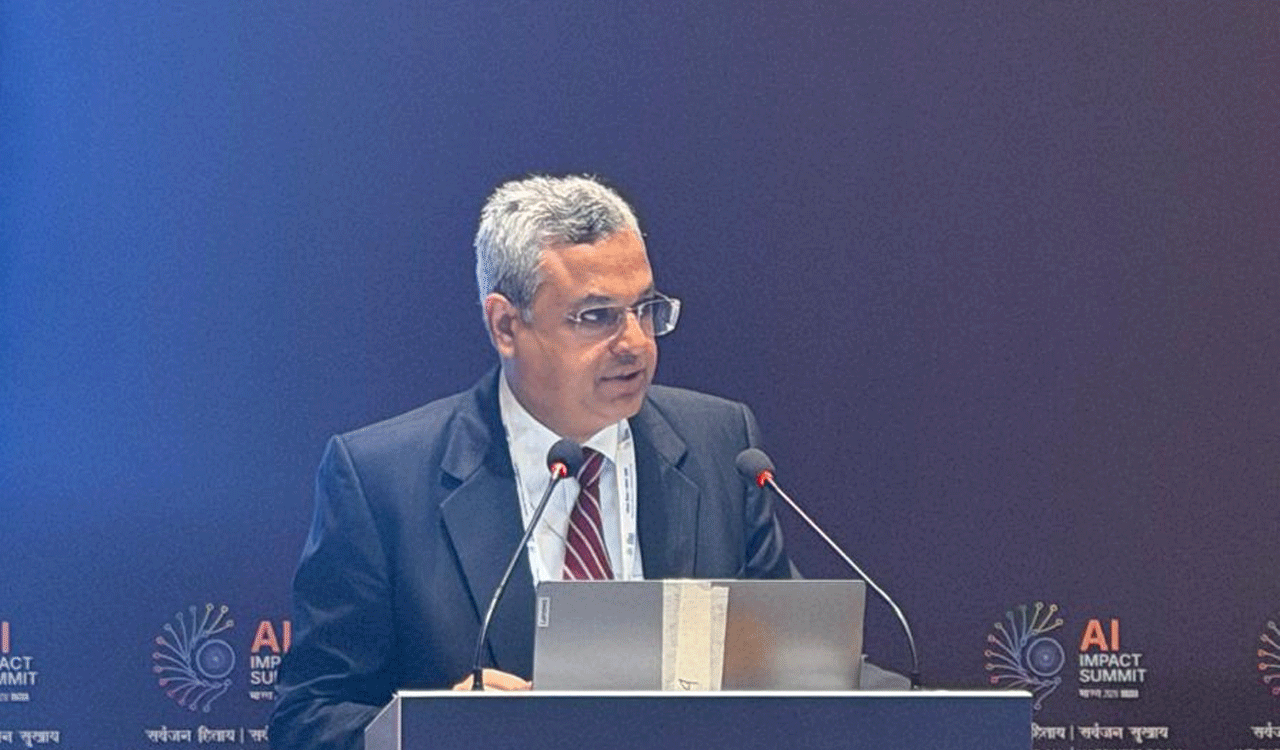


New Delhi: India is focusing on a model where the government, philanthropists and the private sector can collaborate to ensure that affordable computing capacity is accessible to all, Statistics Secretary Saurabh Garg said on Friday.
Speaking at a session titled ‘Building Public Interest AI: Catalytic Funding for Equitable Access to Compute Resources’ at the AI Impact Summit, Garg said, “The focus is not on rationing but on intelligent prioritising of compute capacity access. I think that is going to be the focus — that compute capacity is an enabling platform.”
He said philanthropic organisations would have a large role to play, as their focus is on ensuring that AI benefits all.
“So, with that focus in view, the government, philanthropic organisations and the private sector can collaborate to ensure that affordable computing capacities are accessible to all. I think that’s the model we are looking at, and that will ensure experimentation going forward,” he stated.
Artificial intelligence (AI) will definitely transform the world, and the key question is whether that transformation will be equitable, inclusive and aligned with public interest.
“And I think that’s really the issue which concerns a lot of people. The AI Summit itself was built around guiding sutras — people, planet and progress. Therefore, the concept is that AI must ultimately serve human welfare, development and shared prosperity,” he said.
Referring to the Working Group’s discussions, Garg noted that six foundational pillars had emerged to form the backbone of the collective roadmap for the future.
“Compute, no doubt, is today’s defining barrier. Access to GPU accelerators is a major issue for all AI ecosystems. But the challenge is how it can be made distributable, affordable and global, and not concentrated in a few geographies,” he said.
He added that the government is focusing on innovation and how it can become part of public interest infrastructure.
However, infrastructure alone would not be sufficient, he said, noting that the skill gap is widening.
“So, how can we consider capability diffusion, focusing on joint research, shared standards, open platforms and mutual learning? What needs to be done for responsible deployment is to link innovators to compute resources and citizens to trustworthy AI-enabled services,” he said.
Equally important is governance, where the framework must be robust enough to build trust, yet flexible enough to adapt to diverse social and cultural contexts.
Open source and possibly a modular AI tax would help enable localisation without creating dependencies, he pointed out.
In another session at the summit, Alexandria Walden from Google said, “It is important for companies to have a programmatic approach to stakeholder engagement, with regular interaction and not just on specific product issues.”
She also stressed the need for structured consultation processes while developing products.

Related News