India among six countries with ‘severely restricted’ academic freedom: Report
Academic freedom in India is “severely restricted”, according to Scholars at Risk’s ‘Free to Think 2026’ report. It cited growing government influence over higher education, restrictions on student expression, protests and cases involving faculty members, while India’s academic freedom score declined sharply
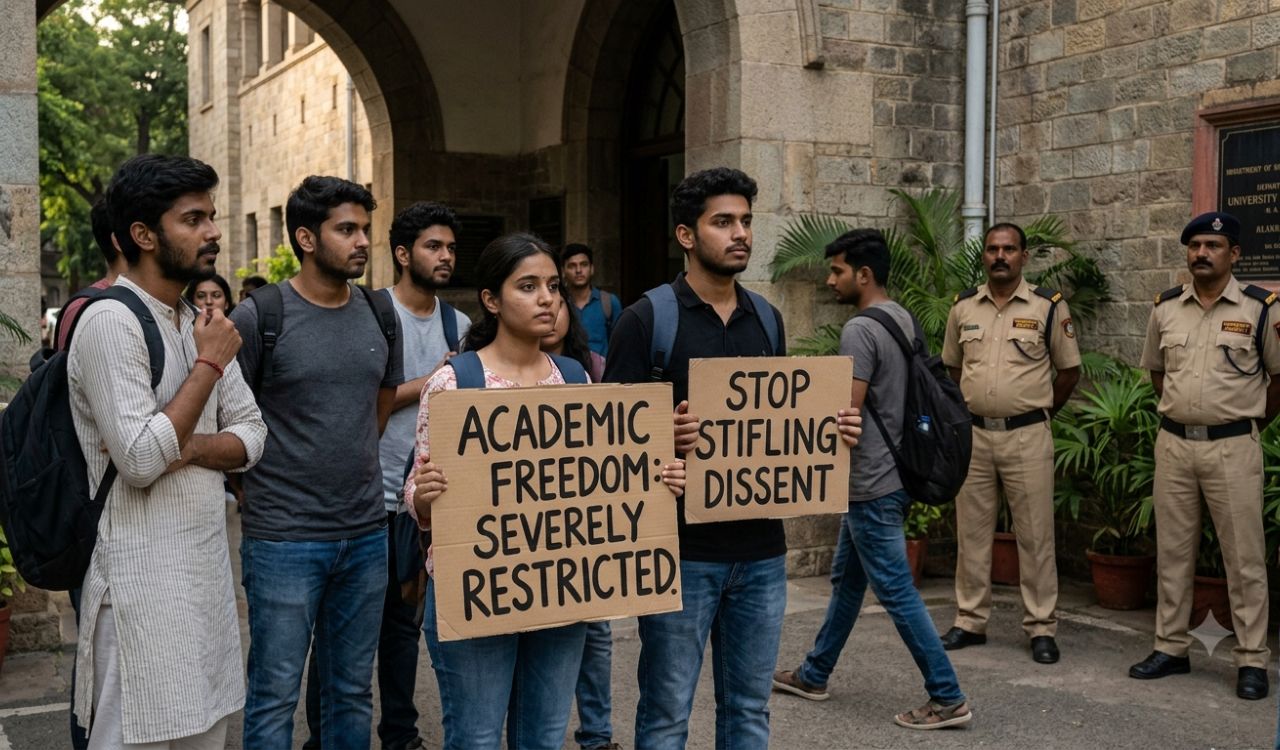


New Delhi: Academic freedom in India is “severely restricted”, with growing government authority over higher education influencing university governance and curbs on student expression and protests, according to a report by Scholars at Risk, an international network that monitors attacks on higher education.
The report, titled ‘Free to Think 2026’, documents 382 attacks on higher education communities in 59 countries and territories between July 1, 2025, and June 30, 2026. It warns of government campaigns to silence dissent and enforce political compliance in higher education.
According to the 2026 Academic Freedom Index (AFI), academic freedom declined significantly in 50 of the 179 countries analysed over the past decade, while only nine recorded improvements.
The six countries listed under the “severely restricted” category are Hong Kong, India, Indonesia, Pakistan, the West Bank and Ukraine.
The report’s lowest category, “completely restricted”, includes Afghanistan, China, Iran, Russia, Turkiye, Syria, Venezuela, Zimbabwe and Gaza.
“India’s Central government expanded its authority over higher education, influencing university governance, leadership appointments, and academic priorities. University administrators took actions that stifled campus discourse, including dismissing faculty members, cancelling academic events, and enforcing new policies restricting student expression.
“Both students and police committed acts of violence at protests or other campus gatherings. Academic freedom was ‘severely restricted’ in 2026,” the report said.
It also alleged that the ruling BJP continued to deploy the University Grants Commission (UGC) as a “primary vehicle for state influence” over higher education.
“The UGC faced scrutiny in recent years for policies perceived to tighten government control over universities, including loosening academic qualification requirements for vice-chancellors and accelerating the casualisation of academic labour by removing the 10 per cent cap on non-permanent, contract faculty,” it said.
India’s AFI score fell from 0.38 in 2022 to 0.14 in 2025, according to AFI data.
However, the decline is not limited to India. The 2026 AFI data shows significant declines in academic freedom in 50 of 179 countries over the past decade, while only nine recorded improvements.
In the US, institutional autonomy fell from 3.3 in 2019 to 1.7 in 2025, with the score dropping from 2.4 in 2024 alone.
The report cited several recent cases involving what it described as the “suppression of dissent” among faculty members.
For instance, it highlighted the 2025 termination of South Asian University professor Snehashish Bhattacharya for “misconduct against university interests”.
Bhattacharya and 14 other faculty members had signed a November 2022 letter expressing concern over the university’s handling of student protests in October that year.
It also cited the firing of Lora Santhakumar, an assistant professor at the SRM Institute of Science and Technology in Tamil Nadu, in 2025 over a social media post on Indian military action in Pakistan.
On May 7, 2025, Santhakumar shared a series of WhatsApp status updates opposing calls for war. One post read: “Say NO to war. And don’t be afraid to say so, even if it is not the popular opinion.”
Her phone number and photograph subsequently circulated rapidly on social media, triggering online abuse and death threats. The university suspended her on May 8 and terminated her services on December 9, 2025.
“When universities justified event cancellations, they often pointed to the content of the event or extramural statements made by the invited speakers. Student protesters on Indian campuses faced pressure from university authorities, police, and opposing student factions.
“Policy shifts, academic decisions and debates about national identity, caste, religion and historical interpretation led to student protests. In some instances, demonstrations resulted in clashes between opposing student factions,” the report said.
It also said national and state government actors took actions that constrained freedom of research, teaching and publication.
For instance, it cited the Supreme Court’s March 11, 2026 order barring three academics from participating in publicly funded curriculum development. The three scholars had worked with the National Council of Educational Research and Training (NCERT) on a Class 8 social science textbook.
The court had initially imposed what the report described as a “life ban” on the three academics, holding them responsible for “projecting a negative image of [the] judiciary”. However, on May 22, 2026, the Supreme Court modified the order, allowing states, Union Territories, public universities and other institutions to independently decide whether the three could participate in future curriculum development.

Related News