Indian scientists find data ‘fully consistent’ for dwarf galaxies to host black holes
A study by Indian researchers from the Indian Institute of Astrophysics found dwarf galaxies orbiting the Milky Way may host intermediate-mass black holes, with stellar motion data consistent with their presence, advancing understanding of galaxy and black hole evolution


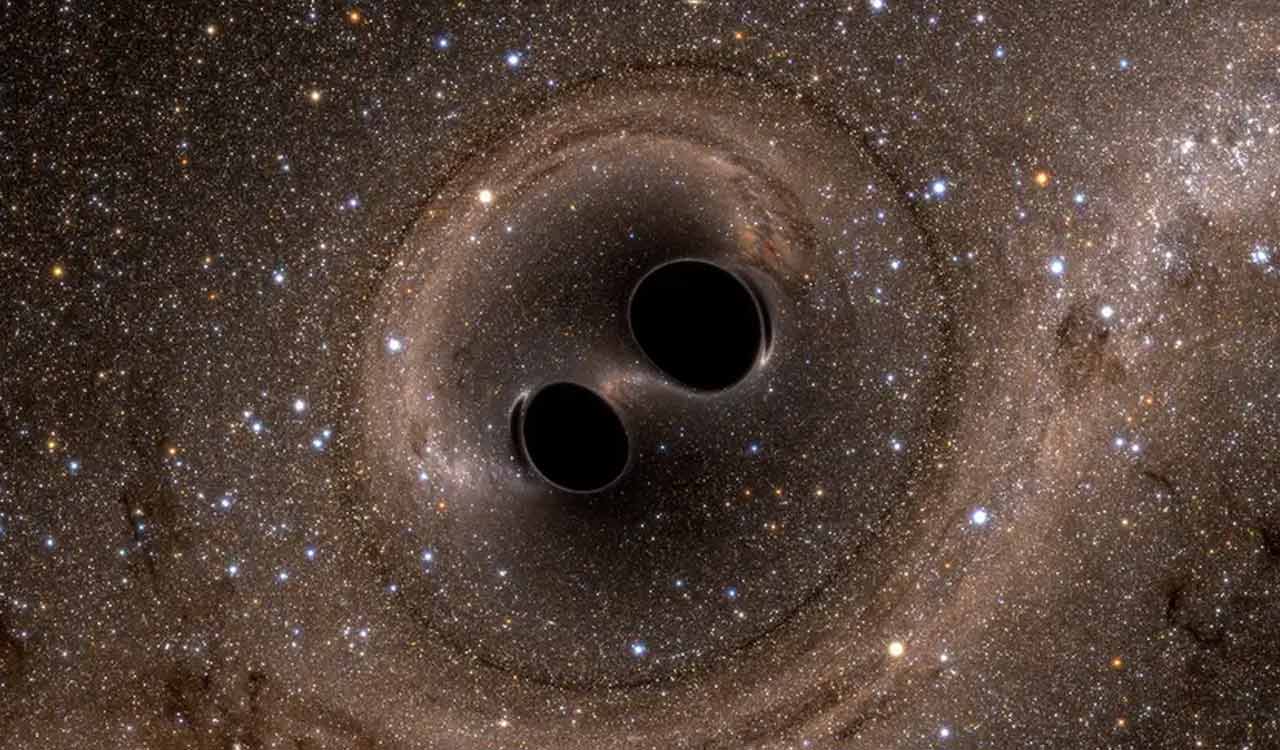
New Delhi: A new study from Indian scientists probed the possibility of some of the smallest galaxies- dwarf spheroidal galaxies orbiting the Milky Way, hosting black holes and found data “fully consistent with the presence of intermediate-mass black holes,” an official statement said on Friday.
The study by K. Aditya and Arun Mangalam of the Indian Institute of Astrophysics built self‑consistent dynamical models that include three gravitational components — stars, a dark matter halo and a possible central black hole.
Using high-quality stellar kinematic data, they modelled how stars move in these galaxies and used this information to constrain the mass of any central black hole, if one were to exist.
“We find that our models, combined with the data, place strong upper limits on central black hole masses of these dwarf spheroidal galaxies, typically below one million solar masses, with several galaxies allowing only much smaller values”, Arun Mangalam explained.
“The data do not require that massive black holes must exist but are fully consistent with the presence of intermediate-mass black holes instead,” he added. The statement from the Ministry of Science & Technology said the work has important implications for both theory and future observations.
“By establishing a unified relation down to the smallest galaxies, it provides a critical benchmark for simulations of galaxy and black hole evolution,” said Arun Mangalam.
This work is particularly timely in the context of upcoming next-generation observing facilities, including the proposed National Large Optical Telescope (NLOT) by IIA and the Extremely Large Telescope (ELT). These facilities will deliver unprecedented spatial and spectral resolution, enabling precise measurements of stellar kinematics in faint, low-mass galaxies.
The unified relation presented in this study provides a robust theoretical and observational framework for interpreting such data, especially in the regime of dwarf galaxies, where black hole signatures are subtle.
Supermassive black holes are routinely observed at the centres of large galaxies, but the smaller ones like the dwarf spheroidal galaxies orbiting the Milky Way are extremely faint, gas-poor, and dominated by dark matter, making direct detection of black holes exceptionally challenging.

Related News
-

Science uncovers how brain interprets artistic beauty
-
Scientists find evidence of rare form of exploding star with missing black holes
-
Data collected at Kodaikanal observatory helps researchers piece together one of Sun’s mysteries
-
IIA astronomers’ groundbreaking study confirms black hole activity suppresses the birth of new stars