ISRO targets seven launches this financial year, says V Narayanan
ISRO Chairman V Narayanan said the space agency is targeting seven launches during the current financial year, with the next mission scheduled within two months. He also announced that the Kulasekarapattinam launch complex is expected to be commissioned within six months
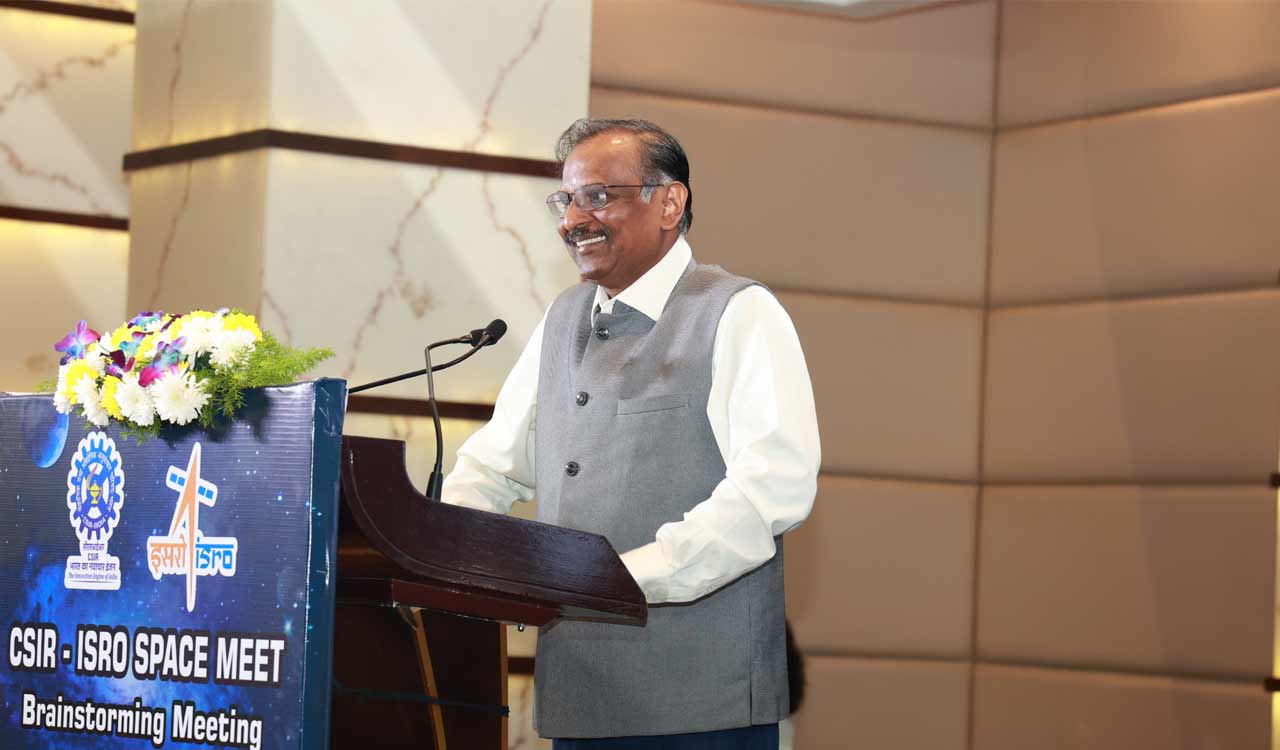


Sriharikota (Andhra Pradesh): ISRO is targeting seven launches during the current financial year, with the next mission scheduled to lift off within the next two months, ISRO Chairman V Narayanan announced on Saturday.
Speaking at a press conference following the historic maiden orbital launch of Skyroot Aerospace’s Vikram-1 rocket, Narayanan said two satellites are already fully built, while five to six others are in the final phase of integration.
“This financial year, we have targeted at least seven launches. We will start the next launch within two months,” Narayanan said.
The space agency’s upcoming schedule includes the first uncrewed mission under the Gaganyaan human spaceflight programme, along with several satellite launches.
Hailing the successful flight of Vikram-1 by private startup Skyroot Aerospace as a milestone, the ISRO chief lauded the young team, with an average age of 28 years, for achieving a successful orbital mission in its very first attempt. He noted that the breakthrough provides immense satisfaction to the country’s space community and contributes significantly to the “Bharat 2047” vision.
Incidentally, both the co-founders of Skyroot Aerospace, Pawan Kumar Chandana and Naga Bharat Daka, are former ISRO scientists.
Later, speaking to PTI Videos, Narayanan likened ISRO’s feeling of pride to that of parents watching their children excel.
“We are just like parents who get excited and feel proud to see their children studying well and securing the first rank,” he added.
Reflecting on the evolution of the country’s space ecosystem, the ISRO Chairman highlighted the impact of policy reforms.
“In 2020, space sector reforms were introduced, and startups and private companies were allowed to carry out activities in the space sector. Today, for the first time in the country, a private rocket has successfully placed a satellite in orbit,” he said, adding that the milestone would drive substantial economic growth and foster a strong scientific temper among the youth.
He pointed out that when the reforms were introduced, there was only one startup. “Today, there are 400 startups,” he added.
Responding to a question about India’s infrastructure capacity to sustain high-frequency private and commercial launches, Narayanan said ISRO plans to commission its second launch complex at Kulasekarapattinam in Tamil Nadu within the next six months.
He pointed out that while Sriharikota possesses comprehensive capabilities, deploying massive launch pads for small satellites in the 300 kg to 350 kg category is logistically sub-optimal.
“Initial launches will take place from here. We are also building the second launch complex at Kulasekarapattinam. It is getting ready. Within this financial year, we are going to commission it,” Narayanan said, adding that the facility is currently in its final phase.
Once operational, launches will be optimised between the two spaceports depending on specific payload requirements, he added.

Related News
-

Editorial: Diluting institutional autonomy may boomerang
-
Incredible to watch capability ISRO is developing in science missions: Indian-American NASA senior official
-
Opinion: DeepTech isn’t SaaS — India should stop judging it like software
-
India, France step up space cooperation with new private-sector deals