NASA trials next-gen Mars helicopter on Earth and red planet
At NASA's Jet Propulsion Lab, New Mars Helicopter Rotor Tested at Near-Supersonic Speeds


Washington: In a historic first, NASA has tested next-generation Mars helicopter design on both Earth and the Red Planet.
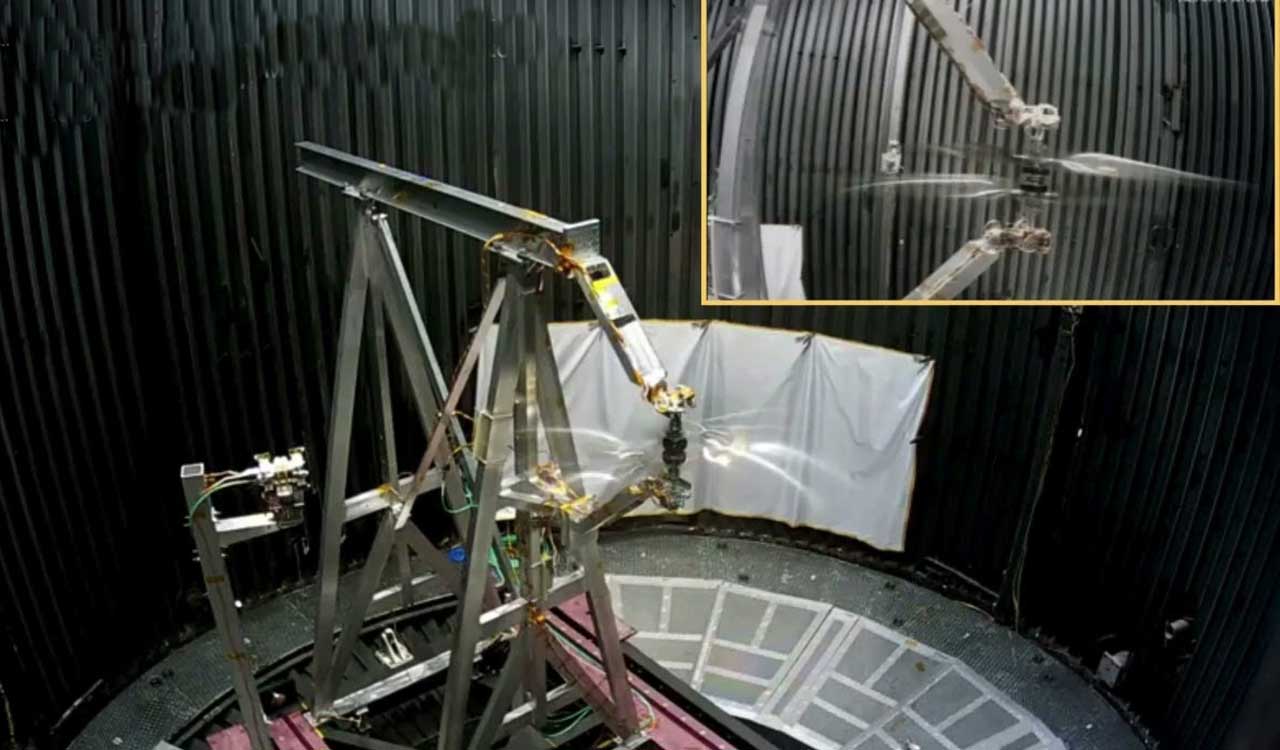
On Earth, the US space agency tested a new rotor that could be used with future Mars helicopters at NASA’s Jet Propulsion Laboratory in Southern California, spinning at near-supersonic speeds (0.95 Mach).
On the other hand, Ingenuity Mars Helicopter achieved new altitude and airspeed records on the Red Planet in the name of experimental flight testing.
“Our next-generation Mars helicopter testing has literally had the best of both worlds,” said Teddy Tzanetos, Ingenuity’s project manager and manager for the Mars Sample Recovery Helicopters, in a statement.
“Here on Earth, you have all the instrumentation and hands-on immediacy you could hope for while testing new aircraft components. On Mars, you have the real off-world conditions you could never truly re-create here on Earth,” Tzanetos added. That includes a whisper-thin atmosphere and significantly less gravity than on Earth.
The next-generation carbon fibre rotor blades being tested on Earth are more than 10 centimetres longer than Ingenuity’s, with greater strength and a different design. NASA thinks these blades could enable bigger, more capable Mars helicopters. The challenge is, as the blade tips approach supersonic speeds, vibration-causing turbulence can quickly get out of hand.
For three weeks in September, a team monitored sensors, metres, and cameras as the blades endured run after run at ever-higher speeds and greater pitch angles.
“We spun our blades up to 3,500 rpm, which is 750 revolutions per minute faster than the Ingenuity blades have gone,” said Tyler Del Sesto, Sample Recovery Helicopter deputy test conductor at JPL. “These more efficient blades are now more than a hypothetical exercise. They are ready to fly.”
NASA’s Ingenuity mini chopper, originally slated to fly no more than five times, has now successfully flown 66 times on Mars.
“Over the past nine months, we have doubled our max airspeed and altitude, increased our rate of vertical and horizontal acceleration, and even learned to land slower,” said Travis Brown, Ingenuity’s chief engineer at JPL.
Although the helicopter can cover more ground in a single flight by flying faster, flying too fast can confuse the onboard navigation system. So, to achieve a higher maximum ground speed, the team sends commands for Ingenuity to fly at higher altitudes (instructions are sent to the helicopter before each flight), which keeps features in view longer.
Further, the team experimented with Ingenuity’s landing speed with lighter landing gear.
On Flights 57, 58, and 59 they gave it a whirl, demonstrating Ingenuity could land at speeds 25 per cent slower than the helicopter was originally designed to land at.
In December, after solar conjunction, Ingenuity is expected to perform two high-speed flights during which it will execute a special set of pitch-and-roll angles designed to measure its performance.

Related News
-

Incredible to watch capability ISRO is developing in science missions: Indian-American NASA senior official
-
Astronauts remove faulty ISS antenna during spacewalk; out of time to install spare
-
NASA invites ISRO to join Moon Base programme for lunar South Pole outpost
-
NASA astronauts Anil Menon, Jessica Meir undertake spacewalk to upgrade space station