NASA uses oreo-sized device on Vikram for precise Lunar target location
As per ISRO, the scientific instruments/payloads on Vikram and the lunar rover Pragyan have demonstrated satisfactory performance.
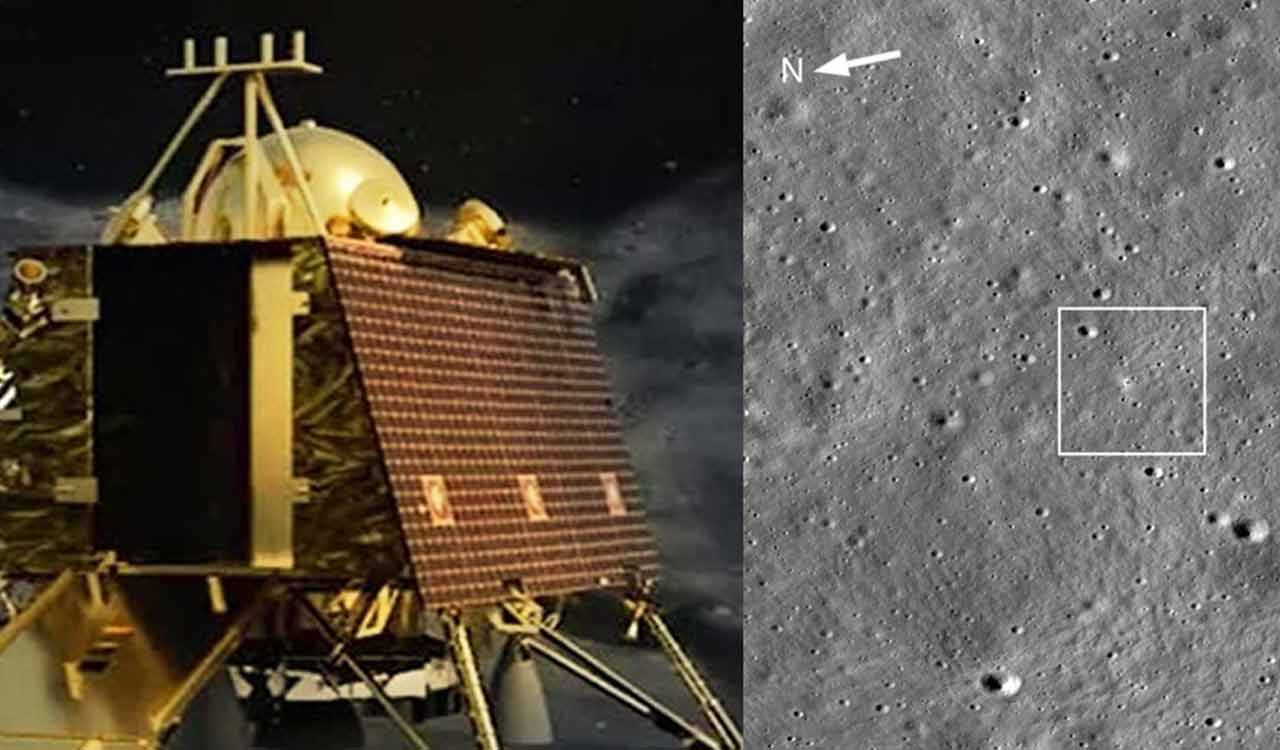


Chennai: With Vikram landing safely on the moon last year, one of its instruments is now serving as a location marker on the moon near its South Pole.
According to ISRO, the scientific instruments/payloads on Vikram and the moon rover Pragyan have performed well.
Also Read
The Laser Retroreflector Array (LRA) on Vikram has begun providing ‘fiducial points’ (precisely located markers for reference) on the moon. The National Aeronautics and Space Administration’s (NASA) Lunar Reconnaissance Orbiter (LRO) achieved a laser range measurement using the LRA by successfully detecting signals reflected by it on December 12, 2023.
“For the first time on the Moon, a laser beam was transmitted and reflected between an orbiting NASA spacecraft and an Oreo-sized device on ISRO’s Vikram lander on the lunar surface. The successful experiment opens the door to a new style of precisely locating targets on the Moon’s surface,” NASA said.
Sending laser pulses toward an object and measuring how long it takes the light to bounce back is a commonly used way to track the locations of Earth-orbiting satellites from the ground. But using the technique in reverse — to send laser pulses from a moving spacecraft to a stationary one to determine its precise location — has many applications at the Moon, NASA said.
The range utilised the Lunar Orbiter Laser Altimeter (LOLA) on the LRO. The observation occurred during lunar night time, with the LRO ascending to the east of Chandrayaan-3, ISRO said.
NASA’s LRA was accommodated on the Vikram lander under international collaboration. It comprises eight corner-cube retroreflectors on a hemispherical support structure.
This array facilitates lasers ranging from various directions by any orbiting spacecraft with suitable instruments. The passive optical instrument, weighing about 20 grams, is designed to last for decades on the lunar surface.
Landed near the lunar south pole on August 23, 2023, Chandrayaan-3’s Vikram lander has been accessible for LOLA measurements since then.
While several LRAs have been deployed on the Moon since the beginning of lunar exploration, the LRA on Chandrayaan-3 is a miniature version and is the only one available near the south pole currently.
NASA’s LRA on Vikram lander will continue to serve as a long-term geodetic station and a location marker on the lunar surface, benefitting current and future lunar missions.
These measurements, apart from helping in precise determination of spacecraft’s orbital position, will help refine the lunar geodetic frame, revealing insights into the Moon’s dynamics, internal structure, and gravitational anomalies.
Be that as it may, last month, ISRO had brought back the Chandrayaan-3 propulsion module to orbit the Earth from orbiting the Moon.
The move is similar to the unique hop experiment of the Vikram the moon lander done earlier.
The primary objective of Chandrayaan-3 mission was to demonstrate soft landing near the lunar south polar region and perform experiments using the instruments on Vikram and Pragyan-the moon rover.
The spacecraft was launched on July 14, 2023 on-board LVM3-M4 vehicle from the Sriharikota rocket port.
On August 23, Vikram Lander made its historic touch down on the Moon and subsequently Pragyan rover was deployed.
The scientific instruments in Lander and Rover were operated continuously for 1 lunar day as per the defined mission life. The mission objectives of Chandrayaan-3 have been completely met.
ISRO said the main objective of the propulsion module was to ferry the Vikram lander from the geo transfer orbit (GTO) to the final lunar polar circular orbit and separate the lander.
Subsequent to separation, Spectro-polarimetry of HAbitable Planet Earth (SHAPE) payload in the propulsion module was also operated.
The initial plan was to operate this payload for about three months during the mission life of the propulsion module.
The precise orbit injection by LVM3 and optimal earth/lunar burn maneuvers, resulted in the availability of over 100 kg of fuel in the propulsion module after over one month of operations in the lunar orbit.
It was decided to use the available fuel in the propulsion module to derive additional information for future lunar missions and demonstrate the mission operation strategies for a sample return mission, ISRO said.
In order to continue SHAPE payload for Earth observation, it was decided to re-orbit the propulsion module to a suitable Earth orbit.
This mission plan was worked out considering the collision avoidance such as preventing the propulsion module from crashing on to the Moon’s surface or entering into the Earth’s GEO belt at 36,000 km and orbits below that.
According to ISRO, the main takeaways from this action are: (a) Planning and execution of trajectory and maneuvers to return from Moon to Earth (b) Development of a software module to plan such a maneuver and its preliminary validation (c) Planning and execution of a gravity assisted flyby across a planets/ celestial body and (d) Avoiding uncontrolled crashing of the propulsion module on the Moon’s surface at the end of its life and avoid debris creation.

Related News
-

Editorial: Diluting institutional autonomy may boomerang
-
Incredible to watch capability ISRO is developing in science missions: Indian-American NASA senior official
-
India, France step up space cooperation with new private-sector deals
-
ISRO says remains at centre of India’s space programme, refutes media reports as ‘baseless’