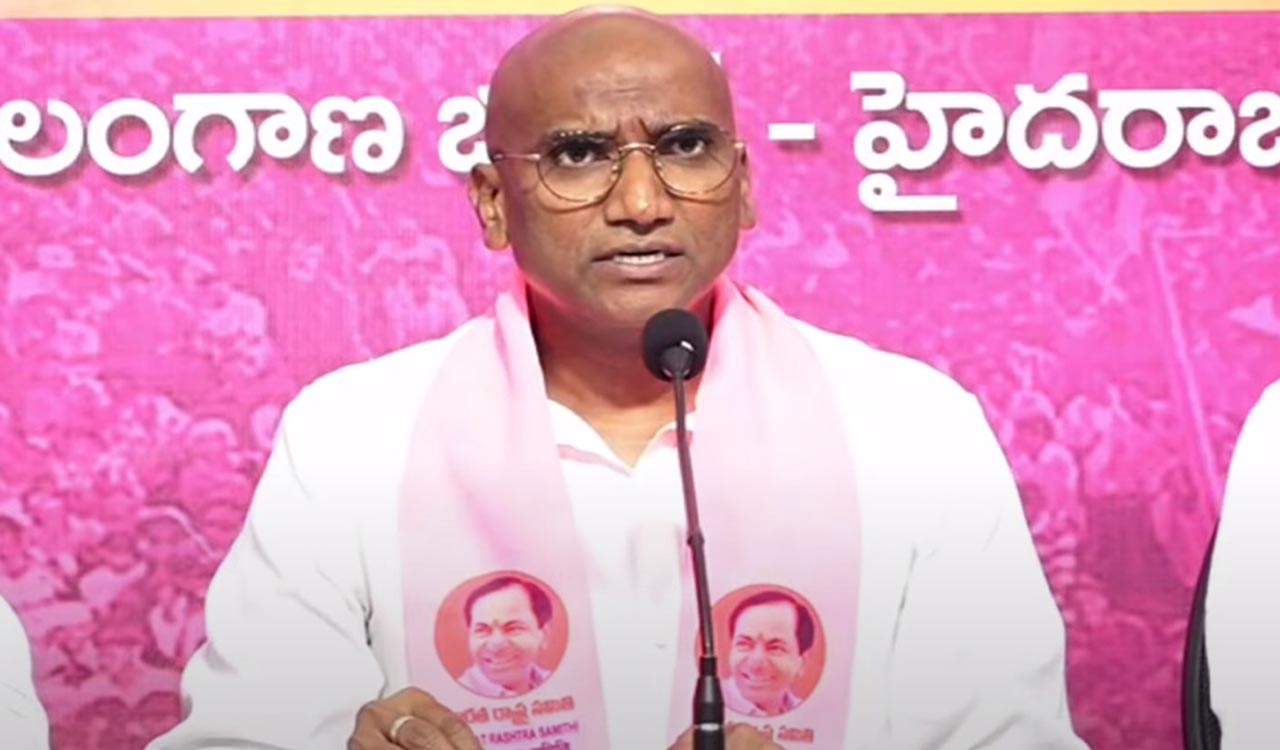
Niranjan Reddy challenges Congress to remove Kudikilla obstruction
Former Minister S Niranjan Reddy challenged the Congress government to remove an obstruction near Kudikilla to enable gravity flow from Narlapur to downstream reservoirs. He accused the government of neglecting the Palamuru-Rangareddy project and sought water release to protect crops.


Mahabubnagar: Former Minister S Niranjan Reddy challenged the Congress government to remove an obstruction near Kudikilla to enable water from the Narlapur reservoir to flow by gravity into the Yedula, Vattem and Karivena reservoirs. He offered to execute the work effectively if the government was willing to award a contract.
Accompanied by former MLA Beeram Harshavardhan Reddy, he inspected the bund on Thursday after accepting Minister Jupally Krishna Rao’s challenge to the BRS to explain how water could be released from Narlapur. He asked Krishna Rao to stop making sarcastic remarks and fulfil his duty by focusing on ensuring water supply to farmers.
Speaking to mediapersons, Niranjan Reddy said removing a portion of the earthen bund, proportionate to the capacity of the two pumps currently operating, would allow water to reach the downstream reservoirs by gravity. He urged the government to issue a GO and award the work through nomination, stating that the BRS would oversee the removal and demonstrate the flow.
He accused the Congress government of neglecting the Palamuru-Rangareddy lift irrigation scheme for three years, depriving farmers of water despite the readiness of reservoirs with a combined storage capacity of 70 TMCft. He said the previous BRS government had acquired 27,000 acres and spent Rs 35,000 crore to construct the reservoirs.
The former Minister said more than 100 TMCft of water had flowed into Andhra Pradesh due to the Congress government’s inaction in Telangana, while 60 TMCft was still available in the Srisailam reservoir. He said lifting 20 TMCft could protect standing crops, recharge groundwater and meet people’s needs.

Related News