Rajnath hails Op Sindoor as tech-driven military success
Rajnath Singh hailed Operation Sindoor as a decisive, tech-driven strike showcasing India’s military strength, citing use of advanced systems like Akash and BrahMos. He stressed adaptability, surprise tactics, and stronger defence R&D during a symposium in Prayagraj
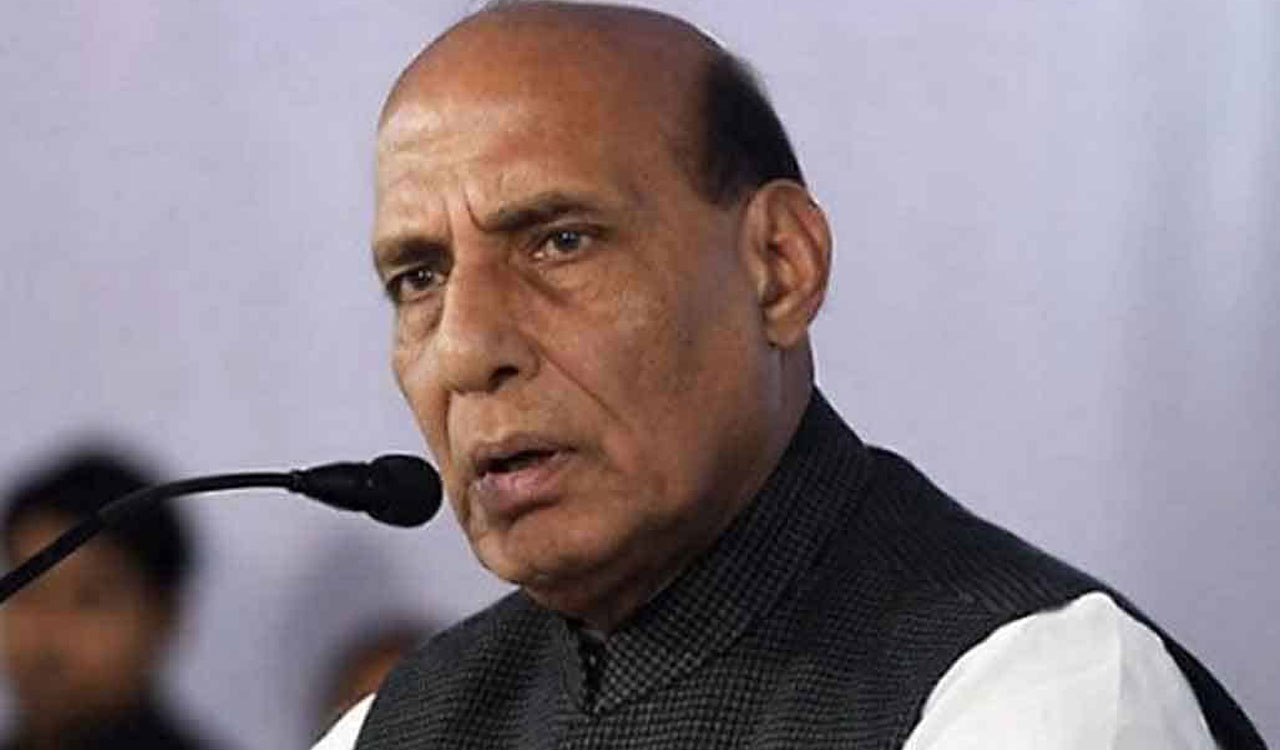


Prayagraj (UP): Days ahead of the first anniversary of Operation Sindoor, Defence Minister Rajnath Singh on Monday described it as a “unique” example of how the Indian military utilised advanced technology to deliver a decisive blow to terror groups and their “patrons”.
Addressing the inauguration event of North Tech symposium, Singh emphasised that while the armed forces “showed patience”, they were clinical in destroying terrorist infrastructure. He added that the operation served as a global reminder of the Indian military’s capabilities. India launched Operation Sindoor on May 7 last year in response to the April 22 Pahalgam terror attack.
The operation targeted terror infrastructure in territories controlled by Pakistan.
The strikes triggered four days of intense clashes that ended with an understanding on stopping the military actions on May 10.
“The decisive response our soldiers gave to the terrorists and their patrons made the entire nation proud. It was a good thing that we showed patience and destroyed only the terrorists; otherwise, the whole world knows what our armed forces are capable of,” Singh said. He described the operation as a unique example of technology use. “Advanced missile systems like Akash and BrahMos, along with a host of latest equipment, were used in this operation,” Singh said.
“This proved that our forces both understand changes and use them with confidence,” he said.
Singh said that technology is evolving at an extraordinary pace in the present time, and perhaps never in human history has it changed so explosively.
“We have seen how drones and sensors have emerged as game-changing factors.” He added, “Today, it is impossible to predict what can be turned into a weapon. If even a pager can be weaponized, then there is no limit to what might become a weapon in the future.” Singh said that India must develop capabilities to deliver strikes in ways that adversary nations could never have imagined. Citing the current geopolitical environment, he underlined the need for the military to remain alert and adapt to the changing environment.
“In today’s complex and rapidly changing environment, there is only one mantra to move forward: adaptability. Changing ourselves according to changing circumstances should be our priority,” he said.
Explaining this, Singh called for “pro-active preparations” for any possible national security challenge.
“When I’m talking about proactive preparation, there’s another important aspect to it — the surprise element. We also need to develop such capabilities so that when the need arises, we can take action that the opponent never even thought of,” he said.
“Let them get surprised. History bears witness that in war, the decisive edge has always been with the one who has the surprise element. I know that our armed forces are working in this direction.” “But we need to be even more proactive and continue working in this direction,” he said.
Singh also emphasized that there is no alternative to research in today’s world. The nature of future warfare is being decided in laboratories today. Therefore, the government has placed research at the centre of its priorities, he said.
“Through DRDO, we have decided to take research to the next level. DRDO is also bringing industry along with it. Twenty-five percent of research and development has been allocated to industry, academia, and startups,” he said.
Singh further said that a new policy for technology transfer has been implemented. Earlier, a 20 percent fee was charged for technology transfer, but now this fee has been completely waived for development-cum-production partners, he said. Besides, he said that DRDO has started providing free access to its patents for Indian industry.
At this three-day symposium organized by the Indian Army’s Northern and Central Commands along with the Society of Indian Defence Manufacturers (SIDM), more than 250 companies working in the defence sector are showcasing their defence products and technologies. The event was also attended by Army Chief Upendra Dwivedi and others.

Related News