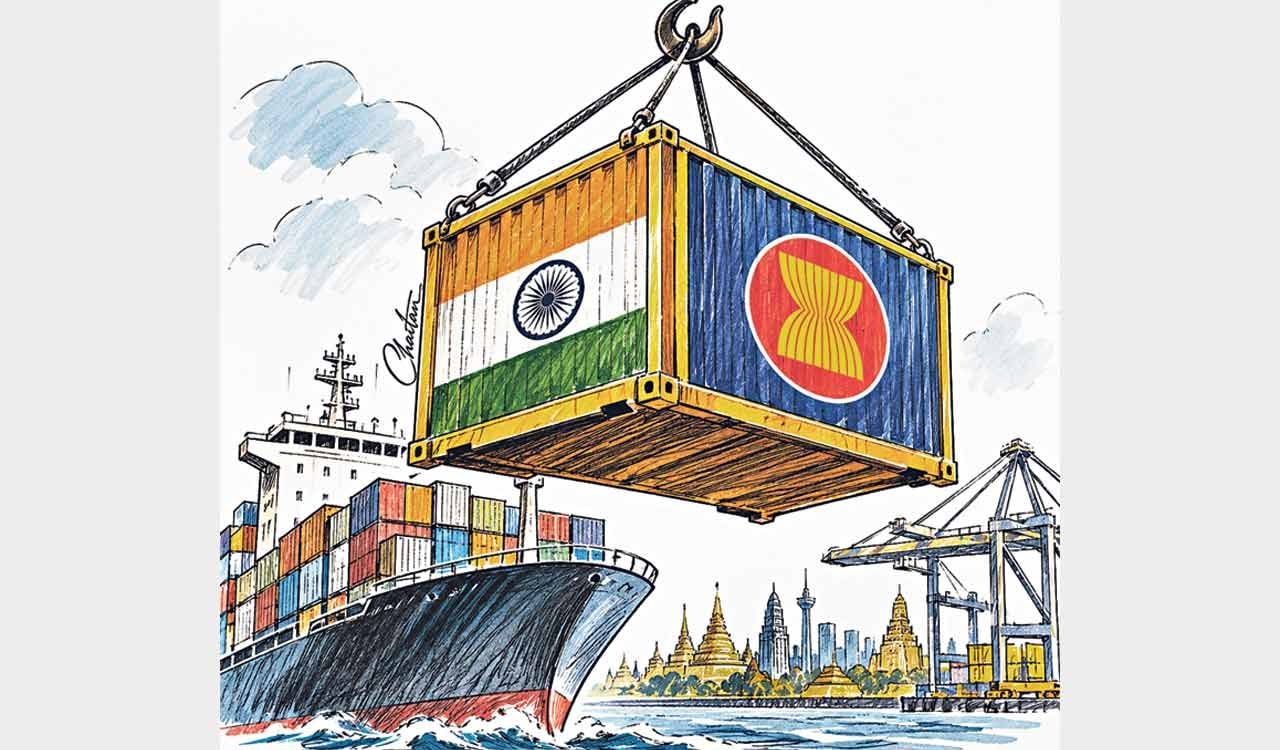
Opinion: India–ASEAN trade — unlocking $41 bn in export potential
India–ASEAN trade is expanding, but a widening trade deficit and persistent market access barriers continue to hold back Indian exporters' regional ambitions


By Janvi Singhi
The 23rd ASEAN-India Summit held in Manila on November 17, 2026, took place at a significant juncture in India-ASEAN. Bilateral trade hit more than US$ 123 billion in 2025, while India’s trade deficit with ASEAN stood at a whopping US$ 51 billion. This disparity highlights the core challenge in their relationship: while trade continues to expand, the benefits of coupling remain unequal between the two parties. The next phase should not only focus on expanding trade agreements, but also on creating greater opportunities for Indian companies to enter Southeast Asian markets and building a stronger economic framework for the partnership.
Since the introduction of its Look East Policy in 1991, India has maintained steady engagement with ASEAN. The policy began as India’s effort to reinvigorate its economic ties with Southeast Asia and eventually culminated in the Comprehensive Strategic Partnership in 2022. The ASEAN-India Trade in Goods Agreement (AITIGA) was signed in 2009 and implemented in 2010, marking a major milestone in their economic integration. Trade in goods between them reached about $123 billion in 2025, up from $53 billion in 2010. Still, trade growth has been uneven, with an emphasis on imports.
India’s imports from ASEAN grew from $24 billion in 2009 to around $87billion in 2025, while exports rose from $18 billion to about $36 billion. Moreover, the composition of imports has also changed. While India’s imports were previously dominated by palm oil, coal, and petroleum products, they now consist of integrated electronic circuits, communication devices, machinery and precious metals. The shift can be attributed to ASEAN’s enhanced industrial capacity and its integration into regional and global distribution chains. It also illustrates India’s rising need for intermediate and capital goods for electronics production and an expanding manufacturing sector.
Unequal footing
Nevertheless, disparities in market access imply that Indian exporters may not be enjoying a level playing field in affected ASIAN markets. A factor could be the differing approach to tariff liberalisation by AITIGA signatories. India has committed to remove tariffs in respect of 74.18 per cent of tariff lines as against 76.40 per cent by ASEAN members collectively. However, the significance of regional averages is diminished due to disparities in actual efforts involved.
Indonesia’s commitment to tariff elimination covers just 46.60 per cent of tariff lines while Vietnam’s commitment is as high as 68.10 per cent. Some major ASEAN economies maintain huge lists of excluded items or have adopted less ambitious tariff-reduction commitments. Another problem is that some ASEAN economies already enjoyed considerable duty-free access before AITIGA came into force.
Untapped potential
India’s trade performance also reveals a discrepancy between export diversification and actual market penetration. Indian exporters have entered the ASEAN market with several products, including pharmaceuticals, chemicals, machinery, aluminium, cars, and processed food. However, this diversification has not translated into export growth comparable to that of imports. According to the estimates cited in the ASEAN-India Development and Cooperation Report, India is capable of exporting $77 billion worth of goods to the ASEAN market in 2026, while the actual exports in 2025 amounted to just $36 billion. This means India had a gap of $41 billion in terms of potential trade opportunities. Machinery, chemicals, basic metals, and cars account for a substantial share of this untapped potential.
The ongoing AITIGA review could help level the playing field by addressing tariff disparities, regulatory hurdles and logistics costs that constrain India’s export competitiveness in ASEAN markets
Tariffs are not the only obstacles to trade. Regulatory requirements, product specifications, certification processes, and sanitary standards can increase compliance costs for Indian companies. This is particularly relevant to sectors where India has considerable export potential. For instance, the proportion of manufacturing products subject to non-tariff measures is approximately 92.78 per cent in the Philippines, and 72.77 per cent in Malaysia, compared with 14.40 per cent in India. Though these regulations cannot be classified as protectionist measures, differences in compliance requirements can make preferential tariff access less meaningful for exporters.
The problem is further compounded by logistics costs. In 2021, the average ad valorem sea freight charge for ten leading categories of Indian exports to ASEAN stood at 14.48 per cent. The corresponding figures were 10.47 per cent for Japan and 11.35 per cent for South Korea. In the case of electrical machinery, the freight-charge ratio for India was 31.80 per cent, whereas for South Korea, it was only 14.50 per cent. These discrepancies undermine the competitive edge of Indian goods despite the presence of tariff preferences. The benefits of trade agreements cannot be realised in full because in reality transport costs and supply chain inefficiencies erode the gains from lower import duties.
Making AITIGA work
The ongoing review of AITIGA therefore offers an opportunity to resolve the agreement’s key deficiencies. First, negotiations need to focus on genuine tariff reductions in sectors where India has been successful in exporting, rather than relying on overall tariff coverage as an indicator of success. Second, stronger verification mechanisms for rules of origin, electronic certifications and customs cooperation are needed to safeguard the agreement from possible violations. Unexplained jumps in certain imports from ASEAN countries to India, such as platinum and raw silk, warrant closer scrutiny. However, trade patterns alone do not establish origin fraud. Verification must therefore be evidence-based and should not create unnecessary difficulties for legitimate businesses.
Third, greater emphasis should be placed on regulatory collaboration. Recognition of conformity assessment, transparent standards and simplified certification procedures can help reduce exporters’ compliance costs, especially in pharmaceuticals, machinery and food products. Finally, investments in maritime connectivity, improved port operations, customs digitisation and electronic trade documents could help address India’s logistics problem.
One must assess India–ASEAN economic integration not just based on trade numbers, but also in terms of market accessibility and participation in regional production networks, from the perspectives of both sides. With an estimated $41 billion worth of unrealised Indian export potential, the immediate priority should be to translate existing commercial capabilities into greater market access. The future of this partnership will depend on whether the AITIGA review can effectively address the regulatory, logistical and institutional hurdles that continue to impede trade.

(The author is a Senior Research Fellow at India Forth, a Sydney-based geo-economic intelligence firm)

Related News