Opinion: Midnight muhurtham—why India became Independent at 12
India became independent at the stroke of midnight on August 15, 1947. The unusual timing was shaped by astrological beliefs and Mountbatten’s schedule


By KSN Prasad
Indian independence came in the last hours of 14 August 1947, in the early hours of August 15. At midnight, the transfer of power from the British government to India took place, and the Constituent Assembly assumed the authority to govern the country. Why did all this happen at midnight and not on August 14 or on the morning of August 15? These questions naturally arise. Behind this decision lies an interesting story.
Also Read
The British government had officially announced that the transfer of power to India would take place on 15 August 1947. For many Indians, religious beliefs and traditional practices are important considerations. There is a strong belief that planetary positions affect human life. That’s why, before every auspicious work, astrologers check Rahukalam, tithi, nakshatras, etc. With such beliefs in mind, some national leaders of the time consulted scholars and astrologers to determine whether August 15 would be an auspicious day.
August 15 was a Friday, and fell on Chaturdashi. The scholars pointed out that after 2:30 am, Amavasya would begin and, therefore, August 15 was not a good day. August 14 was also not regarded as particularly auspicious. They suggested August 17 as a favourable date. This left the leaders with a difficult problem. If the transfer of power were held on August 14, Lord Mountbatten would be in Karachi for the transfer-of-power ceremony in Pakistan. He could return to Delhi only later that night. Moreover, the British government had already announced in Parliament that India would get independence on August 15.
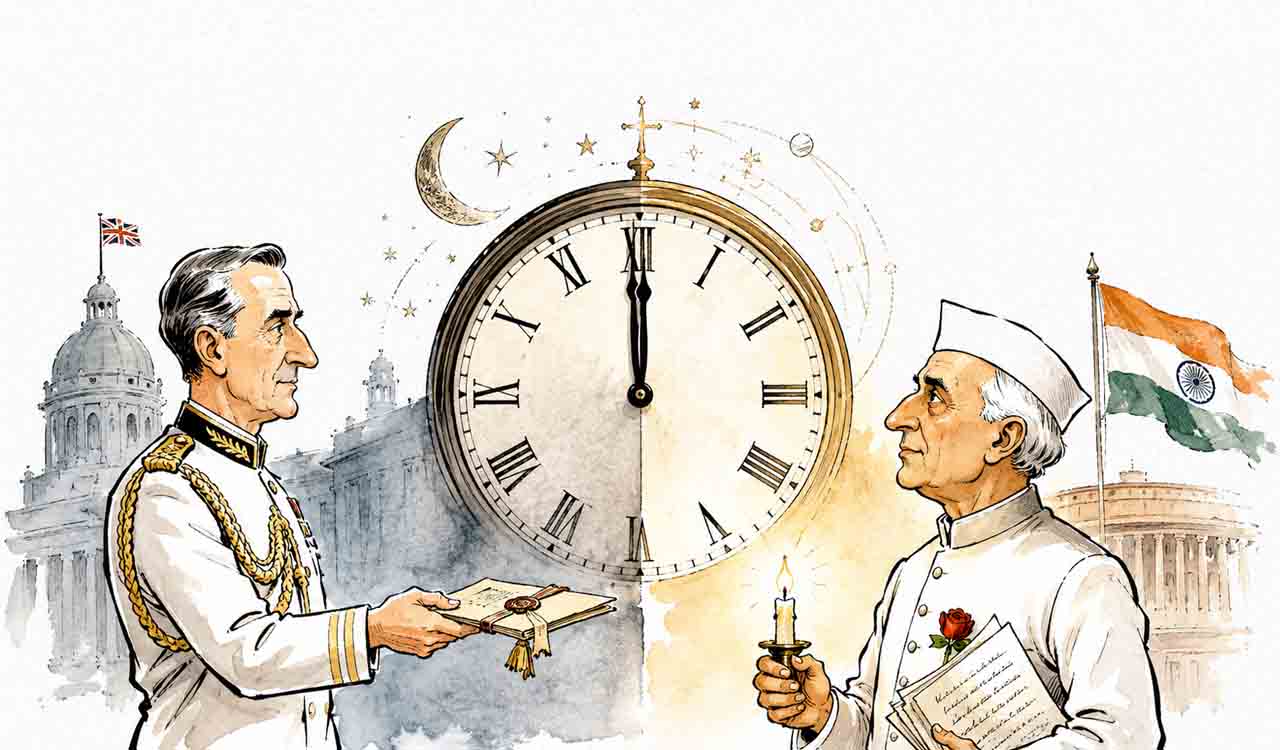
Prominent journalist and scholar KM Panikkar is said to have suggested a solution: the Constituent Assembly would meet at 11 pm on the night of August 14. At the stroke of midnight, it would assume power from the British government. This arrangement allowed the British government’s announced date of August 15 to remain unchanged while also accommodating the astrological considerations.
At 10 am on August 15, Mountbatten took a special oath as Governor-General before the Constituent Assembly. Goodwill messages poured in from across the world. The Indian national flag was hoisted on the grand building, now Parliament House. A gun salute marked the occasion.
Mountbatten’s Appointment
On 31 July 1947, Constituent Assembly Chairman Dr Rajendra Prasad announced the programme for August 14-15 ceremonies. He said that the leader of the House, Jawaharlal Nehru, should request Lord Mountbatten to accept the office of Governor-General.
However, a great sacrificer named Mahaveer Tyagi objected. He pointed out that the Assembly had never discussed the question of Mountbatten becoming the Governor-General of India, nor had it ever agreed to appoint him to that position. He argued that without passing a formal resolution to this effect, it was not right to invite Mountbatten to the Assembly.
August 15 was a Friday, and fell on Chaturdashi. Scholars pointed out that after 2:30 am, Amavasya would begin and, therefore, August 15 was not a good day. August 14 was also not regarded as particularly auspicious
In response, Dr Rajendra Prasad said that he would bring this matter before the House in the form of a resolution. However, several members immediately rose and said: “no, no.” They insisted that the matter should proceed as had already been decided. Thus, in the Constituent Assembly, Lord Mountbatten came and took charge as the Governor General of India without any discussion, acceptance, or resolution.
Transfer of Power
The historic Constituent Assembly session began at 11 pm on August 14, 1947, under the chairmanship of Dr Rajendra Prasad. At the stroke of midnight, the Assembly formally assumed power for the governance of India. House leader Nehru moved the historic resolution, which was introduced before the House and subsequently approved by the members.
As the clock struck 12, the members of the House stood in solemn silence. As each sentence was being read aloud, the members repeated it in both Hindi and English. With the solemn ceremony, the Constituent Assembly took over the administration of India.
The Assembly then endorsed Mountbatten’s appointment as Governor-General of India from August 15. Dr Rajendra Prasad announced that Jawaharlal Nehru would convey the Assembly’s decision to Mountbatten. The national flag was subsequently presented to the Assembly by Hansa Mehta. On the occasion of the transfer of power, the House also approved, as a mark of appreciation, a song written in Chinese by India’s Ambassador Dr Chin Lu.
Following this, the first few lines of ‘Saare Jahan Se Achha Hindustan Hamara’ and the opening lines of ‘Jana Gana Mana’ were sung by the members of the House. Immediately thereafter, the House was adjourned until 10 am on August 15. This is how the historic transfer of power unfolded that momentous night.
A Misstep at the Start
There is also an interesting incident worth recalling. On the night of August 14, Nehru went to Viceroy’s House and informed Mountbatten about the recommendation for his appointment as India’s Governor-General. He handed over to him a cover containing a list of the names of the Council of Ministers.
After everyone present had left, Mountbatten opened the cover, only to find nothing inside! The cover was empty, which surprised him. Whoever had prepared the cover had forgotten to put the list inside it. Though it seemed like a humorous incident, Nehru’s governance appeared to have begun with a kind of “misstep at the very beginning”.
A Funny Incident
There’s an interesting anecdote associated with that historic night. When Nehru came back from Viceroy’s House, he delivered his famous speech. The lighting in the Assembly was inadequate, making it difficult for Nehru to read the notes from which he was speaking. He asked for a candle so that he could see the text clearly. Photographers captured that moment. That candlelight speech became historic. Nehru’s speech became famous as the “Tryst with Destiny”, delivered in candlelight.
Pakistan’s independence was formally marked on August 14. It was said that Muhammad Ali Jinnah preferred August 14 because it coincided with the 27th day of Ramzan, considered holy by Muslims.
(The author is a journalist)

Related News