Opinion: Reality of submarine deal
With AUKUS, Australia has wedded itself to a risky US policy on China – and turned a deaf ear to the region


By Matt Fitzpatrick
Much has been made of Australia’s renewed engagement with Asia and the Pacific since Labor came to power.
Foreign Minister Penny Wong’s “charm offensive” in the Pacific was seen as the beginning of a new process of listening to the region, not dictating to it. Labor’s Asia-Pacific policy has also been hailed as striking a balance between the US and China.
Colonial Vision
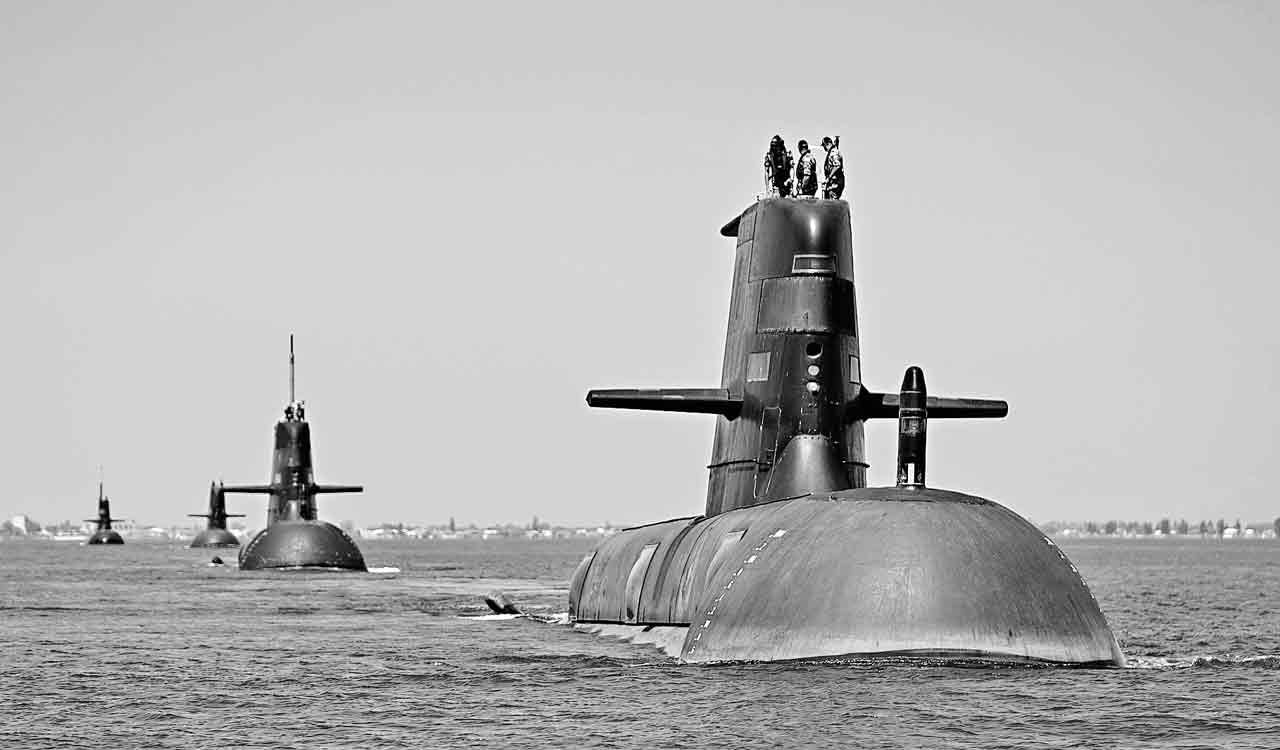
In announcing the AUKUS submarine deal in the US this week, Prime Minister Anthony Albanese emphasised it was aimed at allowing nations in the region to “act in their sovereign interests free from coercion” and would “promote security by investing in our relationships across our region”.
The reality of the submarine deal is not, however, in that spirit. Instead, it leads Australia towards half a century of armaments build up and restricted sovereignty within a US-led alliance aimed at containing China.
Worse, it hearkens back to a colonial vision of the region as rightfully dominated by Anglophone powers who enjoy a military advantage over others that live there.
In the process, it has also deliberately endangered the spirit – if not the letter of nuclear non-proliferation agreements – and heightened what our neighbours see as a destabilising and unnecessary naval race that can only further provoke China.
Sovereignty of Foreign Policy
The deal confirms two things that nations in the region have long suspected. First, Australia is incapable of imagining an Asia-Pacific region that is not militarily dominated by the United States.
In addition, the deal suggests we are still politically attached to the United Kingdom – the post-Brexit ghost of a past British empire once again looking east of the Suez Canal towards Asia and the Pacific.
The second is that, despite the window dressing, Australia’s deafness to regional misgivings has not improved since the change to a Labor government. AUKUS and the nuclear submarine deal are far from universally admired in Asia and the Pacific. The ASEAN bloc has repeatedly expressed its wish to avoid an arms race in the region. Regional powers such as Indonesia and Malaysia have made this clear on several occasions.
Other approaches to regional security do exist. And our neighbours have their own sense of how the Asia-Pacific can best balance the growing influence of both the US and China.
Malaysia, for example, has emphasised that so clearly identifying China as an enemy will be a self-fulfilling prophesy. The Pacific states have warned against becoming so clearly aligned with the US and sparking a renewed arms race in the Pacific. New Zealand, too, says it sees no sense in moving towards a nuclear-fuelled foreign policy.
Instead of taking these concerns seriously and engaging in deep regional diplomacy to head off future conflict, Australia seems to have has given up sovereign control of its foreign policy.
Canberra is moving towards what former Prime Ministers Malcolm Turnbull and Paul Keating have respectively called “shared sovereignty” and “outsourced” strategic sovereignty.
Contrary to the assurances of Defence Minister Richard Marles, Australia has decided to become absolutely central to the US policy of containing and encircling China.
Retreating from the assumed military role that comes with this would take the kind of foreign policy courage that has not been seen for many decades.
War with China
The submarine deal also comes against a backdrop of some dangerously incautious media predictions that Australia could be at war with China within three years.
Scarcely to be heard is the view that if war were to occur, it would be a war of choice, not a war to defend Australian sovereignty, even broadly defined.
Bad assumptions about the future can unfortunately drive bad policy. The assumption of a regional war is in part a consequence of viewing China through the lens of the faulty idea of an inescapable “Thucydides Trap”.
For adherents of this belief, war between the US and China is simply a natural fact dictated by history when a rising power challenges an established power, similar to what happened in the war between Athens and Sparta in ancient Greece.
Chinese brinkmanship and assertion of control over disputed territories and waters, however, is not a Greek tragedy. And Australian strategic decision-makers should not take for granted that war is coming either between China and Taiwan, or China and the United States – much less with Australia.
Herein lies the danger of handing over our sovereign foreign policy decision-making to the US and relaxing into the faux security offered by AUKUS. We are led to the false sense there is no alternative but to be involved militarily wherever the US is in a conflict, whether that be in Iraq, Afghanistan or a future war over Taiwan.
Ceding Australia’s capacity to make serious decisions about war and peace cannot be accepted unless all pretence of Australian sovereignty is abandoned. Australia could have tried to work towards a regional approach with other Asian and Pacific countries. But this week’s agreement makes that all but impossible.

theconversation.com

Related News