Opinion: Women’s safety needs insistence, not just resilience
Prevention must receive as much attention as response, and women’s safety must remain above politics, geography, and ideology


By Sree Divya Vadlapudi
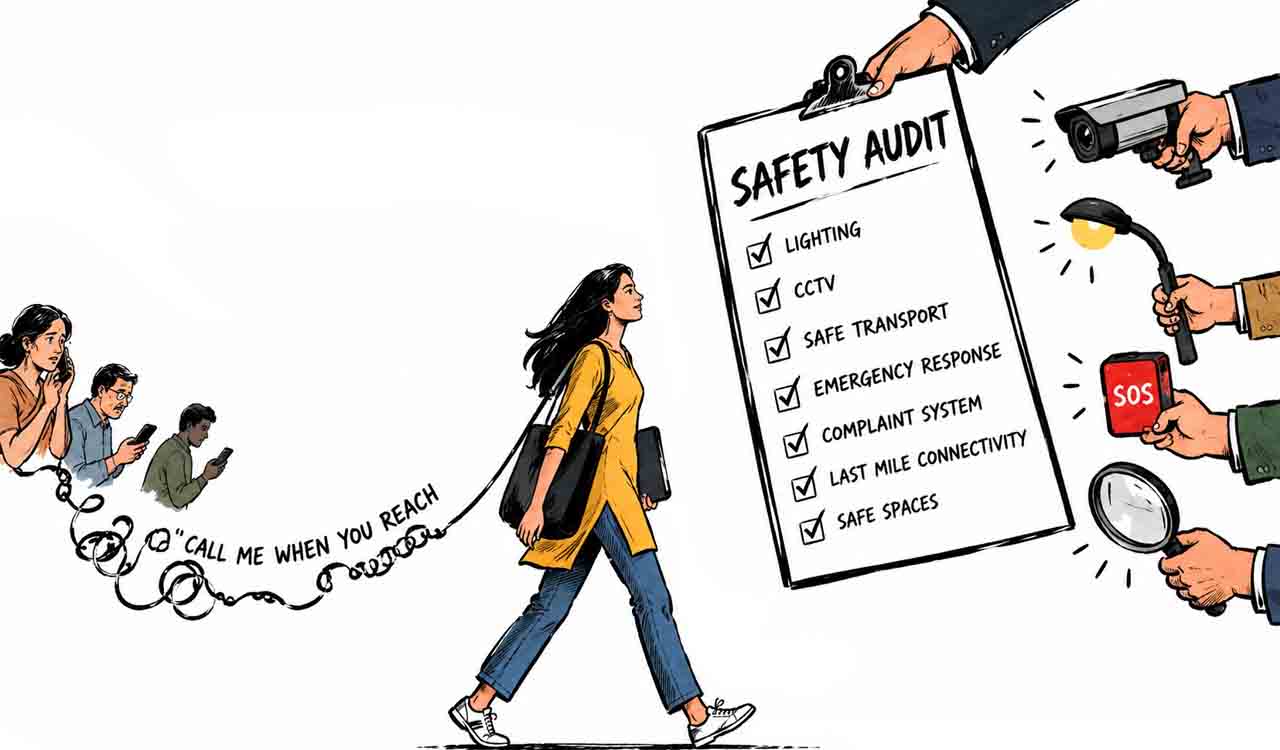
India has a women’s safety system that appears on no government map. It is the father waiting outside an office long after his own working day has ended. The mother who stays awake until the key turns in the door. The brother on the phone through the last kilometre of a journey. The husband tracking a cab. The friend who says, “Call me when you reach.”
Also Read
It is also the woman herself — choosing the brighter road, checking the number plate, sharing her location, reconsidering the late meeting, calculating the distance between the bus stop and home.
We rarely count any of this as infrastructure. But perhaps we should.
Architecture of Protection
For generations, Indian families have quietly built their own architecture of protection around women. Some of it has been loving; some restrictive. Women have rightly challenged those restrictions. Freedom cannot mean being protected by being prevented from participating in the world. Yet beneath these practices lies a truth we should not romanticise away: fear has been privatised into the household, and risk has often been transferred to the woman.
India has changed profoundly. Women lead companies, laboratories, hospitals and institutions. Yet an extraordinarily accomplished woman and a college student can still perform the same small arithmetic before travelling home: What time is it? Which road? Who knows where I am?
A truly safe society should make that arithmetic increasingly unnecessary.
Women’s Resilience
For years, we have celebrated women’s resilience. It is a beautiful word, but sometimes an unfair one. We invoke it when survivors rebuild, when mothers turn grief into action, and when families spend years pursuing justice. Resilience tells us something admirable about women. It may also tell us something uncomfortable about what we have required them to endure. What women’s safety now needs, alongside resilience, is insistence.
Insistence belongs to the moment before tragedy: that risks be identified before women encounter them; that safeguards work rather than merely exist; that families understand the path to justice without requiring influence or extraordinary perseverance.
Resilience tells us something admirable about women. It may also tell us something uncomfortable about what we have required them to endure. Women’s safety now needs not just resilience, but also insistence
I arrived at this distinction slowly. More than a decade ago, my work began with advocacy for women in STEAM. As our community grew, we discovered that empowerment could not be separated from safety. By 2015-16, our engagement had expanded into initiatives addressing violence against women. In Hyderabad, we participated in the wider ecosystem of programmes around the 16 Days of Activism, including initiatives during the tenure of US Consul General Katherine Hadda, when women’s empowerment and gender-based violence were prominent areas of engagement.
Advocacy gradually became handholding. In 2024, we hosted a conference in New Delhi on women’s safety and the prevention of rape, bringing together voices from policy, law enforcement, law, education and civil society. Later, meeting victims’ families and listening to their journeys through police procedures, courts, documentation and waiting rooms changed the nature of the question for me. It was no longer only: What should happen after a crime? It became: What should have happened before it?
Safety Audit
That question lies at the heart of the proposed National Framework for Women’s Safety that we are working towards as a parliamentary initiative. One idea within it is remarkably ordinary: audit safety before tragedy audits it for us.
We inspect buildings for fire hazards before they burn. We audit finances before institutions collapse. We inspect food before it makes people ill. We do this because civilisation rests, in part, on a simple agreement: foreseeable danger should not have to become disaster before it deserves attention.
Why should women’s safety be different? A Safety Audit could examine CCTV functionality, lighting, blind spots, access controls, complaint mechanisms, emergency response, workplace safeguards, and last-mile connectivity. Its purpose is not to find fault. It is to find risk — before a woman does.
The rape and murder of a young doctor at Kolkata’s RG Kar Medical College and Hospital brought home a difficult truth: education, professional accomplishment and independence cannot compensate for an unsafe environment. Nor can technology alone.
Cab apps now allow journey sharing and SOS alerts. Home-service platforms use verification and safety protocols. These innovations acknowledge something important: safety can be designed. But an SOS button is meaningful only if somebody responds.
A CCTV camera protects only if it works. A committee matters only if a woman trusts it enough to complain. So we must graduate from asking whether a safeguard exists to asking whether it works.
The proposed framework connects that principle across five areas: education and early sensitisation; police, legal and victim assistance; workplaces and public spaces; transport and urban planning; and support, mental-health and rehabilitation systems. Many interventions need not wait for national legislation. States, cities and institutions can begin identifying vulnerabilities and measuring safety now.
The case of Nikhita Godishala revealed another frontier: what happens when an Indian family must navigate a serious crime overseas? Distance, unfamiliar procedures, and another legal system can compound trauma. Such cases invite us to examine stronger pathways for expedited assistance and coordination for Indians facing violence abroad. Persistence can change a case. But justice should not depend on a family’s capacity for exceptional persistence. That, too, is insistence.
Doing it Together
Women’s safety cannot become a contest between women and men, citizens and governments, or institutions and activists. Few issues offer greater common ground. Families want their loved ones safe. Employers want their employees safe. Governments want citizens safe. Communities want their neighbourhoods safe. And women want something simpler and larger than all of these: the freedom to live without continuously calculating danger.
The task, therefore, is not to find someone to blame. It is to find what remains undone — and do it together. Over the years, India has progressively strengthened laws, established institutions, expanded specialised policing and judicial mechanisms, and invested in women’s safety initiatives.
Technology companies and civil society have added further layers of support. The opportunity now is to connect these efforts into an increasingly measurable architecture of prevention. We must insist and ask: “We have come this far. What can we build next?”
We must ask whether safeguards work. Insist that vulnerabilities are identified. Insist that families can navigate justice with dignity. Insist that prevention receives as much attention as response. And insist that women’s safety remains above politics, geography and ideology.
For generations, Indian women have been taught resilience. Perhaps progress can be measured by how little of it the next generation is forced to summon. By the mother who no longer watches the clock. By the daughter who accepts the opportunity without first calculating how she will return home. By the woman whose freedom no longer depends upon another person’s availability to accompany her.
And perhaps, one day, by the disappearance of four ordinary words from millions of nightly conversations: Call me when you reach.
Until then, we must insist.
(The author is an activist, advocate for women in STEAM, and a support partner for MCRF Consortium, part of a Private Member Bill for women’s safety)

Related News