
Punch Trade’s safety-first design: how a deep discount broker is making risk management the default, not an afterthought
The steps a trader would otherwise need to take between an entry decision and the protective wrapper around that entry are taken before the trader gets to them. That structure shows up in three places inside the platform.


Indian retail trading has changed character over the last decade. The number of demat accounts has multiplied many times over, and the share of those accounts active in equity futures and options has grown alongside them. SEBI’s investor protection mandate, articulated through study group reports and successive policy interventions, has spent sustained bandwidth on the conduct of retail derivatives traders — the rate at which positions are opened and closed, the size of those positions relative to capital, and the realised outcomes published in the regulator’s own retail studies. Within that environment, a thinner cohort of newer brokers has started treating the question of trader conduct not as a disclosure problem alone but as a product-design problem.
Punch Trade, a deep discount broker run by Market Pulse Securities, sits inside that thinner cohort. The company’s principle on the safety question is straightforward: risk control is built into the platform’s default state, rather than offered as a parallel feature an active trader has to remember to enable. The intent is not to slow trading down in general — it is to remove the friction from doing risk management itself. The steps a trader would otherwise need to take between an entry decision and the protective wrapper around that entry are taken before the trader gets to them. That structure shows up in three places inside the platform.
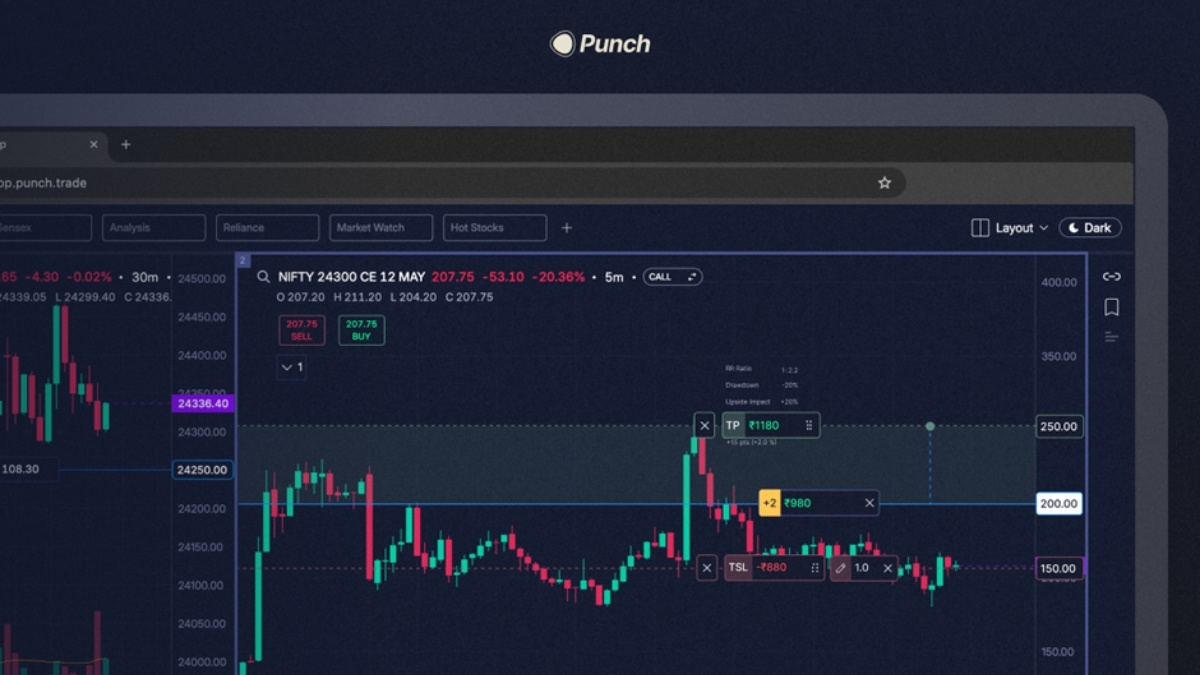
The first is Preset SL/TP. Traders configure a default stop-loss distance and a default target distance — usually as a percentage or a points value — at the start of the session. After that, every order the trader places carries those values as a stop and target leg, attached automatically the moment the entry executes. The configuration is platform-wide rather than tied to a single order channel: the same defaults attach whether the order is fired from the order ticket, dragged onto the chart, or routed through the one-tap order toolkit. The protective wrapper is built into the order placement step, not added on after.
The second is Protection Orders. Once an entry is filled, users can drag and drop SL and target without any extra margin. They are wired in by default — leaving them in place is the path of least resistance; removing either leg requires the trader to take an explicit action. That reorients the convention in many trading apps, where a downside boundary is something the trader has to remember to add rather than something they have to actively step around.
The third is Kill Switch. When a session has gone in a direction the trader does not want to extend — a string of losses, a misread setup, a moment to step away — Kill Switch locks further trading for a duration the trader picks. On activation, open positions are squared off and pending orders cancelled. Once locked, it cannot be reversed: the trader stays out for the full duration, even if conviction returns mid-window. That irreversibility is the point. A typical kill-switch only blocks new orders, leaves existing exposure in the market, and usually allows an override before expiry. Industry-standard implementations also lock for a fixed 12-hour window; on Punch, the duration is the trader’s own choice — but once chosen, it holds.
Three product facts sit around the safety stack. Brokerage on Punch is held at ₹1 for every executed order, charged uniformly whether the trade is in equity, futures or options; access to the platform itself does not carry an additional subscription cost. The charts on the platform are built inside Punch by the company’s engineering team — they are not a third-party charting product. And the queue of features that ship on Punch is published as Builder’s Lab — an open page where traders log feature requests, upvote what others have asked for, and watch the prioritised items move into the engineering pipeline.
Punch’s product set is narrower than the established broker landscape. Coverage stops at equity, futures, options and ETFs — there is no commodity or currency trading, no mutual fund or IPO platform, and no fixed-income or bond product. There is no API for programmatic order placement, and the order-type catalogue does not include the conditional varieties — AMO, GTT, bracket, cover — that some longer-running platforms list alongside their standard order set. Traders covering cross-asset positions or running rule-based strategies will need to keep a second account alongside Punch.
These defaults are not framed by Punch as a guarantee against trading losses. Three failure modes are worth being explicit about. Stop-loss orders — Preset SL/TP and Protection Orders both — can still trigger at a price worse than the configured level when the market gaps or thins out in low-liquidity sessions. Preset SL/TP values are only as good as the volatility judgement built into them; a stop calibrated for a routine session can be too tight on a high-volatility day. And Kill Switch is a self-imposed pause rather than an external lockout — the duration is set by the trader, and once the window expires, trading on the account is open again. The safety stack shifts the default state in which an active trader operates; it does not reverse market outcomes once a trade has been placed.

