
Satyukt Analytics: How Patented Nitrogen Sensing Is Tackling Fertilizer Waste and Changing Crop Economics for Indian Farmers
Every season, millions of Indian farmers make the same calculation: more urea means better crops. It is a logic born from decades of subsidized pricing, inherited farming practice, and the absence of any credible alternative.
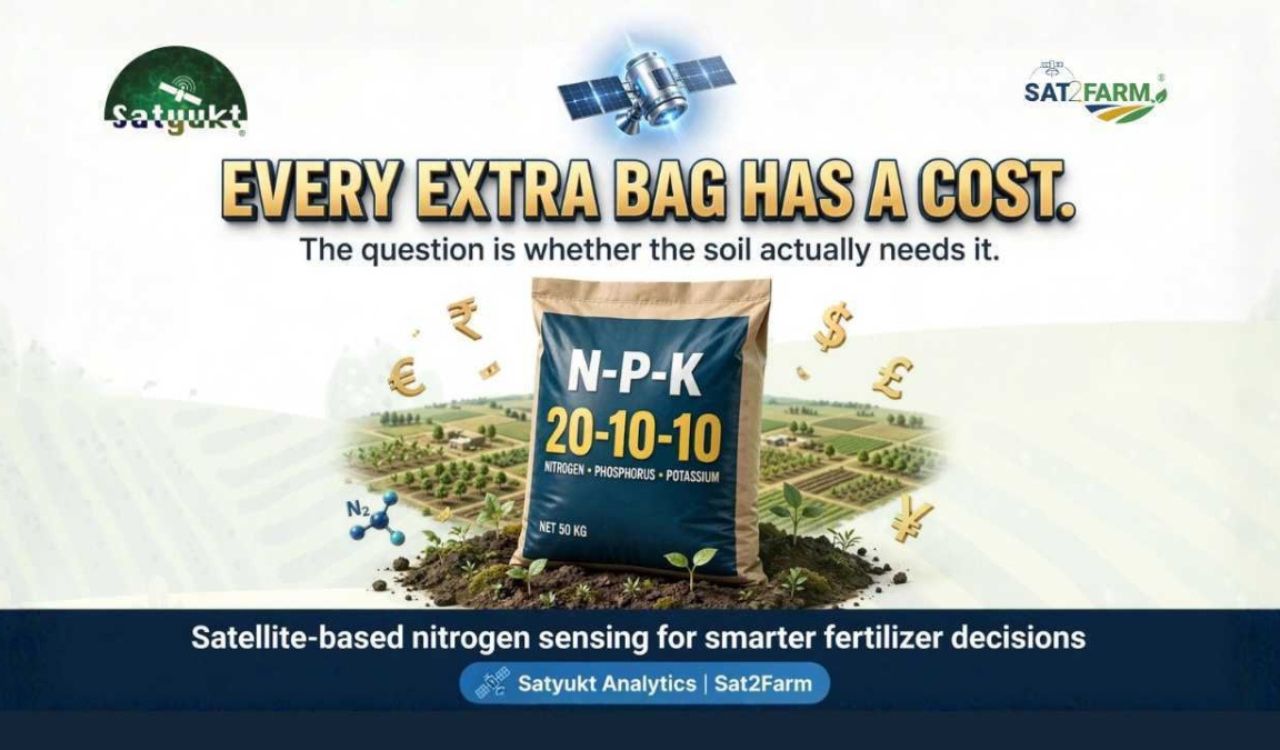


A technology developed in Bengaluru is doing what decades of policy couldn’t — telling farmers exactly how much nitrogen their soil actually needs
Every season, millions of Indian farmers make the same calculation: more urea means better crops. It is a logic born from decades of subsidized pricing, inherited farming practice, and the absence of any credible alternative. The result is a fertilizer crisis hiding in plain sight — one that is quietly eroding soil health, contaminating groundwater, and costing the country far more than the bill suggests.
India spends approximately ₹1.19 lakh crore annually on urea subsidy alone. Total fertilizer subsidies for FY 2026-27 are estimated at around ₹1.7 lakh crore. These are staggering numbers, but the more damaging figure lies in what that spending has produced: a catastrophic imbalance in how farmers apply nutrients to their land.
The ideal NPK (nitrogen, phosphorus, potassium) ratio for Indian agriculture is 4:2:1. During Kharif 2024, the actual consumption ratio had deteriorated to 9.8:3.7:1 — nearly two and a half times the recommended nitrogen load relative to other nutrients. In states like Punjab, Haryana, Uttar Pradesh, and Bihar, the distortion is even more severe. Urea, being heavily subsidized and widely available, has become the default answer to every crop problem, whether it is the right answer or not.
The consequences compound year on year. Excess nitrogen triggers nitrous oxide emissions, a greenhouse gas roughly 300 times more potent than carbon dioxide. Nitrogen leaches into groundwater, contaminating wells and water tables across agricultural belts. Soil microbial activity is disrupted, long-term fertility declines, and farmers find themselves applying more inputs each season to maintain the same yield. It is a debt spiral measured not in rupees but in degraded topsoil.
The Measurement Problem
At the root of this crisis is a problem that policy alone cannot solve: farmers have no reliable, affordable way to know how much nitrogen their soil already contains before they apply more. Traditional soil testing requires physical samples, laboratory processing, and a wait of several days — a cycle that is impractical for smallholder farmers managing multiple plots across a season. The result is guesswork, and the guesses consistently err on the side of excess.
This is precisely the gap that Bengaluru-based agritech company Satyukt Analytics set out to close.
A Patent Built on Satellite Data
In 2024, Satyukt Analytics was granted a patent for a method that had never been successfully commercialized in India: estimating soil nitrogen content using satellite remote sensing. The patent, co-developed by Dr. Sat Kumar Tomer and Dr. Yukti Gill — the company’s co-founders — enables nitrogen estimation at the farm level without any physical soil collection or laboratory testing.
The technology is embedded within Satyukt’s flagship platform, Sat2Farm, a mobile and web application available in Android and iOS. By processing data from earth-observation satellites, Sat2Farm generates hyperlocal soil health reports that include nitrogen levels, soil moisture, crop health indices, and fertilizer recommendations — all delivered to a farmer’s phone.
“People don’t need technology, they need solutions. Technology is only the medium,” Dr. Tomer has said of the company’s approach. The design philosophy shows in the product: Sat2Farm operates in multiple Indian languages, functions on low-end smartphones, and is priced to be accessible to small and marginal farmers — the demographic most vulnerable to input cost overruns.
The Economic Case
The economics of precision nitrogen application are straightforward. A farmer applying fertilizer based on satellite-verified soil data applies less of what the soil does not need and more of what it does. Across a single cropping season, this translates to a measurable reduction in input costs. Multiply that across the 14 crore-plus farm households that Satyukt’s advisory is designed to reach, and the aggregate saving — and the reduction in the government’s subsidy burden — becomes significant.
Beyond individual farm economics, correcting India’s NPK imbalance has a systemic payoff. Healthier soils produce more consistent yields with fewer inputs. Groundwater contamination slows. Nitrous oxide emissions decline. The ₹1.68 lakh crore that the government currently channels into fertilizer subsidies each year could, over time, be redirected toward irrigation infrastructure, agricultural research, or direct farmer welfare — investments with longer-term returns.
From Space to Soil
Satyukt Analytics is not the first company to identify India’s fertilizer problem. It may, however, be the first to have built a patented, scalable, satellite-native solution capable of reaching the farmers who need it most. The company, backed by NABVENTURES, Social Alpha, and C-CAMP, has already deployed across multiple Indian states and operates in over 20 countries globally.
For now, the satellite keeps orbiting. And somewhere below it, a farmer in Punjab opens an app and discovers, perhaps for the first time, that his soil has enough nitrogen. He puts down the urea bag. That, multiplied by millions, is what the economics of precision agriculture actually look like.
Satyukt Analytics Private Limited is headquartered in Bengaluru. Sat2Farm is available on Android and iOS.

