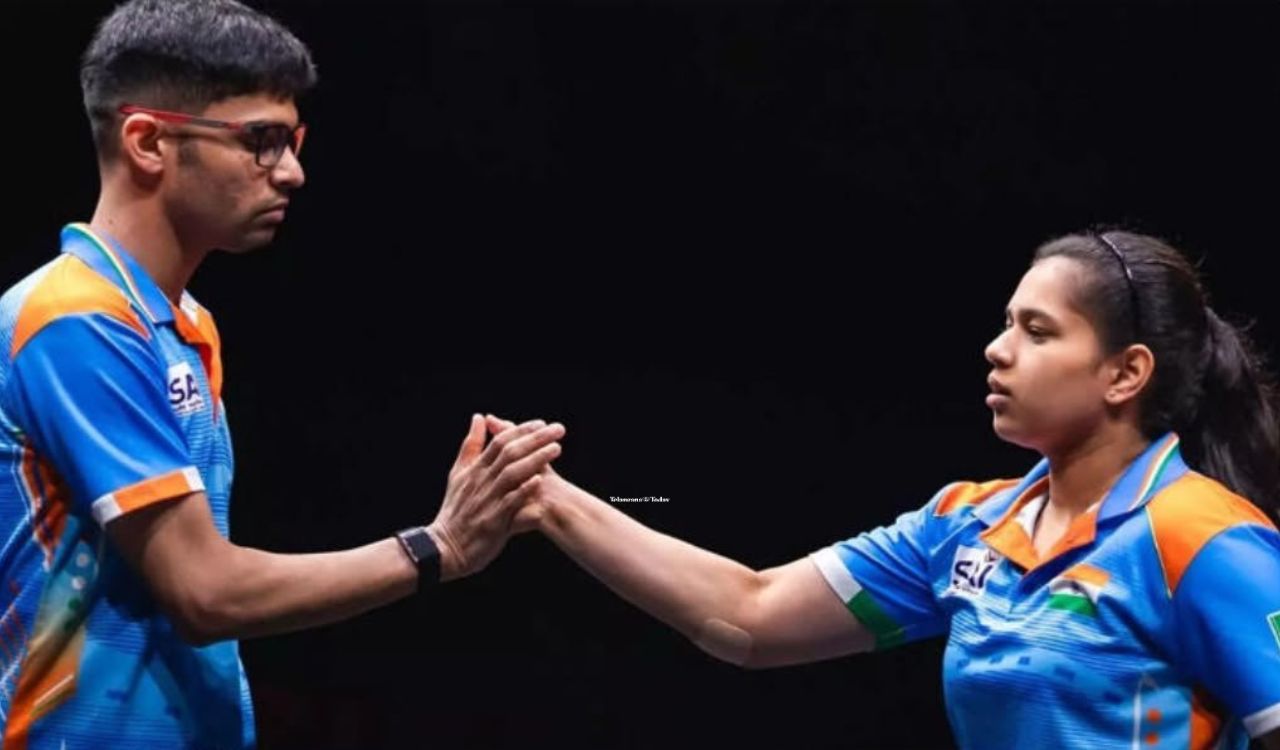
Shimla hosts South Asian Youth Championships as India targets Muscat 2026
The ITTF-ATTU South Asian Youth Championships qualification tournament begins in Shimla, with India entering as the overwhelming favourite. Having swept the previous regional meet in Kathmandu, India’s U-19 and U-15 squads look poised to secure more qualification spots for Muscat 2026.



Hyderabad: The ITTF-ATTU South Asian Youth Championships qualification tournament begins at Indira Gandhi Rajya Khel Parisar in Shimla from Wednesday with familiar expectations—India as the dominant force—but also with renewed intrigue as emerging talents from across the region look to
disrupt that narrative.
India enters the competition, hosted by Himachal Pradesh Table Tennis Association, with a formidable reputation. Their clean sweep at the previous regional meet in Kathmandu, where they amassed 13 gold and three silver medals, underscores their depth across categories. While our U-19 boys have already qualified, the girls have their chance to join them at the Muscat event.
The Under-19 boys’ singles draw reflects both India’s strength and the region’s growing competitiveness. As seen in the entry list, Priyanuj Bhattacharjee—ranked 35th in the world youth standings—and Punit Biswas headline the Indian challenge. Bhattacharjee, in particular, carries momentum and pedigree, having been part of the bronze medal-winning team at the 2025 Asian Youth Championships in Tashkent.
Alongside them are contenders from Nepal, Bangladesh, the Maldives, and Sri Lanka, but the gulf in ranking and experience suggests the Indian duo will be the ones to beat.
The doubles events further underline India’s clear edge. In the U-19 boys’ section, Balamurugan Rajasekaran and Senthil Mehan form the lone Indian pairing, up against a Maldivian duo. The U-19 girls’ draw mirrors that script, with Prisha Goel and Ditsa Roy pitted against the Maldives as well.
With limited entries, both contests may appear straightforward on paper, but they offer India a valuable chance to stamp its technical authority and lock key qualification spots.
In the girls’ singles, India’s depth is equally evident. Jennifer Varghese and Ananya Muralidharan lead the field, ranked 73rd and 138th, respectively. Their closest challengers—from the Maldives, Sri Lanka, Nepal, and Bangladesh—trail significantly in ranking points, reinforcing India’s status as favourites. However, youth competitions often produce surprises, and players like Maldives’ Ali Fathimath could pose resistance.
At the U-15 level, the competition broadens. The boys’ team event features India, Maldives, Bangladesh, and Nepal, with India fielding a balanced quartet that includes Rishaan Chattopadhyay and Aditya Das.
The girls’ team event sees five nations in contention, with India again boasting a strong line-up led by Ankolika Chakraborty and Sreejani Chakraborty. Notably, India’s U-15 boys carry confidence from their historic silver medal at the 2025 Asian Youth Championships.
While India’s qualification in certain categories is already secured, the tournament remains crucial for fine-tuning combinations, gaining match sharpness, and reinforcing dominance ahead of the continental stage in Muscat 2026.
For the visiting nations, this is more than just a qualification event—it is a chance to measure progress and challenge a regional powerhouse.

Related News