South Africa’s ‘sardine run’
Every year, the world’s greatest marine migration takes place off the South African Wild Coast. Millions of silvery Pacific sardines follow the cold winter currents north towards the warm Indian Ocean, bringing with them thousands of predators: dolphins, sharks, whales, seals, and marine birds. One popular explanation for why the sardine run occurs is that […]
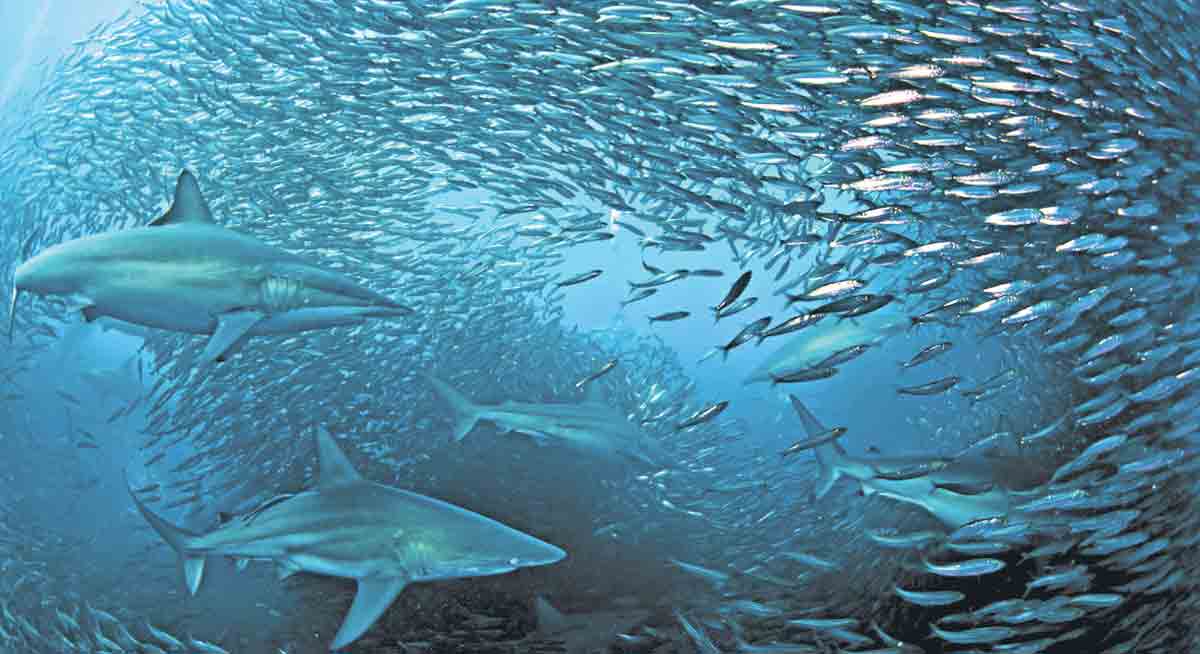


Every year, the world’s greatest marine migration takes place off the South African Wild Coast. Millions of silvery Pacific sardines follow the cold winter currents north towards the warm Indian Ocean, bringing with them thousands of predators: dolphins, sharks, whales, seals, and marine birds. One popular explanation for why the sardine run occurs is that the migration might be a relic of spawning behaviour dating back to the last glacial period, about 10,000 years ago.
The ‘sardine run’
The sardine run occurs from May through July when billions of sardines – or the Southern African pilchard Sardinops sagax – spawn in the cool waters of the Agulhas Bank and move northward along the east coast of South Africa.
The run, containing millions of individual sardines, occurs when a current of cold water heads north from the Agulhas Bank up to Mozambique where it then leaves the coastline and goes further east into the Indian Ocean.
An ecological trap
According to a study published in Science Advances, the sardine run is an ecological trap: a scenario where the fish’s behavior drives them into an unfavourable habitat that decreases their chances of survival.
Predators
Dolphins, mostly the common dolphin (Delphinus capensis), are largely responsible for rounding up the sardines into bait balls. These bait balls can be 10–20 metres in diameter and extend to a depth of 10 metres. The bait balls are short-lived and seldom last longer than 10 minutes.
Once the sardines are rounded up, the bronze whaler, the Cape gannet bird, and Bryde’s whales take advantage of the opportunity. Other whale species, regardless of whether they do or not join the run, may appear in the vicinity such as humpback, southern right, and minke whales.
Those fish that survive the predation still don’t have it easy. The journey is so strenuous that the sardines which eventually arrive on the east coast are emaciated.
Oceanographic influences
Sardines prefer water temperatures between 14 and 20 degree Celsius. Each southern winter the near shore sea temperature along the South African southeast coast drops to within this range.
Along the KwaZulu-Natal coast, sardine may be found in water warmer than 20 degree Celsius.
Factors besides temperature may influence the movement of sardine along the KwaZulu-Natal coastline, one of these factors may be predation pressure.
Major riddles solved
A small fraction of the sardines present on the south coast participate in the run. The bulks of those sardines are native to this region and are adapted to warm-temperate conditions. Because of this, they show little interest in the cold, upwelled water.
The upwelling on the southeast coast attracts west coast sardines that have dispersed to the south coast, but that is not well adapted to the warmer water temperatures in this region.
They essentially consider the upwelling regions in the southeast to be the west coast habitat. For a short time, it is as if they are back home in the Atlantic – but when the upwelling ends and water temperatures rise, their fateful error is revealed.
(BLURB) The oldest known record of the run is a mention in the Natal Mercury newspaper of August 4, 1853. More recently, the run has been the subject of natural history documentaries (the BBC’s Nature’s Great Events) and printed popular media (National Geographic).
Now you can get handpicked stories from Telangana Today on Telegram everyday. Click the link to subscribe.
Click to follow Telangana Today Facebook page and Twitter .

Related News