Study planned to ease traffic bottlenecks on JNTU-Miyapur-Raidurg corridor
A comprehensive study will examine traffic bottlenecks, pedestrian safety and last-mile connectivity along Hyderabad’s 8.5-km JNTU-Miyapur-Raidurg corridor. The plan includes continuous walkways, pedestrian crossings, dedicated pick-up and drop-off bays, regulated auto stands and measures to decongest school zones.
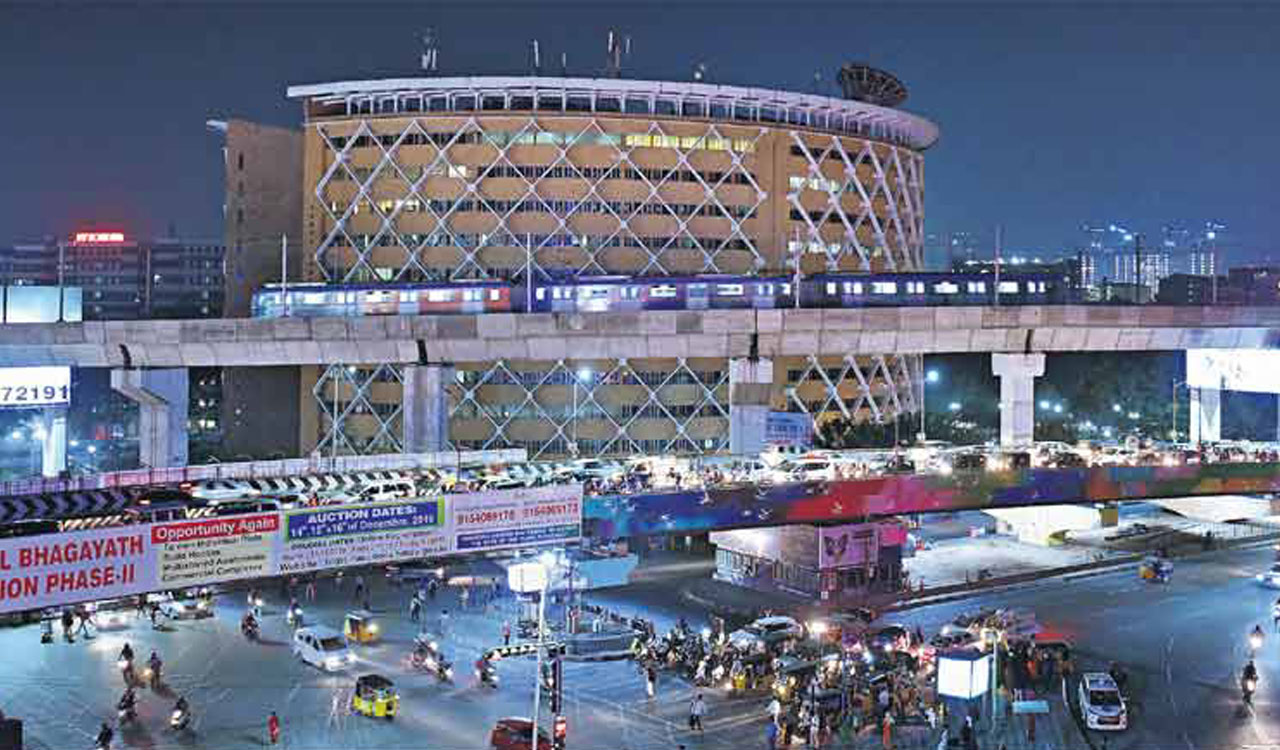


Hyderabad: The 8.5-km JNTU–Miyapur–Raidurg corridor is one of Hyderabad’s most vital links between several major residential areas and a bustling employment zone in the IT corridor.
However, for scores of professionals who shuttle for work, several traffic bottlenecks mar their daily commute, mainly getting worse near the Raidurg Metro Station.
As the corridor approaches Raidurg, the road configuration abruptly shifts. Broad multi-lane avenues suddenly constrict into narrow, single-lane bottlenecks. This creates a ‘funnel effect’ where thousands of vehicles, surging from the Miyapur and Kukatpally directions, are forced to squeeze into a limited carriage space.
The sudden reduction in road width completely breaks the traffic flow, causing bumper-to-bumper tailbacks that paralyse the surrounding grid.
In the recent convergence meeting, Cyberabad Municipal Corporation (CMC), TGSRTC and Cyberabad traffic police officials decided to map ‘break-points’ across the JNTU–Miyapur–Raidurg corridor through a study to eliminate missing footpath links and commercial encroachments.
The study will mandate the construction of continuous, barrier-free walkways and safe, highly visible pedestrian crossing zones.
“The strategic review meeting aimed to permanently re-engineer the heavily choked IT artery,” a CMC engineering official told ‘Telangana Today’.
The study is also aimed at dismantling one of Cyberabad’s most punishing bottlenecks through a comprehensive blueprint for a traffic mobility and last-mile connectivity study on the 8.5-km JNTU–Miyapur–Raidurg corridor, he said.
The proposed last-mile transformation of the 8.5-km JNTU–Miyapur–Raidurg corridor will fundamentally alter how hundreds of thousands of people commute daily between Hyderabad’s major residential suburbs and its prime IT district, the CMC engineer explained.
A structural overhaul of a Cyberabad corridor will separate school-zone bottlenecks from active traffic lanes, aiming to ease daily gridlock, improve traffic flow, and save commuters’ travel hours, said the CMC official.
- Study of an end-to-end audit of the 8.5-km transit corridor
- Aim to optimise pedestrian safety, traffic management, and seamless multi-modal connectivity
- Dedicated pick-up/drop-off bays
- Regulated auto stands
- Decongesting school zones
- Off-carriageway drop-offs

Related News
-

Graduate voter enrolment sluggish in Telangana, 3.55 lakh applications received
-
Cyberabad commissioner directs officials to improve upkeep of sports facilities
-
KTR alleges Rs 3,000-crore coal import scam, seeks white paper on power crisis
-
Five IAS officers deployed to review Yadadri plant operations