Telangana’s drought concerns bring Kaleshwaram scheme back into focus
Telangana's drought concerns have renewed focus on Kaleshwaram's role in storing and distributing Godavari water. Damage to Medigadda and low reservoir levels have constrained the system, while the BRS urges the government to use available river flows to protect crops.
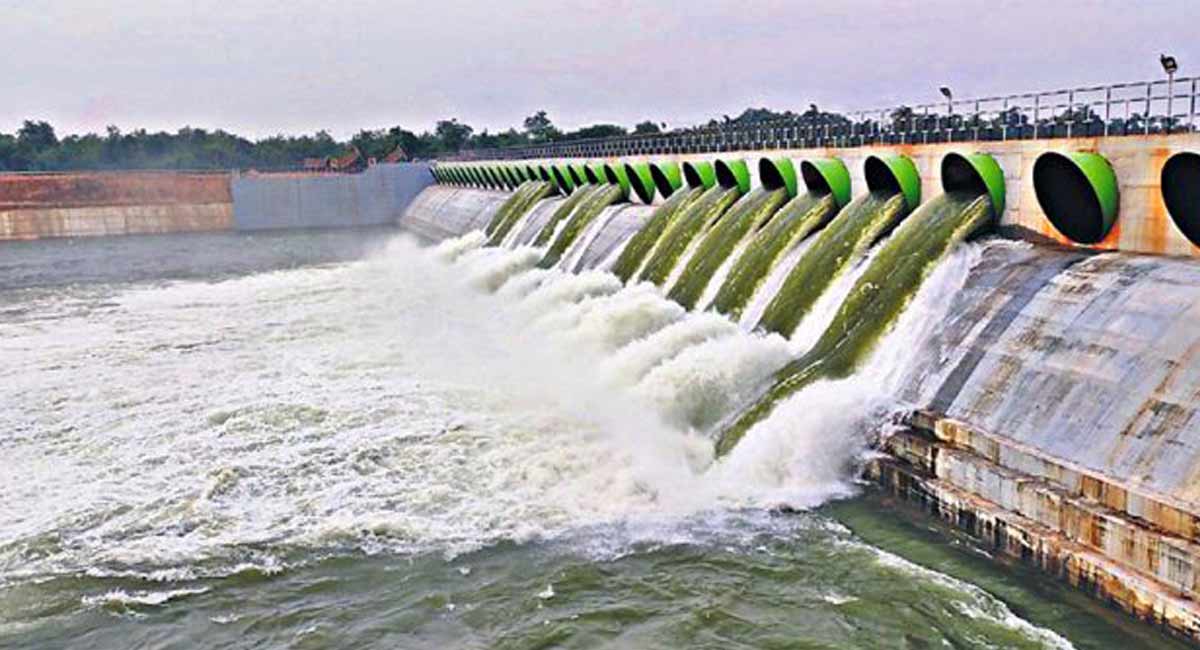


Hyderabad: Telangana’s struggle to protect crops and secure drinking water amid deficit rainfall due to El Nino conditions has brought the Kaleshwaram Lift Irrigation Scheme back into focus. Conceived to capture Godavari River water and move it across drought-prone regions, the project could have provided the State with a crucial buffer against erratic monsoons and prolonged dry spells if its pumping, storage and distribution network had been fully operational.
The project’s central advantage was not merely the volume of water it could lift, but its ability to store it across a network of reservoirs and well-connected water bodies, including a chain of minor irrigation tanks, making it available beyond the monsoon. However, the damaged Medigadda barrage and the Congress government’s reluctance to carry out repairs or at least operate the pumps to lift available water and replenish reservoirs using existing infrastructure had severely restricted the State’s water security.
The Kaleshwaram project was designed to irrigate 18.26 lakh acres of new command area and supplement water supplies to another 4.71 lakh acres under existing projects. It comprises 14 reservoirs, three barrages, 31 lifts and 1,832 km of canals, tunnels and pipelines. The reservoirs were planned with a combined capacity of about 147.71 TMCft, including 125.18 TMCft of live storage.
That storage capacity could have been decisive during a deficient monsoon. Water lifted during periods of substantial Godavari River flows could be retained in reservoirs and then released in stages to support irrigation when rainfall weakened. The network was also intended to supplement existing irrigation systems facing shortages, potentially reducing pressure on farmers dependent on uncertain rainfall and groundwater.
During the previous BRS government, water was lifted from Medigadda to Yellampally and moved through the network to Mid Manair and other reservoirs. Supplies were also extended to Ranganayaka Sagar and existing irrigation projects. Irrigation officials lifted more than 25 TMCft annually for three years to protect standing crops. Reservoir storage also helped stabilise existing command areas and improve groundwater levels.
Kaleshwaram was part of a wider water-security strategy of the previous BRS government. Mission Kakatiya aimed to restore thousands of minor irrigation tanks by desilting beds, repairing feeder channels and strengthening tank infrastructure. The programme was intended to improve local water storage, groundwater recharge and irrigation reliability, complementing major projects such as Kaleshwaram. Mission Bhagiratha was designed to provide assured drinking water through a network drawing on reservoirs and other sources.
That stored water mattered in October 2023, when the State was already facing a weak monsoon and dwindling inflows. The Krishna River Management Board said the scope for irrigation releases from the common Krishna basin reservoirs had been ruled out and asked Telangana and Andhra Pradesh to prioritise drinking-water requirements.
The Medigadda barrage’s structural failure on October 21 further disrupted the Kaleshwaram system, forcing water to be released from the barrages and halting normal lifting operations. Yet the water already moved into other reservoirs and local storage systems did not disappear with the barrage failure. Those reserves gave officials options to manage supplies even as the project’s central intake was compromised.
The political context was also difficult. The Assembly election code had come into force, restricting major policy decisions by the caretaker government led by K Chandrashekhar Rao. However, routine water management continued through the irrigation machinery. Officials could manage available water because the network had distributed it across the system before the crisis deepened.
But the available storage buffer is now under pressure. The BRS has repeatedly asked the government to use Godavari River flood flows to replenish reservoirs. Mallanna Sagar currently has 13 TMCft of water against its 50 TMCft capacity, while Kondapochamma Sagar has six TMCft against 15 TMCft. Annapurna and Ranganayaka Sagar are near dead-storage levels. Pumping water could have protected nearly five lakh acres and supported drinking-water needs.
Kaleshwaram cannot eliminate drought or guarantee supplies without adequate river flows. But its effectiveness depends on functioning pumps, safe barrages and the ability to transfer and store water when it is available. The immediate challenge for the Congress government is to capture available flows and ensure that stored water reaches farms and households when they need it most.

Related News