Uncertainty grips Vaishno Devi medical college as NMC withdraws permission
Uncertainty has engulfed the Shri Mata Vaishno Devi Institute of Medical Excellence in Katra after the NMC withdrew its letter of permission, citing non-compliance, even as faculty and students allege political pressure behind the decision following protests over admissions
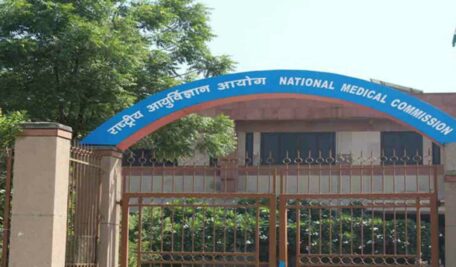


Katra/Jammu: Clouds of uncertainty hung over the Shri Mata Vaishno Devi Institute of Medical Excellence in Jammu and Kashmir‘s Katra after the National Medical Commission abruptly withdrew its letter of permission to the institute, stalling it just months after its inaugural session commenced.
While the Medical Assessment and Rating Board (MARB) of the National Medical Commission (NMC) cited a failure to meet “minimum standards” following a surprise inspection on January 2, faculty and students allege that the decision was fuelled by local political pressure rather than academic deficiencies.
The withdrawal follows weeks of protests by the Sangharsh Samiti, a conglomerate of right-wing organisations backed by the BJP, demanding the cancellation of the current batch’s admissions to 42 Muslim students from Kashmir, seven Hindus and one Sikh candidate.
All of them qualified through the National Eligibility-cum-Entrance Test (NEET).
The conglomerate was lobbying for the college to scrap the current merit-based list and reserve all seats exclusively for Hindu students.
Despite the NMC’s claims of non-compliance, faculty members, speaking on the condition of anonymity, defended the institution as one of the best in the Union territory.
“We got the permission after a lot of hard work and investment. We have the best infrastructure and faculty, and whatever is required to run a medical college was in place,” a senior faculty member said, questioning the decision of the MARB.
The order issued by the MARB on Tuesday evening said that all students admitted to the college during the counselling for the 2025-26 academic year shall be accommodated in other medical institutions in Jammu and Kashmir as supernumerary seats by the competent authority of the UT administration.
There has been no official communication from the medical college so far.
The faculty members said the NMC findings can be contested point-by-point and “everyone knows what led to the inspection and the subsequent decision, especially in view of the unrest created in the Jammu region”.
Highlighting the human cost of the decision, another faculty member said that around 150 people left their jobs in government and private sectors and joined the institution, who are now left concerned for their future.
The faculty members also questioned the “unusual haste” of the NMC’s decision, arguing that standard administrative protocols were bypassed as the institute should have been served a show-cause notice first, allowing for a formal response and a window for rectification.
“The established procedure involves a reply to a show-cause notice,” a faculty member said, adding, “If the response is deemed unsatisfactory, the matter is typically escalated to the Union health ministry for a final hearing before such a drastic measure as derecognition is taken.” The faculty member said that being one of the best institutes, which was in a developmental phase, the NMC’s move came as a setback for the medical college.
“We know that the NMC order does not mean that the institute will be closed forever. We are hopeful that the shrine board will work out the next course of action and safeguard the staff and the future of the institution,” he said.
Referring to the option of reapplying for the letter of permission, the faculty member said it may not resolve the issue.
“We can apply afresh in response to the notification at any time, but it may not be helpful because the situation could be the same. What is needed is to avert this situation altogether and ensure long-term measures so that the institute runs smoothly,” the faculty member said.
Possible alternatives
Outlining the possible alternatives, he said, “We have two options. One, the Chief Minister issues a no-objection certificate so that admissions are done through Central counselling, allowing students from across the country to join purely on merit, like in the Sharda University in Uttar Pradesh.” The second option, he said, is to seek deemed university status.
“We are already running three of the five required faculties – medicine, nursing and social sciences (Gurukul). We need two more, such as allied health sciences and public health specialisation. This can be done under the leadership of the shrine board chairman and may take about a year,” he said.
“The college has the potential to be one of the best medical colleges in the country, given its infrastructure and facilities. I have visited many medical colleges in India and abroad, but this one had better infrastructure and faculty compared to the other colleges in J-K,” another faculty member said.
Students also expressed distress over the withdrawal of permission, describing the decision as “heartbreaking”.
“We secured admission through a competitive exam, and the NMC’s decision has come as a shock because we did not expect such a development at the beginning of our course,” Bilquis, a student from Budgam, said.
She added that they faced no problems or discrimination based on religion on the campus.
Mahit Srivastava, a student from Udhampur, termed the decision “very unfortunate” and said “it (the protests) served as an example of “axing one’s own feet”.
“I was confident that the college would earn a strong reputation in the coming years. Suspending the course is a big mistake and a major loss for us as well as our region. We have no idea where we will be shifted. We are confused and do not know anything,” he said.
Another student said they got admission solely based on merit.
“The facilities were outstanding, which nobody can question. We did not face any trouble inside the campus despite the protests outside by right-wing groups. We were living in harmony. This decision has left us heartbroken,” the student said.

Related News