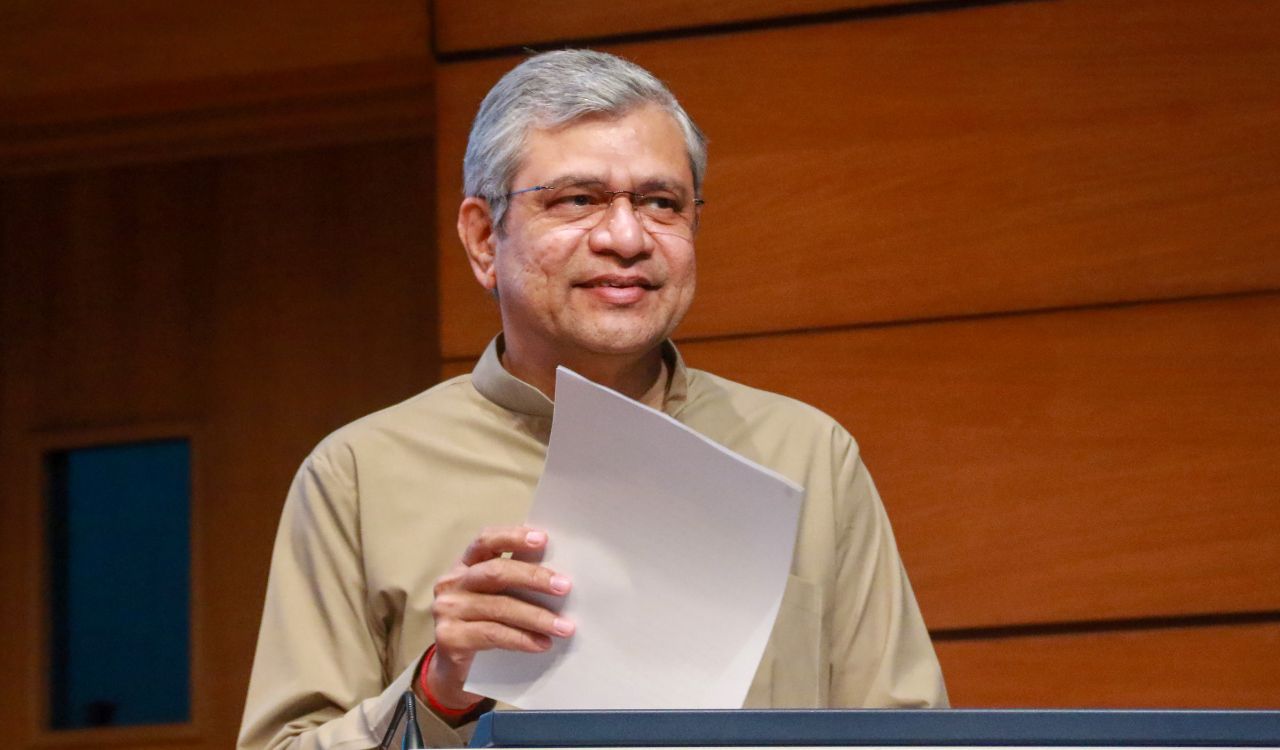
Vaishnaw expects more companies to start production of memory chips in India
India will see rising investments in memory chip manufacturing as demand for AI and data centre storage surges, Union Minister Ashwini Vaishnaw said. Under the India Semiconductor Mission, new fabs, design, and equipment manufacturing are planned to boost domestic semiconductor capacity


New Delhi: New companies are likely to invest in India to manufacture memory chips while existing investors will scale up production to address the demand-supply gap in the segment, Union minister Ashwini Vaishnaw said in an interview to PTI.
Strong demand for memory (data storage) cards and advanced chips has tightened global supplies and supported higher prices in past quarters, and manufacturers have been sprucing up investments and production capacities to meet market requirements worldwide. The higher memory chip prices have, in turn, led to a rise in production costs for a range of electronic products, including smartphones and laptops.
“Definitely, a lot more investment is coming in the memory manufacturing units, and that is because for the first time in the way the semiconductor industry has grown at such a rapid pace, for the first time we are seeing a huge shortage of certain components which are required in the AI data centres, the high bandwidth memory chips,” Vaishnaw said.
Data centre investments in India are expected to cross USD 200 billion soon, which may need billions of gigabytes of storage capacity.
The minister said there is a global phenomenon of supply-demand imbalance, which is now getting filled up by setting many more units.
“For example, there are the high bandwidth memory chips, which are manufactured by Micron. They are the first plant to start commercial production on February 28th this year. This is the second plant which started commercial manufacturing on March 31st. These are the steps which have started giving results. There is a serious supply-demand mismatch in the case of memory,” he said.
When asked if there will be new investments in the memory chip segment or only existing players have plans to ramp up production, Vaishnaw said, “Looks like both might happen”.
He said the India Semicon Mission 1.0 could get about 48 startups to work on the tech products.
“In ISM 2.0, that will be the topmost priority, design will be the topmost priority. The second biggest priority will be machines, which are used in the manufacturing of semiconductors. We will seriously be looking at getting the equipment manufacturers to come to India for designing the equipment as well as manufacturing the equipment,” Vaishnaw said.
The minister said that after decades of effort, India has been able to attract chip makers to the country under Prime Minister Narendra Modi’s regime, as the India Semicon Mission 1.0 programme sets the foundation for a robust domestic semiconductor industry.
He said that work is in advance stage for ISM 2.0, under which chip design will be a topmost priority.
The minister said the government will also look at the indigenous production of complex chemicals and gases that are used for manufacturing chips.
“Of course, we will be adding many more fabs (chip manufacturing plants) and ATMP (chip packaging) units. We will be carrying forward the progress we made in talent development in the first version of the semiconductor mission,” Vaishnaw said.
Talking about rising investment in the data centre space in India, the minister said the large pool of talent availability in India is one of the basic reasons that is attracting companies from across the globe to set up their units in India.
“Second, our grid is practically a new grid. More than 2 lakh kilometres of transmission lines have been constructed in the last decade. Unbelievable upgradation of transmission is happening. It is a very robust grid. Third is the large availability of renewable energy in our country. Practically 50 per cent of our power generation capacity is from renewable sources,” Vaishnaw said.
He said that these three big factors are attracting the hyper-scalers to come to India.
“Many countries, including some of the rich countries, have grids which are 30- 50 years vintage, which are causing imbalances when the power requirement at the data centre grows significantly higher. That is very different from the robustness of our grid, which has happened in the last few decades,” the minister said.
When asked about environmental concerns around data centres, Vaishnaw said, “Of course, we are following very stringent norms. Many innovations are also coming up. Innovations in terms of power requirement, water, and using certain water cooling methods, which reduce water requirement by about 70 per cent. Those kinds of innovations are happening.” There have been concerns on growing power and water consumption by data centres across the globe.
According to a study by Mordon Intelligence, water consumption by data centres in India is estimated at 150.30 billion litres in 2025, and is expected to reach 358.66 billion litres by 2030.

Related News