Water Purifiers with Affordable Maintenance Costs: Features and Prices to Consider
The best choice depends on your water source, household needs and the cost of keeping the machine working. Among the many options, Livpure and Eureka Forbes water purifiers are popular. However, before you choose a brand, check service charges and replacement parts alongside other features to compare them and make the right choice.
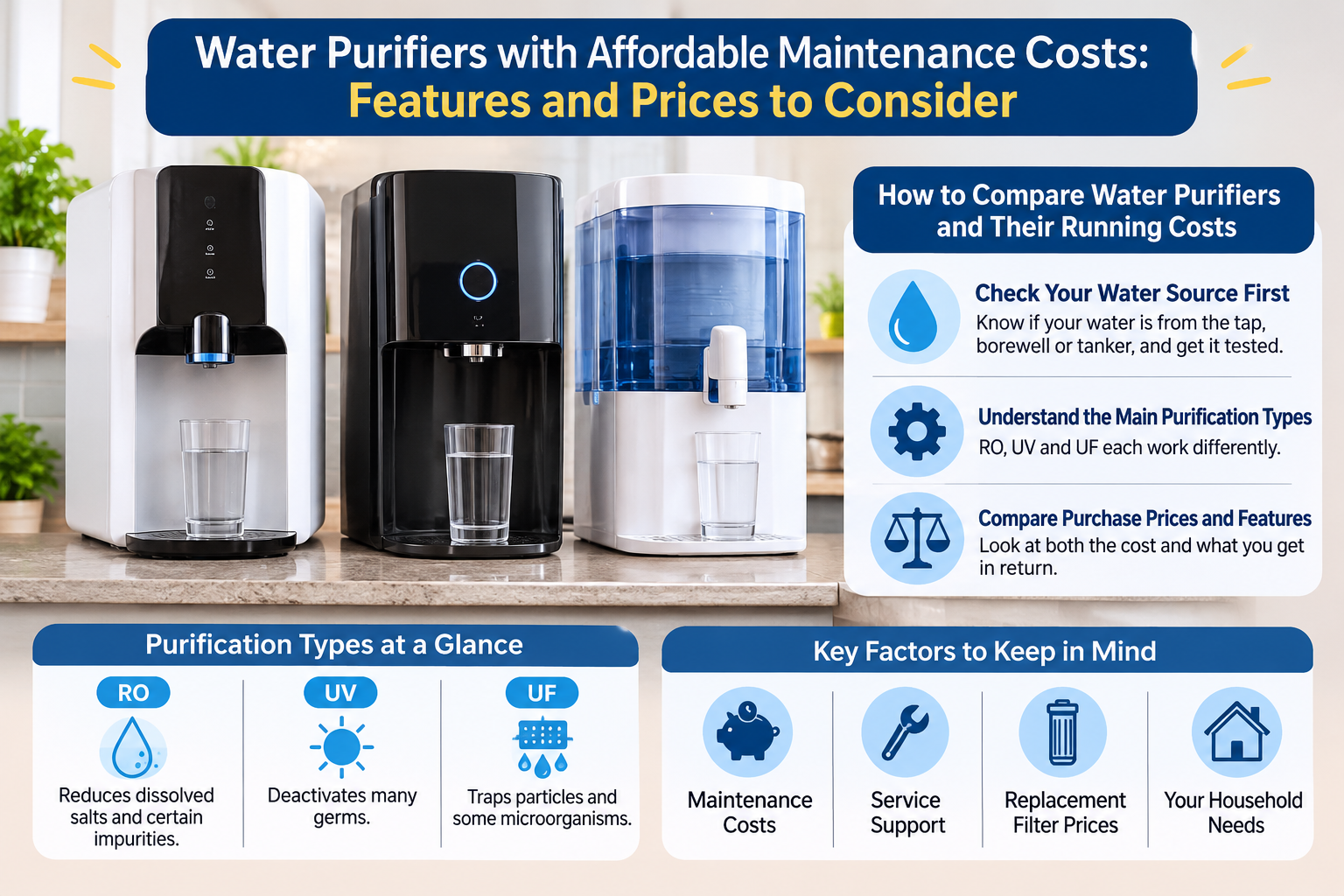


Buying a water purifier means looking beyond its price tag. Filters need replacing, parts can wear out, and service visits can add to your yearly bill.
The best choice depends on your water source, household needs and the cost of keeping the machine working. Among the many options, Livpure and Eureka Forbes water purifiers are popular. However, before you choose a brand, check service charges and replacement parts alongside other features to compare them and make the right choice.
How to Compare Water Purifiers and Their Running Costs
Check Your Water Source First
Before buying, find out where your water comes from. If supply changes by season, mention that when arranging a test, since water quality may not stay the same throughout the year.
Municipal water, borewell water and tanker supplies can contain different levels of dissolved salts and other impurities. If possible, get the water tested instead of relying on taste, smell or appearance.
A test can help you decide whether you need RO, UV, UF or a combination. Buying a purifier with unnecessary features may increase the purchase price and maintenance costs.
Understand the Main Purification Types
- RO (reverse osmosis): Uses a special membrane to reduce dissolved salts and certain impurities. It is often considered for water with high dissolved solids.
- UV (ultraviolet): Uses ultraviolet light to deactivate many germs. It does not remove dissolved salts.
- UF (ultrafiltration): Uses a fine membrane to trap particles and some microorganisms, but does not remove dissolved salts like RO.
Compare Purchase Prices and Features
As a rough guide, basic models may cost around ₹5,000–₹8,000, while many RO or RO-plus-UV models cost ₹8,000–₹20,000 or more.
Useful features to check include:
- A storage tank suited to your family size.
- A filter-change indicator, if available.
- Clear warranty terms and access to authorised service.
- Installation included in the quoted price.
- Replacement filters that are readily available.
Find Out the Price of Replacement Filters
Filters are regular expenses, and their replacement schedule depends on water quality and daily use. Sediment and carbon filters may need changing every few months, while an RO membrane may last longer. Poor water quality or heavy use can shorten their life.
Before buying, ask the seller for the price of each filter, its usual replacement interval and whether labour is included. Also check whether replacement alerts are based on actual use or a fixed timer.
For instance, a Livpure water purifier can also become expensive if the chosen model’s filters are costly or difficult to find. Check whether genuine replacement parts are readily available to ensure better access and quick support.
Check Service Charges and AMC Plans
A purifier may need a technician to clean it, replace parts or fix a problem. Some companies offer an annual maintenance contract (AMC), which covers certain services for a fixed fee.
As a rough guide, yearly maintenance may cost around ₹1,000 for a simple model and ₹3,000–₹7,000 for some RO models. The actual amount depends on the purifier and the work required.
- How many service visits are included.
- Whether filters and labour are covered.
- Whether the RO membrane, pump or electrical parts cost extra.
- The contract period and renewal price.
Read the Warranty Carefully
A warranty covers only the parts and problems listed in its terms. Confirm whether registration is required and whether an authorised technician must complete regular servicing. Consumables such as filters may be excluded, and installation issues or voltage-related damage may not qualify.
Ask whether the pump, membrane, electrical components and service visits are covered, and for how long. Don’t assume a longer warranty means every repair will be free.
Include Electricity and Water Wastage
RO purifiers use electricity to run a pump and send some water to a reject outlet. The amount varies with the model, water pressure and incoming water quality. Ask for figures for your expected daily use, not only laboratory conditions.
UV versions typically use less power than RO systems; however, actual electricity consumption depends on the purifier’s design and how long it runs. In some circumstances, you can reuse rejected water to clean floors; however, you should not drink it or use it for cooking.
Compare Brands and Local Service Availability
When considering an Eureka Forbes water purifier, check the price of replacement filters, service charges and available maintenance plans. A purifier may seem affordable at first, but expensive parts or limited service options can increase your yearly spending.
Find out whether authorised technicians are available in your area and how long a normal service visit takes. Apply the same checks when choosing an Atomberg or a Livpure water purifier.
Ask the seller about filter availability, repair costs and warranty coverage. You can also read the brand’s service policies before buying. Comparing these details for specific models will help you choose one that is easier to maintain.
Calculate the Total Cost of Ownership
Before buying a purifier, calculate how much it could cost you over the next three years. Add the purchase price, replacement filters, service visits, annual maintenance contract (AMC) fees and electricity expenses.
For example, a purifier that costs ₹10,000 and needs ₹4,000 a year in repairs would cost about ₹22,000 over three years, not counting the cost of electricity.
Over the same period, another model that costs ₹14,000 and needs ₹2,000 a year in repairs would cost about ₹20,000. Because of this, the second choice may end up being cheaper, even though it costs more. You can compare models more accurately by asking the seller how much they think it will cost to keep it up to date.
Conclusion
A Eureka Forbes water purifier may suit your needs if its service access and maintenance costs work for your household. You should also compare a Livpure water purifier on the same basis.
Choose the model that matches your water quality and offers affordable, clearly explained upkeep, not simply the lowest sticker price. Confirm current prices and coverage with the seller before paying.