Webb telescope endures impact from larger than expected micrometeoroid
Washington: The next-generation and powerful James Webb telescope was hit by space debris called micrometeoroid, leading to a “marginally detectable effect in the data” but has suffered no damage, according to NASA. Since its launch on December 25 last year, the Webb telescope faced four smaller measurable micrometeoroid strikes. However, this most recent “impact was larger […]


Washington: The next-generation and powerful James Webb telescope was hit by space debris called micrometeoroid, leading to a “marginally detectable effect in the data” but has suffered no damage, according to NASA.
Since its launch on December 25 last year, the Webb telescope faced four smaller measurable micrometeoroid strikes. However, this most recent “impact was larger than was modelled, and beyond what the team could have tested on the ground”, NASA officials wrote in a blogpost.
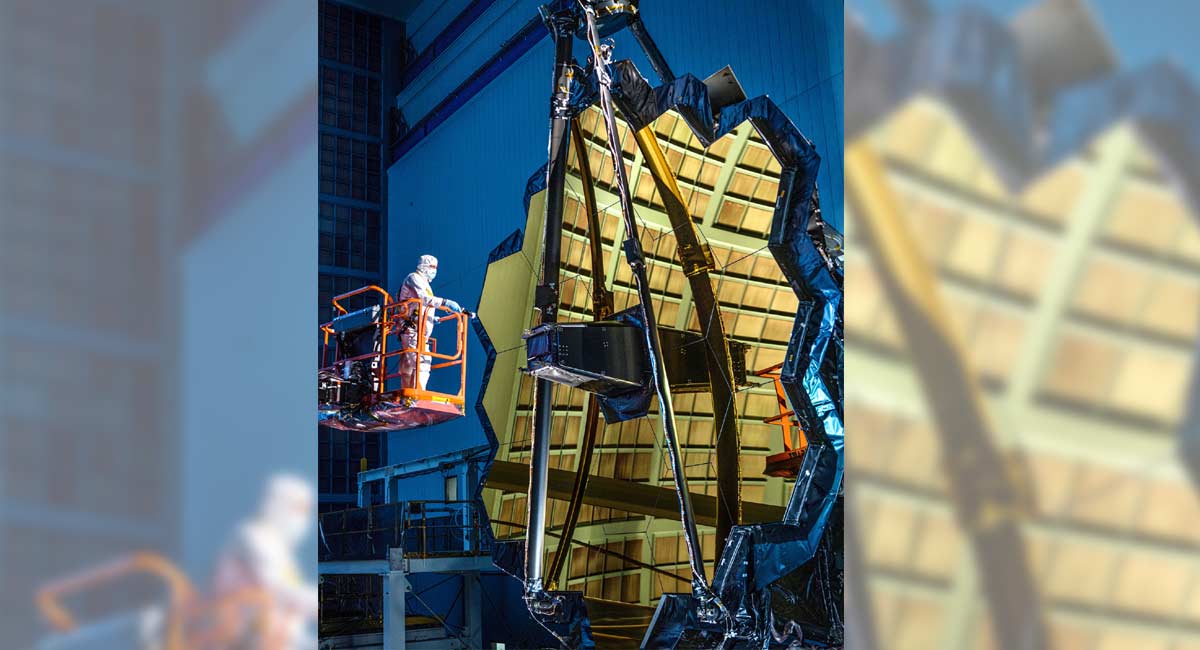
“Between May 23 and 25, NASA’s James Webb Space Telescope sustained an impact to one of its primary mirror segments. After initial assessments, the team found the telescope is still performing at a level that exceeds all mission requirements despite a marginally detectable effect in the data,” the blogpost read.
“Since launch, we have had four smaller measurable micrometeoroid strikes that were consistent with expectations and this one more recently that is larger than our degradation predictions assumed,” said Lee Feinberg, Webb optical telescope element manager at NASA Goddard.
Micrometeoroid strikes are an unavoidable aspect of operating any spacecraft, which routinely sustain many impacts over the course of long and productive science missions in space.
While Webb is no different, such events were anticipated when building and testing the telescope’s mirror on the ground. Webb’s mirror has been engineered to withstand bombardment from the micrometeoroid environment at its orbit around Sun-Earth L2 of dust-sized particles flying at extreme velocities.
“We always knew that Webb would have to weather the space environment, which includes harsh ultraviolet light and charged particles from the Sun, cosmic rays from exotic sources in the galaxy, and occasional strikes by micrometeoroids within our solar system,” said Paul Geithner, technical deputy project manager at NASA’s Goddard Space Flight Center in Greenbelt, Maryland.
“We designed and built Webb with performance margin, optical, thermal, electrical, mechanical, to ensure it can perform its ambitious science mission even after many years in space,” he added.
Further, NASA said that the recent hit was not a result of a meteor shower and is currently considered an “unavoidable chance event”.
Feinberg said that occasional micrometeoroid impacts are expected to “gracefully degrade telescope performance over time”.
As a result, the agency has formed a specialised team of engineers to look at ways to mitigate the effects of further micrometeoroid hits of this scale.
Meanwhile, NASA also stated that the recent impact “caused no change to Webb’s operations schedule”. NASA expects to unveil the first science-quality images from the telescope on July 12, and also start science operations.
The $10 billion Webb telescope, which is an international programme led by NASA, European Space Agency and the Canadian Space Agency, will explore every phase of cosmic history, from within our solar system to the most distant observable galaxies in the early universe.

Related News